LA ESQUINA CALIENTE (THE HOT CORNER) - A STUDY OF PARTICIPATORY DEMOCRACY IN ACTION AROUND THE WORLD

PARTICIPATORY DEMOCRACY vs REPRESENTATIVE DEMOCRACY

We as citizens of the United States observe politics from afar and the vast majority of us may participate in the political process only to the extent that we go to the polls once a year to vote. We may endeavor to follow the news accounts of our nation's politics as they unfold, and of the consequences those political actions yield, but we have little power to influence our "democratically" elected officials. Perhaps we write an occasional letter to our senator or representative, but we almost inevitably receive a vague and impersonal response explaining why they will vote in our opposition.

Over the decades, our representative democracy has been systematically undermined and has ultimately failed in preserving the well being of the people of this nation. The system that the founding fathers painstakingly devised in order to best serve the interests and the will of the people has been corrupted and the systems of checks and balances on power that they instituted have been stripped away. Most of us accept this reality as being beyond our control and continue to observe, comment, and complain without aspiring to achieving any real change, without any hope of instituting a new system of governance that would instead take directly into account your views, and the views of your neighbors, and would empower you to make real positive change possible in your communities.

This site will attempt to explore in depth the places in the world where people are successfully bringing about that type of change in the face of similar odds, where an alternate form of democracy, which is called participatory or direct democracy, is taking root. Initiative, referendum & recall, community councils, and grassroots organizing are but a few ways in which direct/participatory democracy is achieving great success around the world.

Our system of representative democracy does not admit the voice of the people into congressional halls, the high courts, or the oval office where our rights and our liberties are being sold out from underneath us. Our local leaders and activists in our communities, and even those local elected officials who may have the best of intentions are for the most part powerless to make real positive change happen in our neighborhoods, towns and villages when there is so much corruption from above.

In places like Venezuela, Argentina, Bolivia, Nicaragua, Ecuador, Brazil, South Africa, India, and the Phillipines, new experiments in grass roots community based governance are taking place. There is much to be learned from these and other examples of participatory democracy from around the world when we try to examine how this grass-roots based governance could begin to take root here in our own country in order to alter our political system so that it might better serve the American people.

In the hope that one day we can become a nation working together as a united people practicing true democracy as true equals, we open this forum…

LATEST ENTRIES:
Showing posts with label Zapatismo. Show all posts

Saturday, September 13, 2008

MEXICO: Sobre la Reforma del Estado desde el Zapatismo

Sobre la reforma del Estado desde el zapatismo

Luis Villoro

Fuente:
http://www.jornada.unam.mx/2008/07/23/index.php?section=opinion&article=019a1pol


Porfirio Muñoz Ledo me ha invitado a participar en la discusión de su libro La ruptura que viene, con tal de añadirle, por mi cuenta, una alternativa crítica. Pero esa alternativa conduce a un nuevo proyecto de nación.

El libro de Porfirio presenta propuestas valiosas que requerirían, después de tomarlas en cuenta, discutirlas, pero también presentar otra alternativa. Es lo que yo me propongo en estas líneas.

Para ello tenemos que partir de nuestra situación actual, después de la última elección a la Presidencia de la República. Hoy enfrentamos un país dividido, en lo económico entre pobres y muy ricos; en lo social, entre sociedades aisladas; en lo cultural, entre pueblos diferentes de culturas distintas y, a menudo, con lenguas diferentes... ¿Cuál sería la alternativa ante esta situación?

Porfirio ve una “reforma del Estado” que permita llegar a las condiciones que condujeran a un nuevo proyecto de nación.

En el libro de Muñoz Ledo se señala el balance negativo que han dejado las políticas del neoliberalismo. “Profundización de la desigualdad, así como ruptura del tejido social, el incremento exponencial de las inmigraciones, la inseguridad interna, la fractura de las cadenas productivas, el reinado del narcotráfico y la supeditación de la economía a fluctuaciones externas con un grado enorme de vulnerabilidad (p. 347).”

En nuestro país se añade la conciencia de que la política se ha convertido en el monopolio de los partidos políticos. No vivimos una auténtica democracia, sino lo que podríamos llamar una “partidocracia” (p. 53). Para contrarrestarla, habría que definir los sistemas directos de participación ciudadana: referendo y plebiscito (p. 52).

Existe la necesidad de una reforma del Estado, tantas veces postergada, que presenta asignaturas pendientes y que fuera la fundación de una nueva República (p. 355). Se necesita un cambio radical. Ese cambio –dice Porfirio– no podría darse en el Congreso. “No creo en el Congreso para impulsar el cambio que México necesita (p. 356).” Lo que se requiere es “otro proyecto de nación” (p. 270) que estuviera fundado en una “democracia participativa” (pp. 176, 270).

¿Pero cuál sería ese nuevo proyecto de nación, pregunto ahora yo? Para contestar a esta cuestión no tengo que ir lejos. Lo tenemos a nuestro lado, aunque a menudo nos cueste reconocerlo. Se trata de un proyecto de democracia tal como, de hecho, se tiende a practicar en muchos pueblos indígenas. Los representantes de los pueblos indígenas en México se reunieron en varios congresos. El primero tuvo lugar en la comunidad mixe de Tlahuiltotepec, en Oaxaca, en octubre de 1993. Las ideas de los pueblos indígenas han sido la base de las enunciadas por el actual movimiento zapatista para otro proyecto de nación.

Porque la democracia “representativa” actual no es la única posible ni la más adecuada, hay otra más auténtica, desde abajo y a la izquierda, que permita caminar hacia un orden nuevo y más justo: sería un “democracia participativa” o “comunitaria”. Tanto en México como en toda América Latina, las ideas de los pueblos indígenas originarios presentarían un ejemplo de otro tipo de democracia basada en la idea de comunidad.

Esta sería la alternativa, real y más alta, a la actual democracia representativa.

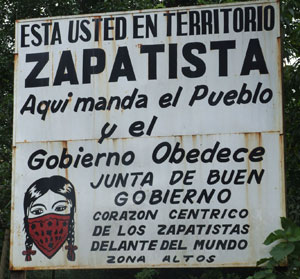
La democracia participativa o comunitaria sería lo contrario a la actual forma de democracia. Se efectúa de hecho, en pequeño, en las llamadas “juntas de buen gobierno” en las zonas zapatistas en Chiapas. Están basadas en el ejercicio de otra moral política siguiendo ciertos principios: participación de todos los miembros de la comunidad en un bien común, rotación del mandato, rendición de cuentas de su labor so pena de revocación. Estos principios expresan el lema zapatista del “mandar obedeciendo”. Podrían ampliarse a la totalidad de la nación. Basado en estas ideas, el subcomandante Marcos ha estado recorriendo parte del país, a pesar de la oposición y represión auspiciada por todos los partidos, incluyendo el PRD.

Esos principios siguen ideas regulativas. Serían las siguientes. 1) La prioridad de los deberes hacia la comunidad sobre los derechos individuales. 2) La realización de un bien común propiciado por procedimientos que garanticen la participación de todos en la vida pública. Son procedimientos de una democracia participativa que impiden la instauración de un grupo dirigente por encima y sin control de la comunidad. 3) Las decisiones que se tomen se orientan por acercarse, lo más posible, al consenso.

Ésta sería lo contrario a la “partidocracia” que ahora se vive, porque la auténtica democracia no se realiza mediante los partidos políticos nacionales (PRD, PRI, PAN). Los partidos se dedican a elegir representantes inamovibles por un periodo, que no son revocables, aunque no cumplan su mandato. La “otra democracia” exigiría la remoción de su mandato si no cumplen.

Otra democracia es la que, de hecho, se practica en las comunidades zapatistas en Chiapas y aun en otros estados. Si se realizara en toda la nación sería la alternativa real a la actual “democracia representativa” de corte liberal que ahora padecemos. Pero para conducir a una democracia efectiva, habría que acabar con la represión en Chiapas, Oaxaca y Guerrero, auspiciada por los gobiernos locales. Tal es lo que pretende la otra campaña, la zapatista: una democracia en la que no quepa la violencia ni la represión. Ese sería el camino que podría conducir a un nuevo proyecto de nación. Eso es lo que puede llegar a una verdadera “reforma del Estado”, para emplear las palabras de Muñoz Ledo.

Saturday, April 26, 2008

Autonomous Communities

Autonomous communities have the potential to be experimentations in participatory democracy. As we have covered in this blog, the Zapatista movement and its fledgling movements practice forms of horizontal power structures that give everyone an opportunity to participate in decisions affecting the community. This interesting article gives past and present examples of autonomous communities without directly discussing the influence of participatory democracy. It is worth reading to learn about where participatory democracy has the potential to flourish, just as it is worth reading our posts about intentional communities, urban democracy, and base communities. - Editor

Autonomous Communities

by dave onion

Source: http://www.defenestrator.org/autonomous_communities

The aspiration for autonomy is above all the struggle against political and moral alienation from life and work - against the functionalization of outside interests, against the internalization of the morals of our foes. This aspiration is concretized when houses are squatted to live humanely or not to have to pay high rents, when workers call in sick in order to party because they can’t take the alienation at work, when unemployed people plunder supermarkets because they don’t agree with absurd demands of unions for more jobs that only integrate people into oppression and exploitation. Everywhere that people begin to sabotage, to change the political, moral and technical structures of domination is a step toward a self-determined life.

- from a 1983 meeting of Autonomen in Hamburg.

Back in the day, LAVA, the space where defenestrator keeps its office chose to call itself the Lancaster AVenue Autonomous space. At the time the name LAVA and the autonomous label seemed like a good fit. To some of us it contained enough meaning to show our general political motivations, while being inclusive enough to allow for a pretty wide spectrum of voices and ways. But after having to explain the meaning of that word over and over again to people who’ve come in to visit the space, it became apparent that even many who were members of the groups using the space probably couldn’t explain why we were called that or where our name even came from. So it seemed like we needed to maybe revisit what that second A in LAVA was all about. Autonomy as a movement seems to first have developed out of study groups inside of the the Italian labour movement. Groups like Potere Operaio (Workers’ Power), Lotta Continua (the Struggle Continues) and later Autonomia Operaia (Workers’ Autonomy) began challenging the role labor unions and political parties had in revolutionary struggle, rejecting some of the institutional and hierarchical Communist ideas at the time in favor of a horizontal, radically democratic form of struggle. Before long this translated into combative worker run organizations in car factories and subsequent wildcat strikes outside of union control. Their ideas often directly clashed with the Leninist dominated paths many anti-capitalist radicals were taking at the time.

These groups and the larger social movement from which they sprang became loosely known as Autonomia (or Autonomy in English). Theoretically, these autonomous thinkers also dug much deeper than many others on the left. Autonomous groups that began in factories looked at the dehumanizing aspects of commodity society and work itself. Essentially, what made up autonomous politics was a rejection of capitalist logic (like working for wages, private property etc.) and a rejection of hierarchical institutions including those on the left. The bulk of politics developed out of lived experience and experiments in how to live outside of and fight powers of capitalism. Folks began attacking ideas of private property and waged work itself, which eventually inspired takeovers of abandoned buildings in Italy’s big cities - both for living spaces and to create spaces where autonomous politics and ways of being could flourish.And flourish they did. Squatted social centers popped up across Italy, and then the rest of Europe, transforming abandoned industrial spaces and housing into vibrant rebel social centers. Between 1969 and 1975 some 20000 buildings were squatted in Italy as part of this movement. Just after the collapse of the Berlin Wall, squatters who had already been active in the West took over hundreds of abandoned buildings on the East Side, also creating free social spaces by the hundreds. Evictions and attacks on the squats were met with riots and attacks on capital, targets including supermarkets, shopping centers, offices of developers and speculators, and always police. Across Western Europe, the politics in these spaces usually spelled out a distinct alternative to the Cold War binary politics that were prevalent. In most of these spaces decisions and work are carried out explicitly without bosses or leaders. In the mainstream media across Europe, Autonomy was often smeared as violent or sometimes terroristic. Squatters often took on police in street battles defending houses from eviction, or defending themselves from police attacks during demonstrations. Guerilla struggles in the global south were definitely an influence tactically at least, but the autonomous riots, defense of spaces, and attacks against capitalist institutions using weapons like molotov cocktails and rocks though hardly non-violent were always a far cry from the armed struggles of the day. And even the armed actions of the left never could compare to the violence of the state whether in the form of police repression or the economic devastation that it feeds off.Autonomy isn’t by any means a European phenomenon.

Shortly after the EZLN (Zapatista Army for Nation Liberation) an army of mostly poor indigenous Mexicans, took over San Cristobal, Chiapas’ City Hall in 1994, the declarations and work which followed the initial government massacres in the South of Mexico had a distinctly different quality. As some of the most influential Latin American guerilla movements were well on their way out, the Zapatistas were talking about horizontal structures, production collectives, autonomous education and seized large swaths of hoarded land from landowners. Though identifying as autonomous, the bulk of Zapatista ideas were not eurocentric but had roots in indigenous “ways and customs”: forms of direct democracy which had been integral to Mayan life for centuries predating any European contact. And immediacy is important here too. Along with demands for Indigenous Rights from the government, from the start the rebel communities re-organized their lives to be revolutionary and egalitarian and continue to do so. Co-operative farming and other economic work have been a big part of the work as has taking back the political space where these transformations could happen. The uprising in southern Mexico helped reinvigorate and enrich movements around the world. Notably, a couple years after the uprising, the Zapatistas hosted the “National Democratic Convention” (or CND), a gathering of thousands of organizers and organizations from across the left, to gather ideas on how to move forward. Out of the CND was born, among other projects, “People’s Global Action”, a global co-ordination of radical social movements, grassroots campaigns and direct actions. It was the PGA who put out the initial calls for the global days of action that reinvigorated the North American anti-capitalist movement, notably in November of 99 when massive direct actions disrupted World Trade Organization meetings in Seattle and gave strength and inspiration to anti-capitalist struggles around the world.If the more recent uprising and subsequent repression in Oaxaca seemed influenced by the Zapatistas one state over, it’s because it was. The Oaxacan People’s Popular Assembly (APPO) also pulled direct action, grassroots direct democracy and rejection of political parties to the center of their struggle. Like the Zapatistas, the Oaxacan struggles also had a strong internal indigenous element informing it politics from the beginning.

Further south, we find active autonomous groups in Venezuelan shanty towns around Caracas, thousands of families claiming land and the political space that comes along with it across Brazil, in Argentina’s occupied factories, unemployed workers groups and neighborhood assemblies. In India groups like the Karnataka State Farmers Association who have destroyed genetically modified crops and the Narmada Bachao Andolan who’ve resisted dams being built on their land are just a few more examples of such movements. Theoretically, autonomy has often been expressed as a healthy mix of anarchism and marxism, drawing the best from each, ditching authoritarian or dogmatic strains , but learning mostly from applying an anti-capitalist desire for freedom to life directly. And though the learning experiences that have come from squatting, the social centers, building non-capitalist alternative economies and from direct actions of various scopes have been a tremendous learning experience stretching over decades, autonomy has also had some thinkers who’ve shaken up radical theory. Toni Negri took on the rigid communist parties of Italy and, together with Michael Hardt, shook up discussions on class and globalization over the last few years. Sylvia Frederici of the Midnight Notes Collective has shared invaluable insights into women’s unacknowledged exploitation by capitalism. The EZLN’s Subcommander Marcos and his sidekick the beetle Durito brought indigenous democracy into the foreground of rebel movements around the world. The discussions in papers, on the internet and in our movements has never been less static.And in the spirit of things not static a small group has been discussing autonomous ideas at LAVA in West Philly. A discussion on autonomous communities at LAVA began what will hopefully become a series of rich and fruitful exchanges. Keep your eyes peeled for future get togethers!

Friday, April 18, 2008

Mexico: The Basics of Zapatista Participatory Democracy

The following article, although a bit dated provides an overview of the participatory system of government insituted in Zapatista villages in Chiapas. - Editor

The Zapatistas, Anarchism and 'Direct Democracy'

by Andrew N. Flood


Published in Anarcho-Syndicalist Review, #27 Winter 1999


The Zapatista rebellion of 1994 has become the 90's equivalent of the Cuban and Nicaraguan revolutions. It has excited the imagination of a layer of active young. The balaclava and pipe toting Marcos is becoming the same sort of visual icon that the bearded and beret wearing Ché was 30 years earlier. And perhaps it is this similarity that has scared the organised anarchist movement into comparative silence on the on-going rebellion in Chiapas?

In Chiapas today we see an on-going Low Intensity War. On one side we have the Mexican state, 60 to 70,000 occupying soldiers and the shadowy presence of US advisors. On the other we have a rebel army calling itself the EZLN and over hundreds of rebel communities.

This could be a snapshot of any number of similar struggles. Why should anarchists single out the Zapatistas for solidarity. The Zapatistas are not and make no claim to be anarchists. The educated leadership of the Zapatistas have their political backgrounds in Marxism. The local leadership's political education is more likely to be from liberation theology and the practical experience of campesino and indigenous organisations.

The military organisation of the Zapatistas is also not one that anarchists would prefer. The army is heierical. But the army is not the decision making centre of the movement like it would be in a Marxist vanguard organisation.

The Zapatista army hasn't used its weapons since the uprising in 1994. Some of its supporters elsewhere may fetishise the guns but on the ground in Chiapas they are seen as a way for people to defend themselves against the organised violence of the Mexican state. What the Zapatista movement has been about since 1994 is the construction of a system of direct democracy.
These structures are what should be of primary importance to anarchists in determing how we relate to the Zapatistas. They form an organisational and decision making network involving hundreds of thousands of people. There are 32 rebel municipalities, each one with 50 to over 100 communities. More then 500,000 people live as part of this decision making network. There are five language groups - these along with high mountains, jungle and bad roads make any form of libertarian organisation difficult. Yet this is exactly what the Zapatistas appear to have constructed.
There are extensive interviews with the main spokesperson of the EZLN, Subcommadante Marcos, which describe the decision-making structure and how it evolved (1). However anarchists should be sceptical about taking the word of the apparent military leader of any rebel group alone - even as in this case where it appears it may be accurate.

Village assemblies

The areas the Zapatistas openly organise in are rural and extremely poor. Small communities of a dozen to over 100 families are typical, forced to live off the land without the benefit of modern agricultural machinery. Some of the men will have worked outside the village in local towns or even as far as the USA but in the villages themselves the only political presence tends to come from the Catholic church's local variety of 'liberation theology' and the EZLN itself.

Prior to the rebellion many communities did not have sufficient fertile land and so the people had to work, often in atrocious conditions, for local landowners. With the rebellion the landowners fled and in many cases their abandoned land was taken over and sometimes used to establish new communities. In describing the structures of decision making at the community level I am drawing on my own experience in the community of Diez de Abril and on interviews with other people from the Irish peace camp (2) there in the years from 1996 to 1999. (3)

Diez de Abril is a new community founded on land seized in 1995. Those who moved onto the land had worked it before the rebellion. They met in assembly on the land before the take over, decided how to divide up the land and decided to call the new community 'Diez de Abril' after the day (10th April 1919) when Zapata was assassinated.

The routine weekly assembly happens after or even as part of mass on Sunday. It is open to all to attend and all over 12 have speaking and voting rights although votes are very rare. This meeting can go on for hours and typically resolves practical questions concerning work in the community or expenditure of community funds. One long running debate was whether to buy a tractor or a truck. There may be other assemblies if needed during the week.

The assembly elects delegates called 'responsibles' to co-ordinate work in particular areas. These delegates serve a limited term (one to two years) and are subject to re-call within this time if it's felt they are not 'leading by obeying' (i.e. the Zapatista slogan for following the mandate given to them).
There are also collectives that carry out particular tasks within the community. They are set up by and answerable to the assembly but are otherwise autonomous. Collectives in Diez include ones for coffee, cattle honey, horticulture, bread, sewing and chicken. Some of the production of each collective goes to its members; the surplus goes into a central community fund controlled by the assembly.

Our direct experience of Diez de Abril contradicts the claim that visits to the rebel zone are somehow controlled so that "On a well-signed route, people have to agree to see only what they have to see and to believe in the leader's words"(4). Issues of security of course determine that there are meetings we don't attend but our presence over three year's means little happens that we are unaware of.

When we move from local organisation to statewide organisation I can no longer rely on personal observation or the accounts of people known and trusted by me. I've talked to enough observers and radical journalists though to know that although Diez may be one of the more politically advanced communities the structures are broadly typical of other communities. However to throw light on regional organisation I'm relying on reports from journalists, NGO's and interviews with individual Zapatistas.

CCRI

The 'Clandestine Revolutionary Indigenous Committee' (CCRI) is the body that actually commands the army. This body (or indeed bodies as there are also regional CCRI's) is composed of delegates from the communities. It is not in itself a military structure.

Regionally it is capable of making decisions that affect individual communities. For instance when one community in the region of Morelia wanted to occupy land shortly after the rebellion "the local Clandestine Revolutionary Indigenous Committee, (CCRI) ordered locals to wait, expecting a region-wide land settlement after the 1994 dialogue"(5).

This in itself is not necessarily a problem if the CCRI is a genuine delegate body. In many revolutionary situations it makes sense to hold back militant sections in case premature action results in the suppression of the movement. In this case I'd probably have disagreed with the decision but the question is how it was made and who made it. The people of the region or some unaccountable body acting in their name?

A month after the rising the Mexican liberal paper 'La Jornada' which extensively covers the Zapatistas interviewed some members of the CCRI. One called Isacc explained the accountability of the CCRI :

"If the people say that a companero who is a member of the CCRI is not doing anything, that we are not respecting the people or are not doing what the people say, then the people say that they want to remove us ...

In that way, if some member of the CCRI does not do their work, if they do not respect the people, well compa, it is not your place to be there. Then, well, excuse us but we will have to put another in your place"(6)
.
The Consulta

Even still the CCRI does not have the power to make major decisions, such as peace or war. These must instead be made through a 'consulta' - crudely a referendum but one where intense discussions in each community is as central to the process as the vote itself. These take months and have been a great source of annoyance to the Mexican government, which always wants an answer to its proposals on the spot or within days.

One EZLN communiqué explained the consulta process as follows:

"The consultations took place in every community and ejido where there are members of the EZLN.

The study, analysis, and discussion of the peace accords took place in democratic assemblies.

The voting was direct, free, and democratic.

After the voting, official reports of the results of the assemblies were prepared. These reports specify: the date and place of the assembly, the number of people who attended (men, women and children older than 12 years old), opinions and principal points discussed, and the number of people who voted."(7)

This broadly ties into what observers who have seen consultas take place tell me. It was such a consulta that decided that the 1994 rising should go ahead, a year before Marcos and the army command considered they were ready. Consultas since have decided to enter into talks with the government, to accept the San Andres agreement and later to break off talks until the government implemented what had already been agreed.

The councils

These regional structures are designed to make the big decisions, the questions of war or peace etc. However obviously state wide meetings are far too unwieldy to settle smaller questions. The rebellion has also meant Zapatista communities refusing all contact with the Mexican state - right down to refusing to register births and deaths.

The practical problem thrown up by the need for inter community co-ordination saw the formation of regional councils. These are known as autonomous municipalities. 100 communities for instance make up the autonomous municipality named after the Mexican anarchist Ricardo Flores Magon. Tierra y Libertad, on the border with Guatemala contains a total of 120 communities.(8)

"Within the newly created municipal structures, the communities name their authorities, community teachers, local health promoters, indigenous parliaments, and elaborate their own laws based on social, economic, political and gender equality among the inhabitants of diverse ethnic communities."(9)

A Mexican NGO in detailing the government's attempts to smash these communities explains how they function:

"The communities of an indigenous zone or area are the ones who decide, at an assembly of all their members, whether or not they will belong to the autonomous municipality ... It is the communities who elect their representatives for the Autonomous Municipal Council, which is the authority for the municipality. Each representative is chosen for one area of administration within the autonomous municipality, and they may be removed if they do not fully comply with the communities' mandates ... Those who hold a position on the Municipal Council do not receive a salary for it, although their expenses should be paid by the same communities who request their presence, through co-operation among the members. In some cases, members of the Council are supported in their farm work, so they can dedicate themselves to their [Council] work, and not have to go the fields."(10)

These structures are obviously ones compatible with anarchism or indeed revolutionary syndicalism. They key checks of mandate and recall are there. The fact that these structures are not consciously anarchist but arise from a blend of indigenous practice, Marxism and Liberation Theology should not prevent us standing in solidarity with them.

More importantly, whatever their origins they offer a current model of some of what we talk about in practise. Chiapas is isolated and extremely poor, the fact that libertarian structures can flourish in such harsh conditions in the midst of a Low Intensity war can only demonstrate how valid they are.
Unfortunately there is not enough room here to go on to discuss the politics of the EZLN in any detail. But in many ways these are a secondary matter. For the community assemblies and the councils to survive they need our continued support. But centrally the question remains - how do we convince workers in our part(s) of the world that such structures are a viable alternative to top down parties.


Footnotes:

1 See http://flag.blackened.net/revolt/mexico/marcos_index.html for English translations of many of these
2 For letters from observers, pictures and other information about Diez see http://flag.blackened.net/revolt/mexico/diez.html
3 This section summarises extensive notes I took. For other articles making use of these see http://flag.blackened.net/revolt/andrew.html
4 Behind the Balaclavas of South-East Mexico, Sylvie Deneuve, Charles Reeve, Paris, August 1995 , http://flag.blackened.net/revolt/mexico/comment/balaclava.html
5 Making Zapatismo irreversible, Michael McCaughan, 20-8-96, http://flag.blackened.net/revolt/mexico/reports/land_se96.html
6 First interview with EZLN CCRI-CG, La Jornada, 2/4/94 & 2/5/94, Blanche Petrich and Elio Henri'quez, http://flag.blackened.net/revolt/mexico/ezln/ccri_1st_interview.html
7 How the consultations with the communities was done, CCRI, La Jornada, June 3,1994, http://flag.blackened.net/revolt/mexico/ezln/ccri_how_consult_june94.html
8 Tierra y Libertad, One Year Later, Luis Fernando Menendez Medina (Human Rights defender and prisoner in Cerro Hueco), http://flag.blackened.net/revolt/mexico/ezln/1999/pris_1year_terr_jun.html
9 The EZLN and Indigenous Autonomous Municipalities
by Mariana Mora - Apr 1998, http://flag.blackened.net/revolt/mexico/comment/auto_munc.html
10 Enlace Civil, A.C., Autonomous Municipalities:The resistance of the indigenous communities in response to the war in Chiapas, Nov. 1988, http://flag.blackened.net/revolt/mexico/comment/auto_munc_nov98.html