CHAIRMAN AIMING TO FINISH PROJECT
Friday, September 26, 2008, 18:33
Source: http://www.thisisplymouth.co.uk/news/CHAIRMAN-AIMING-FINISH-PROJECT/article-357191-detail/article.html
VOTERS have returned Devonport Regeneration Community Partnership chairman Marc Gardiner to the organisation's board – where he will be joined by a new face.
And newcomer Tony Burton has already set targets: jobs and trees.
"I'm very flattered the people of Devonport have voted me into a position of trust, and I hope not to fail them," he said.
"My main interest is jobs. Given the economic downturn I'd like to see a lot of effort put into providing employment."
And trees?
More trees," he said. "For the aesthetics of Devonport. Years ago there were areas of Victorian houses with trees. They look nice and provide more oxygen."
Mr Burton lived in Devonport 18 years ago, but left for Beacon Park after suffering daily abuse and intimidation.
But now he's back and said Devonport has 'completely changed'.
"It's a wonderful, caring community," he said. "And I plan to keep it that way."
Mr Burton, who works in plumbing and home improvements, was voted in alongside Mr Gardiner, a board member since 2002, and Roger Wills and Anne Freeman, both re-elected.
Garry Edwards and Agnes Reynolds failed to be elected.
The election was the last for resident board members before the New Deal for Communities organisation, set up with £48.73million of public cash to regenerate the area, is wound up in 2011 at the end of its 10-year lifespan.
If any board vacancies occur from now on they will be filled with appointees.
Mr Gardiner said the board had the important job of seeing the project through to 'a satisfactory conclusion' and establishing a successor organisation.
And he also wants to use the final years to 'empower' locals to use their 'voice' en masse.
He said this could be done via 'participatory budgeting' an idea imported from Brazil.
"It's an example of direct democracy," he said.
Participatory budgeting would mean setting aside a fraction of the NDC's cash, allowing people to bid for it and present ideas, and then letting the populace to decide which to run with.
"I'd like to see DRC Partnership pilot that for the city," he said.
Miss Freeman was delighted to have the opportunity to see the regeneration project through, and wants to concentrate on promoting education and training.
She stressed: "It's not just about bricks and mortar, you have to regenerate the people and provide opportunities for them."
And Mr Wills said: "Education was my banner the first time I stood, and I stick by that."
He has lived in Devonport since 1976 and remembers times when it was like 'Beirut' – but not now.
"The regeneration that's going on is wonderful," he said.
The election's 17.91 per cent turn-out was down on the 25.73 per cent of eligible Devonport residents who voted last year and the 25.84 in 2005.
But spokeswoman Lynda Harris said the DRC Partnership was 'delighted' with the figure.
"Some NDCs have stopped elections," she said. "The fact that people are still turning out and wanting to vote says a lot."
Wednesday, October 1, 2008
UK: Community to Imitate Brazilian Participatory Budgeting

Friday, September 12, 2008
UK: More Possibilities for Referendum
 The following outlines a proposal by the Liberal Democrats in the U.K. that would expand direct democracy in that country somewhat by allowing people more say in some legislation. - Editor
Let the people have a say over bills in the Commons
Bridget Fox Thursday August 28 2008 11:27 BST
Source: http://www.guardian.co.uk/politics/blog/2008/aug/28/liberaldemocrats.houseofcommons
August bank holiday week, and it must be the quietest of the year for British politics. And one of the most exciting in the US. Whether you support Barack Obama or not, whether he wins in November or not, this week we are witnessing history in the making, a revived American dream.
Obama and Joe Biden may embody the dream, but they're well aware, as Bill Clinton told the convention, that, for many Americans, their dream is "under siege", with rising inequality and poverty in the land of the free market.
We like to think we do better here. But after 10 years of Labour we still have a postcode lottery affecting people's lives from the start: health, childcare, exam results.
Across Islington, there are improved exam results this year. Good news, especially given that the best-connected parents still tend to send their kids out of the borough (our local Labour MP included). Meanwhile Lord Adonis (Islington resident and unrepentant Blairite), is calling for a massive expansion of the academies programme.
Under Tony Blair it was made very clear to councils that academies were an offer they couldn't refuse. Now it looks as if that will continue under Gordon Brown. But Islington's best-performing schools aren't academies. So do academies really make a difference? Especially since the Building Schools for the Future programme means secondaries don't have to become academies to get better buildings.
If the government really believes its own rhetoric on localism, and believes that local communities should have choices around schools, that must include the choice to reject the academy model.
Next month I'm off to Bournemouth for Lib Dem party conference, where one of the issues for debate is improving direct democracy in the UK. Two of the most interesting proposals are for "people's bills" and a "people's veto".
With people's bills, the six bills that got the most petition signatures each year would be guaranteed a second reading debate in the House of Commons. It wouldn't mean the law would get passed - that responsibility would still sit with MPs - but it would mean that citizens could set the agenda.
With a people's veto, if 1 million registered voters petitioned against an act within 60 days of its being passed, a referendum would be held on whether to repeal it. That could give us a real national debate on nuclear power, ID cards, or a third runway at Heathrow.
The impact of having people - and politicians - aware that voters can really influence the agenda between elections could be revolutionary. A similar process already works in the US state of Maine. Their state motto is Dirigo (I lead). Where they lead, perhaps we should follow.
Party conferences are memorable for all sorts of reasons. I'll always associate the Harrogate conference of September 1992 with Black Wednesday. The day interest rates went through the roof, I was worried about losing mine. A group of us abandoned plans for a restaurant meal and contemplated life in negative equity over jacket potatoes instead. There was a chill in the air that had nothing to do with the north Yorkshire weather.
Now with falling house prices, but rising housing costs, it's happening again. Last year repossessions hit a 15-year high. More families are facing the horror of losing their homes – and joining the long queue for affordable rented housing.
So it's good to see that at this year's Lib Dem conference, Vince Cable will be setting out our plans for people who are getting left behind.
It's not about subsidising mortgages, but practical measures to help people stay in their homes with help from housing associations, and to help councils get more social housing too.
Once again Vince is providing excellent free advice to the government: but is Labour listening? Unlikely given the complacency of Ministers reported by the FT.
Friday, August 15, 2008
UNITED KINGDOM: Upcoming Conference on Participatory Budgeting
 Our allies working toward participatory budgeting have notified us of an upcoming conference in Manchester. On September 15, 2008 activists will unite for a one day conference to discuss current projects on participatory budgeting and how to spread the trend. Please see their website for more information: http://www.participatorybudgeting.org.uk/events/national-participatory-budgeting-conference
While the group documents many case studies, here is one example.
Source: http://www.participatorybudgeting.org.uk/case-studies/keighley-decision-day-bradford
National participatory budgeting conference
Source: http://www.participatorybudgeting.org.uk/events/national-participatory-budgeting-conference
We are hosting a one day national conference at the prestigious Midland Hotel in Manchester to showcase PB and look at how we can take PB to the next level.
This one-day conference is designed to explore the way in which PB can be developed as a powerful tool to engage citizens in decision making in a range of budgetary contexts across different areas of public spending.
It will:
- Set out the policy context in which PB is developing, particularly the 'duty to involve'
- Showcase the range of PB pilots that have already been developed across the country
- Explore the possibilities for using PB on devolved mainstream budgets and annual budget consultations
- Look at the first examples of using PB in the contexts of health and policings
- Think through how PB might be auseful tool in making decisions in Local Strategic Partnerships and around pooled budgets in development of Local Area Agreements
Highlight the opportunities and challenges involved in using PB across different tiers of local government
The conference will also demonstrate the range of resources which are available to help public agencies deliver high quality PB projects. These include:
The PB toolkit
- Values, principles and standards for PB
- ICT opportunities for creating dynamic public events around PB
- The developing regional PB learning partnerships for public agencies
- The support of the PB Unit and it's partners
Costs:
Private & public sectors: £200
Charities, voluntary and community sectors: £100
Early bird discount of £50 if booked before 31st July
Bursaries may be available
For more information and to book, please download our leaflet here
Click here to download our booking form
For more information and to book please contact Jenny Lazarus on 0161 236 9321 or email mail@participatorybudgeting.org.uk
LINK: http://www.participatorybudgeting.org.uk/
__________________________________________________________________________ Here is a summary of another recent event by Participatory budgeting U.K.:
Keighley Decision Day, Bradford
Bradford Local Strategic Partnership (Bradford Vision), decided to distribute the 2006/07 round of Neighbourhood Renewal Funding (NRF) in Keighley using a process of Participatory Budgeting.
Overview:
On “Decision Day” community organisations allocated a total of £130,000 to local projects using the participatory budgeting. The Keighley process was led by Bradford Vision’s neighbourhood manager for the area with the support of the senior team.
In March 2006 it was agreed that the Neighbourhood Partnership for Keighley could use PB for the 2006/07 round of Neighbourhood Renewal Funding. Bradford Vision secured a total of £130,000 to be spent on Children and Young People, Safer and Stronger Communities and the Environment to be spent only in areas of relative deprivation and therefore eligible for NRF funds. A reference group was formed comprising Bradford Vision staff, Keighley Voluntary Services, the council’s area coordinator and a representative from the UK PB unit. Priorities were established through community events and door to door interviews. Voluntary organisations and local groups were then invited to submit bits which were then scrutinised by a panel made up of local councillors, members of the PB reference group, and staff from local statutory organisations.
All residents involved in the bidding process were then invited to a Decision Day where all the projects were presented and voted on.
Organisation:
Bradford Vision, Local Strategic Partnership
Aims:
To involve local residents in the allocation of neighbourhood renewal funds (NRF) and the Local Area Agreement (LAA)funds.
To stimulate wider resident engagement with local participatory structures.
To develop greater resident understanding of budgeting processes
To increase cross-community working.
To encourage service provider receptiveness to resident knowledge.
Where:
In 7 processes in 7 neighbourhoods in Keighley, Bradford District Council.
Keighley is a town within Bradford District Council and consists of x number of wards. Bradford is a very urban area with an ethnically diverse population and a known history of unrest between different ethnic groupings.
How:
£130,000 was available for local projects from the Neighbourhood Renewal Funds.
Before the event a reference group was formed from staff at Bradford Vision, Keighley Voluntary Services, Bradford Council and the wider voluntary sector. Spending themes were prioritised by residents – approximately 400 responses were generated from door to door interviews and at community events.
Local groups were invited to send in proposals - to bid for the money. Bids were then reviewed by the scrutiny panel of local service providers and councillors. Invitations to the Decision Day were sent to all residents in the eligible areas.
At the event voting took place in 2 parts, 2 sessions in the morning and 3 in the afternoon. Participants were allowed 3 minutes to make their presentation and voting was carried out on paper sheets after every 5 presentations.
After the event funds were distributed to the successful projects by Bradford Vision. Support and monitoring was provided by Keighley Voluntary Services.
Who:
Staff from Bradford Vision, Keighley Voluntary Sector, Bradford Council and the wider voluntary sector.
What:
The process contributed to community cohesion as there was a coming together of different communities and a greater understanding of each others different needs.
Local people directed the allocation of NRF money for their area.
A new community role for elected members was highlighted as local councillors were involved in the scrutiny panel, in presenting the Decision Day and in the evaluation process.
Saturday, March 22, 2008
UK: The 'Transition Towns' Movement
 The following article discusses the transition town movement in the UK which uses the participatory model to address the pressing evironmental and energy issues that will shape the future of towns and communities and affect their viability and habitability in the near future. By seeking citizen participation in major decision making on such important issues and the design of measures that will be taken to address them, people are not only able to have their voices heard, they are also instilled with a heightened sense of responsibilty for their communities, and a greater level of political participation on all issues. - Editor
Voices of Descent
Under the catchy title of Transition Town Totnes, the south Devon town is the first in the UK to explore what it means to undergo the transition to a carbon-constrained, energy-lean world at a local level. By consciously planning and designing for changes on the horizon, rather than reacting to resource shortages as they are thrust upon them, the participants hope that their town will become more resilient, more abundant and more pleasurable than the present.
The seeds of the transition town idea lie in the small Irish town of Kinsale, where in 2005 a group of students at the local further education college developed a process for residents to draw up an ‘energy descent action plan’ - a tool to design a positive timetabled way through the huge changes that will occur as world oil production peaks. The action plan covers a number of areas of life in Kinsale, including food, energy, tourism, education and health.
For example, for food, the plan envisions that by 2021 the town will have made the transition from dependency to self-reliance, where ‘all landscaping in the town comprises of edible plants, fruit trees line the streets, all parks and greens have become food forests and community gardens’. As a practical step towards this, the plan recommends the immediate appointment of a local food officer.
For housing, the plan envisions that by 2021 ‘all new buildings in Kinsale will include such things as a high level of energy efficiency together with a high portion of local sustainable materials’. A suggested immediate practical step towards this is a review of current building practices and future development plans.
 The energy descent action plan approach landed in the UK when a Kinsale college tutor, Rob Hopkins, moved to Totnes and held a number of talks and film screenings to introduce the idea. In September 2006 Transition Town Totnes was launched, seeking ‘to engage all sectors of the community in addressing this, the great transition of our time’ and seeking to put ‘Totnes on the international map as a community that engaged its creativity and collective genius with this timely and pressing issue’. The initiative has spread beyond Totnes just one year on; towns and villages around the UK have started developing a transition town approach for themselves.
One reason why the initiative has caught people’s imaginations is that, at its core, is a hopeful message. Many ‘transitioners’ are motivated to change energy use patterns not just because of energy shortages in the future but because of self-imposed energy rationing now - because cutting fossil fuel use is essential if climate change is to be lessened.
The transition movement shakes off the usual gloom and limitation around this message by calling for positive and pro-active changes. These are based in how the world actually is, rather than how we would like it to be if only someone, somewhere, would come up with that miraculous solution that will allow us to expand infinitely and indefinitely, all within a finite world. Rather than a vision of deferred promise and baseless hope it offers community-wide participation to find realistic and workable answers.
Whether the transition town approach can work at a citywide level, or whether its call for reduced consumption will have a wider impact on, for example, international trading systems and their inherently heavy use of fossil fuels, remains to be seen. In Totnes, at least, the creation of new businesses and land use initiatives suggests that the transitioners are in it for the long haul.
Tuesday, March 18, 2008
UK: Participatory Budgeting in Salford - A Flawed Example
 The following article describes the ups and downs of the participatory budgeting initiative in Salford, U.K. The author questions whether the people are truly having their say and being heard, or whether community voices have are being drowned out by the power structure within this somewhat token and incomplete participatory model. This case demonstrates the need for such initiatives to be firmly rooted at the grassroots level in order for them to be successful. - Editor
Power to Which People?
The government is promising ’devolution right to the doorstep’ as a means of reinvigorating local democracy. A pilot participatory budget making project, whereby people can ’have a direct say’ in how their taxes are spent, has been running in Salford. Stephen Kingston questions its democratic credentials
Nearly 170 years ago, more than a quarter of a million people marched to Kersal Moor, in Salford, demanding democracy. One of the biggest of the many demonstrations organised by the Chartist movement in the mid-19th century, this huge rally was the Live Aid of its day, with more than 30 bands playing. But instead of Bob Geldof demanding ‘Give us yer fuckin’ money’, there was Feargus O’Connor demanding ‘Give us the fuckin’ vote’.
After much campaigning and demonstrating, five of the six points of the People’s Charter, adopted on Kersal Moor that day, were eventually won. As well as the right to vote itself, these were: secret ballots, equal electoral districts, no property qualification to stand as an MP and payment for MPs. The exception to this successful record was the demand for annual parliaments, which was seen by the Chartists as crucial to stop the corruption of MPs...To read the full article click HERE
Saturday, March 8, 2008
UK: Update on Petition Process
 The following article submitted by Consultation Watch in the UK gives an update on 10 Downing's e-petitions initiative and related moves underway to institute a similar system at the local level. For more information on this subject see our previous related post. CLICK HERE. - Editor
Direct Democracy or Petition Sham?
As part of the Governance of Britain green paper, the Department for Communities and Local Government is now consulting on Local petitions and Calls for Action.
Since November 2006 members of the public have been able to start or sign online petitions at the 10 Downing Street website, which can run for up to 12 months and receive a Government response if signed by 200 or more people.
The Governance of Britain green paper committed the Government to considering means of petitioning Parliament and devising a mechanism which could lead to a debate in the House of Commons – but strangely this is not included within this consultation, with no explanation of why not or whether it will be in the future. To find out you may want to email Hazel Blears (Secretary of State for Communities and Local Government)
Instead, another issue, not even mentioned in the green paper is being consulted upon: petitions to local government.
The consultation document proposes that local authorities would have a duty to respond to petitions in much the same way as the 10 Downing Street system, if they relate to an issue in local government jurisdiction; are organised by a local person; and have a sufficient level of support.
However, as the consultation document admits, "many local authorities already deal with petitions systematically, scrupulously and fairly" – so it is not clear what difference this proposal would make – except for the minority of councils who perhaps do not respond formally to petitions (no examples are cited in the consultation document).
However, the document does mention examples of countries where petitions are a "trigger leading to electoral action, typically in the form of a referendum". One such example of this is Switzerland whereby any change to Swiss law can be subjected to a referendum if 50,000 people sign a petition opposing it within 100 days. Additionally, a referendum on a constitutional change can be initiated by 100,000 people signing a petition within 18 months.Campaigning organisations such as charities, trade unions and other NGOs may therefore wish to reply to this consultation suggesting the Swiss model.The deadline for responses is 20th March 2008.
- Raise public awareness of Government consultations;
- Encourage people to respond to consultations; and
- Share the expertise and insight of charities, trade unions and non-profit organisations.
- Providing links to active consultations on Government department websites;
- Featuring prominent consultations and highlighting their most important aspects; and
- Publishing consultation responses from charities, trade unions and non-profit organisations.
To learn more about Consultation Watch visit their website: http://www.consultationwatch.org.uk/default.asp
Also see this related link for more information on Downing Street's e-Petitions one year on from it's inception: http://newpolcom.rhul.ac.uk/past-events-appearances/2007/11/16/2008-01-30-the-prime-ministers-e-petitions-one-year-on.html
Tuesday, February 26, 2008
Action Network: BBC Adventures in e-Democracy

The following article examines the role of the BBC in promoting citizen participation through their BBC Action Network. An e-democracy promoting website which facilitates grassroots organizing. Evidently some activists have reservations about using a site constructed by a state sponsored institution. The article examines the complexities of a major news organization with links to the state backing such an effort. - Editor
Laurence Pawley - Horizontal politics in a vertical world: The BBC and Action Network
Source: http://www.re-public.gr/en/?p=146
Examining the BBC’s experiments on facilitating participatory e-democracy, Laurence Pawley finds that such re-imaginings of political action must be accompanied by a re-imagination of the institutions that provide them.
The growth of the ‘new’ politics enabled by technological developments like blogs and wikis has, generally speaking, emerged from outside of established nodes of political power. The informal, collaborative methods of action proposed by these spaces have predominantly been taken up by looser social movements and individuals, with the anti-capitalist movement and maverick ‘political bloggers’ serving as obvious examples.
But what happens when similar opportunities are facilitated by a national institution, with substantial links to the state? Can active citizenship be promoted through an organisation associated with a centralised, linear mission to ‘inform, educate and entertain’? This is the question raised by the BBC’s Action Network mini-site (originally launched in 2003 as iCan). 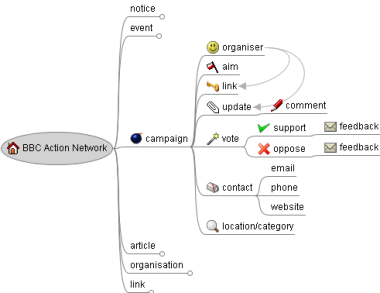 The site takes the form of a facilitative space, aimed in at individuals who wish to develop single-issue campaigns in their local area. Users can leave ‘notices’ (effectively equivalent to a standard online messageboard) or create more permanent ‘campaign’ pages in a collaborative blog format. The site has won several awards for its contribution to e-democracy, and its founder Martin Vogel claimed in late 2005 that Action Network was receiving 175,000 unique users per month.
In itself, this appears relatively unproblematic. Action Network is a well-organised and relatively simple site, with clear ground-rules that forbid (party) political activity and encourage a collaborative, dialogical dynamic. As such, it shares good practices with other successful examples of online campaign activity, and exudes the ethos of equitable participation central to the ideals behind wiki politics. However, if we begin to institutionally contextualise Action Network within the contemporary BBC, a series of tensions emerge with potential implications for the site, its users, and the BBC itself.
For the latter, Action Network appears to have emerged as part of a concerted effort to integrate notions of participation and public agency into the BBC’s practice. This much was made clear in the Corporation’s 2004 mission statement Building Public Value, which identified Action Network as a key initiative within its new goal of ‘supporting active and informed citizenship’. But how does such a notion function within the BBC? The organisation has long been associated with a centralised and sometimes paternalistic approach to the delivery of public service to a passive public, and has been subject to consistent critique on these grounds. Indeed, one might argue that the BBC is in fact reliant on this position, insofar as only the presumption of a uniform, passive citizenry justifies the continuing prominence of a single public service broadcaster.
Within Building Public Value, this issue is never fully resolved. On the one hand, the BBC (evidently responding to external pressures including media fragmentation, and the development of new discourses of citizenship) is keen to develop a more active, decentred conceptualisation of the public sphere- concluding with the aim to build ‘new civic avenues and town squares… places where we can celebrate, debate and reflect’. Simultaneously however, it lauds the historical success both of the national BBC structure and its successful relationship with Parliament and state institutions, and places considerable emphasis on its ability to set both political and cultural agendas.
In this context, the BBC’s support for initiatives like Action Network implies a contestation of its own position. Put simply, the ideas that underlay Action Network and similar projects (a ‘bottom-up’ approach to citizenship, localism, and the achievement of political goals through non-traditional strategies) exist at least in contradiction – if not in fact in direct opposition - to the precepts that have previously bulwarked the Corporation.
In practice, I would suggest that this contradiction has been largely ignored, with the result that both Action Network and the wider BBC appear somewhat compromised. Although the site maintains a certain level of independence from the BBC, the Corporation maintains the right to place its own postings, provide ‘expert’ advice on campaign methods, and editorialises content (for example, the featured campaigns on the front page). The BBC also clearly views the site’s activity as a potential source of content- in 2006 for example, BBC1’s Breakfast ran a series of reports based on Action Network projects. Even as it encourages open participation, it maintains a strong branded presence.
One argument of course is that such links are beneficial- providing advice and the potential for wider exposure for groups and individuals utilising the site. This however comes at a price, insofar as the BBC ‘preferences’ certain types of action in its advice pages, and certain elements of content in its editorial work. This at least carries the potential to skew the success or failure of certain campaigns, and the types of causes to which the site is deemed amenable. One can argue that any attempt to provide similar forums through a state (or in this case, quasi-state) organisation would carry the same risks, if only because the discursive association between provider and service would seem to privilege particular strands of thought.
In addition, there is a risk that sites like Action Network, because of their particular location, will become as much a complaints forum as a place to ‘celebrate, debate and reflect’. A cursory search for ‘BBC’ on the site leads to campaigns called for the Corporation to be banned, or demanding changes in programming. While such entries don’t necessarily undermine the site’s broader potential, their frequency is illustrative of the difficulties it faces in ‘shaking off’ the legacy of its provider (a fact undoubtedly known to Tony Blair’s government after the recent e-petition on road pricing). If such sites become increasingly ‘hijacked’ as a means to attack their founders, it is possible that other users will seek alternative platforms without such strong associations.
So, there appear to be some definite obstacles in the development of online political networks through an established national body. And should it attempt to resolve them, the BBC – by virtue of the more centralised aspect of its institutional logic – may find itself in an awkward situation. It could for example step back from Action Network, removing the obvious links with BBC content and leaving the site truly ‘open’ to participation. Yet while this might alleviate the concerns of some users, it is unlikely to benefit the BBC itself. If such a move succeeded, it would give ammunition to those who wish to see a more general scaling back of the BBC’s role in UK life. And if it failed (for example because users appreciated the guidance offered by the BBC content), then the Corporation has both failed in its attempt to support active citizenship, and wasted licence-payers money in doing so. Meanwhile, to continue with the current format exposes the BBC to the charge of interference with an ostensibly public-led platform.
This article, it should be stressed, is not intended as a condemnation of Action Network, or of the BBC’s intentions in its establishment. The site has much to commend it, and a glance around it will quickly prove that much useful work is being done, both via the campaigns themselves and the broader encouragement of civic responsibility. Nonetheless, it is perhaps the case that to be optimally effective, such re-imaginings of political action must be accompanied by a re-imagination of the institutions that provide them. Such a solution, while optimistic, offers the best chance of transcending tensions between participation and passivity, centralisation and subsidiarity, and past and future.
Further links:
Action network wins e-democracy award
The BBC plans for digital democracy
BBC Action Network
Wednesday, February 20, 2008
10 Downing Street's e-Petitions
 10 Downing St. has set up a website where british citizenry can post their petitions to the prime minister. The petitions can gather signatories on the site, and completed petitions generate a response from the Prime Minister. It is unclear whether this site has in fact been a means for the public to influence policy, or merely a gimmick to allow people to believe that they have a voice in government. It's mere existence however is yet another example of how the internet can be a revolutionary tool in bringing direct democracy to bear on a large scale. The trick is to make the popular will binding, and create a system in which representatives are merely executors of that popular will. Barack Obama in the U.S.A. has proposed measures in his platform that would allow for much more significant citizen participation and transparency than this somewhat symbolic british measure. To learn more about his proposals see our previous post on the subject. (click here) It is encouraging to see such proposals reaching the mainstream but we must continue to build upon them and push for deeper direct democracy. - Editor
Click here to visit the P.M's e-petitions site
Source: http://www.pm.gov.uk/output/Page11051.asp
13 November 2007
There is a long-established tradition of members of the public presenting petitions at the door of Number 10 Downing Street. The e-Petitions service has been designed to offer a modern parallel, which is more convenient for the petitioner. Unlike paper-based petitions, this service also provides an opportunity for Number 10 to respond to every petitioner via email.
Since its launch in November 2006, the ePetitions site has proved to be a highly popular innovation, helping people communicate with Government and with the Prime Minister's Office. ePetitions has become a part of the landscape of debate in the UK.
The service allows any UK citizen to create a petition and collect signatures via the website. Petitioners are asked to meet basic criteria, but we aim to accept most petitions. The principal reasons for rejecting petitions so far have been obscenity, potential to cause offence, libel or duplication.
Facts and figures
Since its launch, the site has been very busy. The facts and figures to the end of October show:
Over 29,000 petitions have been submitted, of which over 8,500 are currently live and available for signing, over 6,000 have finished and 14,601 have been rejected outright.
There have been over 5.8 million signatures, originating from over 3.9 million different email addresses.
The most common reason for rejection is duplication - many users have commented that there are petitions on similar subjects clogging up the site. We are trying to eliminate too much duplication or overlap, although we need to balance that with the need to allow for the nuances of similar petitions.
The other common reasons for rejection are: legal issues, offensive language, party political content and issues outside the government's remit.
If a petition is rejected, petitioners are given a chance to reword their petition. Some users choose to resubmit their petitions, some prefer not to.