Impulsan diputados plebiscito y referéndum
Organización Editorial Mexicana
16 de noviembre de 2008
Fuente: http://www.oem.com.mx/eloccidental/notas/n933996.htm
Víctor Godínez / El Sol de México
Ciudad de México.- El presidente de la Comisión de Puntos Constitucionales de la Cámara de Diputados, Raymundo Cárdenas, aseguró que existe consenso entre las tres principales bancadas legislativas para impulsar en el actual periodo de sesiones las figuras del plebiscito y el referéndum.
Reveló que ya se elabora un dictamen de iniciativa de ley para aprobar estas figuras de la democracia.
Por su parte, el diputado panista Eduardo de la Torre Jaramillo dijo que este instituto político accederá a estas reformas.
Raymundo Cárdenas, presidente de la Comisión de Puntos Constitucionales de la Cámara de Diputados, aseveró que existe consenso entre las diferentes bancadas de esta instancia legislativa, a fin de impulsar en el actual periodo de sesiones figuras de democracia directas como el plebiscito y el referendo.
En una reunión de trabajo realizada en el Palacio de San Lázaro, señaló que las tres fuerzas políticas más importantes en el país como son los partidos Acción Nacional (PAN), de la Revolución Democrática (PRD) y Revolucionario Institucional (PRI), han expresado su interés de abordar este tema.
Por tal motivo, reveló que en la Comisión de Puntos Constitucionales se elabora un dictamen de iniciativa de ley para aprobar estas figuras de la democracia.
Por su parte, el diputado panista Eduardo de la Torre Jaramillo dijo que este instituto político accederá a estas reformas, pero antes se deben resolver las diferencias, pues se tienen que estudiar los modelos utilizados en Latinoamérica y ver si son viables para aplicarse en la vida política nacional.
Sobre el particular, dijo que en el PAN se llegó a un consenso interno para estudiar e impulsar estos mecanismos de democracia directa.
A su vez, el diputado Salvador Ruiz Sánchez, del Partido de la Revolución Democrática, recordó que su partido siempre ha mostrado disposición para tratar los temas y proyectos con los que se pueda perfeccionar la democracia.
Sin embargo, negó que al promover el modelo de referendo se impulse al mismo tiempo la reelección electoral, ya que son temas que se tienen que ver por separado.
Monday, December 15, 2008
MEXICO: Impulsan Diputados Plebiscito y Referéndum

Monday, November 10, 2008
MEXICO: Questioning the Efficacy of Institutions
 Democracy Under Construction
Filed under: Democratization, Latin America — Jason Lakin @ 12:58 pm
October 27, 2008
Source: http://www.harvardir.org/blog/?p=331
In 2006, when supporters of Mexico’s Andrés Manuel López Obrador (AMLO), then candidate for the leftist PRD, took to the streets to protest alleged vote fraud during the presidential elections, many carried banners that said “Democracy Under Construction.” The implication was clear: democracy at the institutional level, where elections were organized and votes counted, was not working. Real democracy was happening in the streets, where the people were organizing and raising their voices against these same institutions.
This “institutions versus the people” dichotomy in Mexican democracy is the most important legacy of the 2006 election. It continues to define the ideology of AMLO and his supporters up to the present. Last week, speaking about the energy reform which was approved by the Mexican Senate, AMLO said that what mattered was not what the legislature said, but what “we decide, the people.”
The logic is familiar to analysts that distinguish between republicanism (rule by democratic institutions, indirectly controlled by the people) and democracy (rule by the people directly). Though we most often use the term democracy in everyday discussions of regime type, what we usually mean is republicanism: rule by democratic institutions. No one believes that rule by institutions is a panacea. Advocates of direct democracy are correct to note that institutions frequently deviate from the will of the people, pursuing their own interests instead. On the other hand, advocates of republicanism presume, also correctly, that direct democracy is neither more realistic nor necessarily fairer than rule by institutions. Republicans point out that democratic publics are easily swayed by dangerous group-think, which, in the absence of institutions that force deliberation, can lead to the repression of minorities, and the prioritization of short-term gains over long-term development.
In general, the relevant question in a republic is whether or not republican institutions are legitimate. When institutions are legitimate, which minimally requires fair elections, then we tend to think that these institutions should be respected, even if we allow citizens to protest, file lawsuits, or lobby to change decisions made by them. What happens, however, when the institutions are not legitimate? This is the position taken by AMLO and his followers, who argued that the 2006 elections were illegitimate because the institutions that organized them were illegitimate, and because the process was not free and fair.
There is no question that AMLO’s attack on Mexican republican institutions is self-serving. However, whether AMLO is motivated by self-interest or not, many Mexicans do doubt the legitimacy and efficacy of their institutions. The only solution to widespread doubts about the legitimacy of institutions is the re-foundation of those institutions with renewed legitimacy, not, as Mexican conservatives sometimes seem to believe, to repeatedly restate that institutions are legitimate because they are institutions.
In fact, Mexico’s legislators are slowly achieving institutional renewal. The PAN (the president’s party) and the PRD were able to reach a consensus earlier this year to renew the leadership of the electoral institute (IFE), whose credibility was severely damaged in 2006. Although President Calderón was among the worst purveyors of the “institutions exist therefore they are legitimate” doctrine during the 2006 elections, he has pursued negotiation and consensus-building on key initiatives, such as fiscal and now energy policy. The result has been limited reform, but increasingly legitimate procedures for arriving at it.
The biggest threat to Mexico’s institutional renewal today comes from a different source: the spiraling corruption engendered by the war on drugs. Today, El Universal reports that officials working for SIEDO, a special government office dedicated to investigating organized crime, have been on retainer for the drug lords since at least 2004. These officials, who earned as much as US$450,000 per month, passed along government information to one of Mexico’s most notorious cartels, that of the Beltrán Leyva brothers. The revelations were the result of the government’s own Operation Cleanup, which means, of course, that they represent a double-edged sword. On the one hand, they should increase confidence that the government is functioning to police its own abuses. On the other, they reinforce the perception that the government is riddled with corruption, so much so that the war on drugs is doomed to failure.
Young democracies frequently struggle to renovate a large number of weak institutions all at once, but many do survive. The renovation of institutions is a tricky business, and there are plenty of reasons to worry that Mexico is not up to the task. But if there is one thing Mexicans proved during the twentieth century, it is that they are exceptionally creative at reinventing institutions. The one-party regime waxed and waned, but it survived intact for decades by adapting to radically changing international and domestic circumstances. Mexico’s leaders have demonstrated, since the crisis of confidence in 2006, a surprising ability to work together to avoid the worst. Many more surprises will be needed to push the country’s democratization forward. On this gloomy Monday, overshadowed by the disillusion of new corruption allegations, the country’s leadership may look down, but I wouldn’t count them out.
Wednesday, September 24, 2008
MEXICO: Democracia Participativa - Baja California
 Urge en México impulsar una democracia participativa
26 de agosto de 2008
por Sonia García Ochoa
Tijuana, Baja California.- En México urge impulsar una democracia participativa, en donde los mexicanos "seamos" corresponsables de la toma de decisiones de quien hoy "nos" gobierna, ya que la Reforma Electoral federal carece de una ley de participación ciudadana, como la que tiene Baja California.
Raúl Flores Adame, consejero electoral del Consejo General Electoral de Baja California, del Instituto Electoral y Participación Ciudadana, hizo el anterior señalamiento, considerando que "debimos insertar las herramientas para crear además, una cultura de participación y no únicamente una cultura electoral".
En el marco de la conferencia dictada por el magistrado José de Jesús Covarrubias Dueñas, ayer en la Casa Jurídica de la Suprema Corte de Justicia de la Nación (SCJN), expuso que ha sido un gran crítico tanto de la Reforma Electoral federal como de la Reforma a la Constitución en materia electoral, que se hizo en el estado de Baja California.
Ha sido crítico porque siente que más que una democracia de representación que se tiene vigente actualmente y que con reformas a la ley se cierra únicamente a los partidos políticos, en el país urge impulsar una democracia participativa.
Una democracia en donde los ciudadanos "seamos corresponsables" de la toma de decisiones de quienes hoy nos gobiernan; para lo cual se necesita en primer lugar, en la Reforma Electoral federal debió haber contemplado otros aspectos que permitieran como los mecanismos que tiene Baja California y que se le llama Instituto de Participación Ciudadana, porque cuenta con su propia legislación.
Flores Adame se mostró convencido de que "se debió incluir en la Reforma Electoral federal, una Ley de Participación Ciudadana, que permitiera que los ciudadanos fueran parte de la toma de decisiones a través de los mecanismos que la propia legislación establece, como son la iniciativa popular, el referéndum y el plebiscito.
"Obviamente esto, a partir también de crear una cultura; no sólo debemos tener una cultura democrática como lo hemos venido haciendo en estos últimos años, sino una cultura de participación", expuso.
Es decir, que los ciudadanos sepan que tienen el derecho de ser parte de la toma de decisiones; ¿a qué me refiero?, "una ley cuando pasa únicamente por la cámara, pasa al arbitro únicamente de los diputados, porque nosotros cedemos o concedemos el derecho -cuado elegimos a nuestros representantes-, de que a partir de este sistema de representación ellos tengan esa facultad única".
Por lo que con este sistema "qué propongo" y que existe en los estados a manera de ley, pero que no es aplicable en estos momentos; lo que se dice, es que los ciudadanos a la hora que se pretenda reformar una ley se tome en cuenta la opinión de los ciudadanos como sucede en otros lugares del mundo, como en el estado de California.
El consejero electoral, subrayó que se necesita este sistema para que "nosotros seamos quienes decidan si una ley tiene procedencia o no; que bien puede ser una ley tan sencilla, como la de no fumadores, que se estableció que por respeto a la mayoría -se supone los no fumadores-, se limitaron los espacios".
Ante esto, dijo que este tipo de situaciones, apoyada en una Ley de Participación Ciudadanos, se hubiera hecho una consulta en donde verdaderamente quienes los que resultarían afectados o perjudicados por una ley, se tuviera la capacidad de decidir si se aprobaba o se abrogada una legislación en ese sentido; "por lo que debemos ir impugnando por una democracia participativa".
Saturday, September 13, 2008
MEXICO: Sobre la Reforma del Estado desde el Zapatismo
 Sobre la reforma del Estado desde el zapatismo
Luis Villoro
Fuente: http://www.jornada.unam.mx/2008/07/23/index.php?section=opinion&article=019a1pol
Porfirio Muñoz Ledo me ha invitado a participar en la discusión de su libro La ruptura que viene, con tal de añadirle, por mi cuenta, una alternativa crítica. Pero esa alternativa conduce a un nuevo proyecto de nación.
El libro de Porfirio presenta propuestas valiosas que requerirían, después de tomarlas en cuenta, discutirlas, pero también presentar otra alternativa. Es lo que yo me propongo en estas líneas.
Para ello tenemos que partir de nuestra situación actual, después de la última elección a la Presidencia de la República. Hoy enfrentamos un país dividido, en lo económico entre pobres y muy ricos; en lo social, entre sociedades aisladas; en lo cultural, entre pueblos diferentes de culturas distintas y, a menudo, con lenguas diferentes... ¿Cuál sería la alternativa ante esta situación?
Porfirio ve una “reforma del Estado” que permita llegar a las condiciones que condujeran a un nuevo proyecto de nación.
En el libro de Muñoz Ledo se señala el balance negativo que han dejado las políticas del neoliberalismo. “Profundización de la desigualdad, así como ruptura del tejido social, el incremento exponencial de las inmigraciones, la inseguridad interna, la fractura de las cadenas productivas, el reinado del narcotráfico y la supeditación de la economía a fluctuaciones externas con un grado enorme de vulnerabilidad (p. 347).”
En nuestro país se añade la conciencia de que la política se ha convertido en el monopolio de los partidos políticos. No vivimos una auténtica democracia, sino lo que podríamos llamar una “partidocracia” (p. 53). Para contrarrestarla, habría que definir los sistemas directos de participación ciudadana: referendo y plebiscito (p. 52).
Existe la necesidad de una reforma del Estado, tantas veces postergada, que presenta asignaturas pendientes y que fuera la fundación de una nueva República (p. 355). Se necesita un cambio radical. Ese cambio –dice Porfirio– no podría darse en el Congreso. “No creo en el Congreso para impulsar el cambio que México necesita (p. 356).” Lo que se requiere es “otro proyecto de nación” (p. 270) que estuviera fundado en una “democracia participativa” (pp. 176, 270).
¿Pero cuál sería ese nuevo proyecto de nación, pregunto ahora yo? Para contestar a esta cuestión no tengo que ir lejos. Lo tenemos a nuestro lado, aunque a menudo nos cueste reconocerlo. Se trata de un proyecto de democracia tal como, de hecho, se tiende a practicar en muchos pueblos indígenas. Los representantes de los pueblos indígenas en México se reunieron en varios congresos. El primero tuvo lugar en la comunidad mixe de Tlahuiltotepec, en Oaxaca, en octubre de 1993. Las ideas de los pueblos indígenas han sido la base de las enunciadas por el actual movimiento zapatista para otro proyecto de nación.
Porque la democracia “representativa” actual no es la única posible ni la más adecuada, hay otra más auténtica, desde abajo y a la izquierda, que permita caminar hacia un orden nuevo y más justo: sería un “democracia participativa” o “comunitaria”. Tanto en México como en toda América Latina, las ideas de los pueblos indígenas originarios presentarían un ejemplo de otro tipo de democracia basada en la idea de comunidad.
Esta sería la alternativa, real y más alta, a la actual democracia representativa.
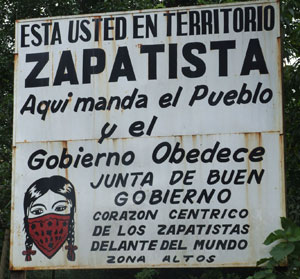
La democracia participativa o comunitaria sería lo contrario a la actual forma de democracia. Se efectúa de hecho, en pequeño, en las llamadas “juntas de buen gobierno” en las zonas zapatistas en Chiapas. Están basadas en el ejercicio de otra moral política siguiendo ciertos principios: participación de todos los miembros de la comunidad en un bien común, rotación del mandato, rendición de cuentas de su labor so pena de revocación. Estos principios expresan el lema zapatista del “mandar obedeciendo”. Podrían ampliarse a la totalidad de la nación. Basado en estas ideas, el subcomandante Marcos ha estado recorriendo parte del país, a pesar de la oposición y represión auspiciada por todos los partidos, incluyendo el PRD.
Esos principios siguen ideas regulativas. Serían las siguientes. 1) La prioridad de los deberes hacia la comunidad sobre los derechos individuales. 2) La realización de un bien común propiciado por procedimientos que garanticen la participación de todos en la vida pública. Son procedimientos de una democracia participativa que impiden la instauración de un grupo dirigente por encima y sin control de la comunidad. 3) Las decisiones que se tomen se orientan por acercarse, lo más posible, al consenso.
Ésta sería lo contrario a la “partidocracia” que ahora se vive, porque la auténtica democracia no se realiza mediante los partidos políticos nacionales (PRD, PRI, PAN). Los partidos se dedican a elegir representantes inamovibles por un periodo, que no son revocables, aunque no cumplan su mandato. La “otra democracia” exigiría la remoción de su mandato si no cumplen.
Otra democracia es la que, de hecho, se practica en las comunidades zapatistas en Chiapas y aun en otros estados. Si se realizara en toda la nación sería la alternativa real a la actual “democracia representativa” de corte liberal que ahora padecemos. Pero para conducir a una democracia efectiva, habría que acabar con la represión en Chiapas, Oaxaca y Guerrero, auspiciada por los gobiernos locales. Tal es lo que pretende la otra campaña, la zapatista: una democracia en la que no quepa la violencia ni la represión. Ese sería el camino que podría conducir a un nuevo proyecto de nación. Eso es lo que puede llegar a una verdadera “reforma del Estado”, para emplear las palabras de Muñoz Ledo.
Thursday, August 28, 2008
MEXICO: Civil Society Requires Means to Participate
 The following article is important to our analysis of participatory democracy because it discusses the very problems caused by politicians who claim to be promoting "democracy". As you read, be aware of the differences between the electoral democracy discussed here and the direct or participatory democracy we demand. -Editor
Democracy and Civil Society in Mexico is the issue that I will, here, develop. It is necessary to point out that these terms have been recently inserted in Mexican politics. During decades, these concepts were practically inactive, in the best of the cases, relegated to second or third level in national politics. Throughout the revolution regime the privileged ideology sustained, an authoritarian Estate instead of democracy. This ideology was based in three main principles: the presidential institution, the official party and the power elite named the revolutionary family. Instead of civil society, what existed was a resistant corporative structure that linked social sectors organized in confederations (labors, peasants and popular) with the Estate by the Institutional Revolutionary Party (respectively the CTM, CNC and CNOP). This kind of structure is similar at extended webs of local organizations in the first floor that are related whit other webs of states organizations in the second floor and, finally, centralized at the top level in the main leaders of the corporations and the Presidency of the PRI.
These structures gave the country political stability and social peace for several decades. But the ways of the old system suffered a process of decay because Mexican politics and civil society opened up to pluralism and democracy. The development of the country produced a notorious differentiation of spheres. Politics, Society, and Economy have become more heterogeneous and more complex. Now a day no one has the possibility to exert hegemonic dominion upon the social body of the country.
It is important to mention that the struggle against authoritarianism took form of electoral vindication. The country has a large tradition of electoral frauds and it was necessary to take out the control of the government over the elections. New political factions entered into the public scene legally recognized for carrying a more equitable and transparent competition for power.
Nevertheless, along with the process of democratization emerged a consistent process of un-governance and the significant increment of social conflict. The old authoritarian order stayed back, however Mexico has not been able to consolidate a new democratic order. The political elite is deeply divided. The conflict originated from the elections of July 2nd makes this is evident, the economic growth doesn’t succeed in including the labor force and Mexican society suffers an abysmal inequality among the rich sectors and the poor mass.
In this essay I’ll try to interpret and explain the paradox of the modern Mexico and I’ll propose a possible way for solution.
Wednesday, August 13, 2008
MEXICO: Derechos civiles y Participación Ciudadana en la capital
■ La Carta de la ciudad de México por el derecho a la ciudad, basada en el movimiento urbano ■ Ejercicio de la ciudadanía, función social de la tierra y democracia, entre los puntos a tocar El jefe de Gobierno del Distrito Federal, Marcelo Ebrard Casaubon, se comprometió con organizaciones de la sociedad civil a escuchar sus propuestas y presentar las de su administración para elaborar la Carta de la ciudad de México por el derecho a la ciudad, e invitar a la Asamblea Legislativa a participar para darle valor jurídico. Al asistir a la instalación del Grupo Convocante al Foro por el Derecho a la Ciudad, en el ex Templo de Corpus Christi, Ebrard dijo que se debe establecer un instrumento que defina obligaciones, políticas públicas y formas de gestión diferentes, construido desde el mismo movimiento urbano popular. Enrique Ortiz Flores, presidente de la Coalición Internacional para el Hábitat-Oficina Nacional para América Latina (HIC-AL), planteó seis fundamentos para armar este documento como una estrategia, más que como un programa para el manejo de la ciudad con una perspectiva de los derechos humanos. El primero de ellos, dijo, es “el ejercicio pleno de la ciudadanía”, como la realización plena de todos los derechos civiles, políticos, económicos, sociales, culturales, ambientales, para todos; el segundo es “la función social de la ciudad, de la tierra y de la propiedad”, que en otros países, como Brasil, ha dado fundamento a la elaboración de instrumentos para el control del suelo, de la especulación, de captación de plusvalías, para evitar que la tierra sea inaccesible a la gente. El tercero es “la gestión democrática de la ciudad”, y en este punto aludió al ejercicio de participación ciudadana del domingo pasado, en el que la población opinó con relación a la reforma energética que se debate en el Congreso, y que significa nuevas formas y prácticas de participación de la comunidad en las decisiones de la ciudad. “No se trata simplemente de cómo fortalecemos la democracia participativa, sino de abrir cauce a instrumentos de democracia directa y a la democracia distributiva”, apuntó. El cuarto fundamento es “la producción democrática de la ciudad”, reconociendo el esfuerzo social que hay detrás de la producción social del hábitat y al cual se debe encauzar y darle apoyo, porque no todo se ha hecho a partir de los desarrolladores inmobiliarios y que tiene que ver también con la iniciación productiva de los jóvenes en la economía de la ciudad. Como quinto fundamento estratégico señaló “el manejo sustentable y responsable de los recursos naturales, patrimoniales y energéticos de la ciudad y de su entorno”, y finalmente, “el disfrute democrático y equitativo de la ciudad”. Por su parte, el presidente de la Comisión de Derechos Humanos del Distrito Federal, Emilio Álvarez Icaza, señaló que la construcción de la Carta de la ciudad de México por el derecho a la ciudad, refleja un cambio en el proceso democrático de la entidad, al unificar la forma de aplicar y ejercer los derechos humanos mediante un pacto político-social en el que participa la sociedad civil, los organismos autónomos, el gobierno, las instancias educativas, entre otras.
El gobierno del distrito federal con la participación de las organizaciones de la sociedad civil esta elaborando un documento que se llama La Carta de la Ciudad de Mexico por el Derecho a la Ciudad. Por una parte habla del fortalecimiento de la democracia directa, segun el ejemplo de la reciente consulta energetica. Esta Carta puede ser un pacto productivo para la gente pero solamente si aprovechan del poder politica que les ofrecen los políticos en la forma de más oportunidades para participar en el proceso, y más plebescitos y referendos. Si el pueblo no se mobiliza para usar su poder, pierde oportunidades importantes en la lucha. - EditorInvita Ebrard a crear pacto para aplicar y ejercer los derechos civiles en la capital
Monday, August 4, 2008
MEXICO: PRI Rechaza por Ahora la Democracia Participativa en Michoacán
 El PRI en el estado de Michoacán, Mexico ha tomado la decisión de no legislar por ahora las figuras de plebiscito, referéndum y revocación de mandato, mientras el PRD sigue luchando por estos elementos basicos del poder popular y la democracia directa y participativa. - Editor
Rechaza el PRI legislar sobre participación ciudadana
Para el legislador Martín Cardona Mendoza hay otras prioridades como educación, salud y seguridad pública
Martes 29 de Julio de 2008
Fuente: http://www.cambiodemichoacan.com.mx/vernota.php?id=83523
La fracción del PRI descarta presentar una iniciativa de Ley que regule las figuras de participación ciudadana en Michoacán, mientras que el PRD será quien impulse el proyecto pero sigue sin tener fecha para hacerlo.
El diputado local del PRI, Martín Cardona Mendoza manifestó que Michoacán no está preparado para legislar las figuras de plebiscito, referéndum y revocación de mandato por la cultura “politizada que se tiene entre los diferentes grupos”.
Asimismo, manifestó que existen otras prioridades que requieren atención como es el tema de educación, seguridad pública y salud, en lugar de regular acciones que “se prestarían para manipulaciones políticas siempre a favor del partido que esté en el poder”.
“Lamentablemente tenemos una cultura de manifestaciones, plantones y movilizaciones, donde podría resultar contraproducente reglamentar estas figuras jurídicas porque en lugar de resolver los problemas los incrementaría al haber grupos inconformes de diferentes partidos o intereses que buscaría destituir a las autoridades o servidores públicos”.
Asimismo, consideró fundamental contar con una sociedad educada e informada de los problemas de la entidad, de lo contrario el consultar a las personas no tiene sentido si desconocen del tema que opinan.
Por su parte, el coordinador del PRD, Raúl Morón Orozco, señaló que su fracción ya tiene lista la iniciativa de Ley de Participación Ciudadana a través de la cual se reglamenta las figuras de la democracia que permite a los ciudadanos opinar, misma que podría ser presentada cuando los diputados regresen de vacaciones y se reanuden las sesiones a mediados de agosto.
Con ello, el legislador perredistas espera sensibilidad de las otras fuerzas políticas para discutir el tema a fin de avanzar en la democracia participativa que permitirá a los michoacanos involucrarse en las decisiones de las autoridades.
Raúl Morón expresó que entre las figuras de participación que han causado polémica con las demás fuerzas políticas se encuentra la revocación de mandato así como la constitución de los consejos populares.
Tuesday, July 29, 2008
MEXICO: La Consulta Popular Energética
 La consulta energética que tuvo lugar en Mexico este Domingo pasado resultó en un profundo 'NO' a la privatización del la empresa petrolera del estado PEMEX. Aunque la consulta no fue vinculante, tiene impacto politico por que sirve para dar voz a la opinión del pueblo y así los representantes elegidos del pueblo sentirán bastante presión respetar esa voz. Ademas, la consulta fue una buena oportunidad para educar el pueblo Mexicano sobre el funcionamiento de la democracia directa, y sus beneficios. Estos dos articulos proveen más detalles y análisis. - Editor
RAMÓN GUZMÁN RAMOS
La democracia representativa parte del principio de que el pueblo delega sus facultades de decisión a representantes que son elegidos, por medio del voto universal, directo y secreto, en procesos electorales. Por encima de sus intereses políticos y sus filiaciones ideológicas, estos representantes populares tendrían que moverse en las instancias parlamentarias en función del interés nacional. Se trata de una democracia representativa, sin embargo, en la que se ha producido un distanciamiento enorme entre los legisladores y la sociedad. Las relaciones de representatividad se han roto y el carácter representativo de esta democracia simplemente se esfuma.
Los legisladores del PAN y del PRI apelaban, precisamente, al argumento de la democracia representativa, apoyados ferozmente por los grandes medios de información, para negarse a abrir el debate a la participación directa de la sociedad, nada menos que sus representados. Decían que ellos habían recibido ya las facultades par tomar decisiones de la sociedad y que podían hacerlo por sí mismos, sin necesidad de consultar a sus electores. Era una cuestión de los diputados y los senadores, no de la chusma.
Mal entendida y mal aplicada, la democracia representativa se ha convertido en un sistema de toma de decisiones en donde sólo participan quienes han recibido sus constancias de mayoría en los procesos electorales y no se sienten obligados a consultar con sus electores las cuestiones que se analizan y se resuelven en las instancias legislativas. Esto es algo que el pueblo sabe y resiente. De ahí la consecuencia: la crisis de credibilidad en este sistema político se hace cada vez más grande, creíamos que irresoluble en sus propios términos, alejando a los ciudadanos de las urnas, quienes buscan y construyen sus propias formas de organización para participar con su presencia directa en los asuntos que a todos conciernen.
La acción que realizaron los legisladores del FAP en su momento, cuando decidieron tomar las tribunas del Congreso para exigir un debate abierto a la sociedad sobre la iniciativa de Calderón, le inyectó a esta democracia representativa nuevo vigor. Desde el Congreso de la Unión un porcentaje considerable de legisladores planteaba la demanda de extender corredores hacia la sociedad civil, es decir, la reconstrucción de los puentes entre la clase política, que se nos ha estado convirtiendo en una aristocracia de élite, y la sociedad en su conjunto. La iniciativa de Calderón es un asunto de profundo interés nacional, algo que no se puede resolver respondiendo a intereses de las empresas trasnacionales, que han acumulado riquezas inmensas a costa de saquear los recursos naturales en el mundo, sino con la participación de todos los mexicanos. Era hora de combinar las tres modalidades fundamentales de toda democracia que se precie: la representativa, la participativa y la directa.
Pero esa acción de los legisladores del FAP no hubiera sido posible, ni hubiera alcanzado el objetivo que se propuso, sin la existencia de otro factor fundamental: la movilización ciudadana. Muchos creyeron que tras el fraude de 2006, o mejor dicho, tras el golpe de Estado anticipado que se orquestó y se consumó en su contra, Andrés Manuel López Obrador se quedaría eclipsado. Pero el presidente legítimo –ahora hasta la expresión ha sido prohibida, seguramente para que la desmemoria se imponga– se dedicó a recorrer los municipios y los territorios del país. Una campaña que a muchos les pareció frenética, como si se hubiera tratado de un escape de la realidad. El caso es que López Obrador aprendió la experiencia y se propuso darle a toda esa simpatía de millones de ciudadanos que lo respaldan una expresión organizada.
Ya no se trataba sólo de llenar el Zócalo con esa rebeldía popular que provenía de todos los rincones del país. Había que construir en el recorrido una estructura organizativa que le diera articulación al descontento y a la voluntad de luchar por un país mejor. Y ha sido esta organización ciudadana lo que ha permitido detener la privatización de nuestro petróleo. La toma de las tribunas del Congreso de la Unión por parte del FAP se vio respaldada por una enorme y poderosa movilización de cientos de miles de ciudadanos.
Vimos en ese momento lo que parecía ya inconcebible en el país: la vinculación dinámica, interactiva, dialéctica, democrática, vigorosamente combativa, entre la acción parlamentaria y la movilización ciudadana.
Los privatizadores se vieron obligados a ceder. Se abrió un espacio especial para que el debate tuviera lugar en el Senado. Especialistas de diversas áreas relacionadas con el petróleo acudieron a expresar sus enfoques y sus análisis con respecto a la iniciativa de Calderón. La mayoría de ellos ha coincidido en que se trata de un intento por abrir Pemex a la participación de las empresas privadas, con lo que se estaría cediendo soberanía nacional, ya que intereses particulares estarían interviniendo en las decisiones que en adelante se tomen sobre nuestros recursos energéticos. El debate fue una conquista democrática. Poco a poco ha bajado a otros niveles y ámbitos de la sociedad. Ha servido para mantener vivo el interés de la población en el tema y para que la gente pueda hacerse de un criterio más fundamentado al respecto.
Pero siempre fue obvio que el debate no era suficiente para detener la reforma petrolera. Podría pasar que a la hora de las votaciones el PAN y el PRI ignoren los resultados del debate y retomen su postura original, o incluso que se intentara filtrar una nueva modalidad privatizadora a través del PRI. Sería un acto de traición al pueblo mexicano, pero igual lo harían. Es algo que ha advertido con precisión Andrés Manuel López Obrador. Por eso mantiene en alerta máxima al movimiento ciudadano. De ahí la demanda de pasar del debate a la consulta popular. De la democracia participativa a la democracia directa. Que la sociedad exprese su voluntad con respecto a la reforma y que los legisladores acaten su mandato. Pero hemos visto el tamaño del miedo que los privatizadores expresan hacia el pueblo. Un miedo que disfrazan con su menosprecio reaccionario. Lo que dicen ahora es que la iniciativa es una cuestión de los expertos y los legisladores, y que la gente común, como nosotros, no tenemos la capacidad para tomar una decisión así
El principio de toda democracia es que la soberanía del país reside esencialmente en el pueblo. El pueblo delega esta función a los legisladores y gobernantes que son elegidos en procesos electorales. Pero a condición de que éstos representen con fidelidad los intereses auténticos de la nación. De no ser así, entonces el pueblo tiene el derecho, consagrado incluso en la Constitución, de cambiar la modalidad del sistema político y recuperar la soberanía para que regrese a su fuente original. Es a lo que le temen realmente los privatizadores neoliberales. Se han colocado por encima de este principio fundamental y se proponen instaurar ya una nueva dictadura de partido, como la que mantuvo durante más de siete décadas el PRI. La consulta, entonces, tiene una significación histórica. Esto lo sabe el pueblo. Por eso se moviliza y se mantiene dispuesto a defender la soberanía nacional con las acciones que se requieran. La consulta popular sobre la iniciativa de reforma petrolera es hoy un ejercicio de participación ciudadana que dejará un precedente histórico para darle a nuestra democracia un nuevo tirón.
Los órganos electorales de la federación y de los estados, a excepción del Distrito Federal, se negaron a organizar directamente la consulta. Esto incluye a nuestra entidad. El Instituto Electoral de Michoacán expresó su negativa a hacerse cargo de este proceso de recuperación de nuestra democracia. Ni siquiera aceptó dar asesoría y capacitación para que el movimiento ciudadano, que crece exponencialmente en todo el país, lo hiciera por su cuenta con las herramientas apropiadas. Estos órganos electorales esgrimen argumentos que se caen por sí solos. Que no hay leyes que contemplen una modalidad de la participación social como ésta. Pero habría que recordarles una y otra vez que tampoco hay leyes que lo prohíban. A final de cuentas, lo que sucede es que los órganos electorales han terminado por alinearse en las filas de los privatizadores. También por omisión se atenta contra el destino soberano de nuestro país.
Pero la consulta va a pesar de todo. Más de mil 200 mesas serán instaladas hoy en todos los municipios de la entidad –a excepción de Cherán– para que los ciudadanos acudamos a expresar nuestra opinión con respecto a las intenciones del gobierno federal de privatizar Pemex. Lo que hay que procurar es que la consulta tenga credibilidad. Esto sólo se logra si los organizadores y los participantes procuramos que se dé en un ambiente de participación y de transparencia que no deje dudas. Sólo así la consulta, a pesar de la ausencia de los órganos electorales, podrá contar con la legitimidad que sólo el pueblo le puede otorgar a las decisiones colectivas.
-------------------------------------------------------------------------------------
Entrevista con el Doctor Luis Daniel Vázquez, especialista en democracia
“La consulta energética sólo tendrá impacto político menor”
Fuente: http://eleconomista.com.mx/politica/2008/07/25/653/%E2%80%9Cla-consulta-energetica-solo-tendra-impacto-politico-menor%E2%80%9D/
La consulta ciudadana y el plebiscito son herramientas democráticas muy valiosas, pero cuando tienen el consenso de todas las fuerzas políticas, opina el experto del FLACSO.
Para conocer la conveniencia, impacto y efecto que tendrá la consulta que el gobierno de Marcelo Ebrard organiza este domingo 27 de julio, El Economista online platicó con el Doctor Luis Daniel Vásquez, coordinador de la Maestría en Derechos Humanos y Democracia del Facultad Latinoamericana de Ciencias Sociales (FLACSO).
Como ciudadano, ¿cómo debe verse la consulta energética que se desarrollará este domingo en el DF?
R: Puede verse de distintas maneras, dependiendo de quién la observe. Puede verse como un ejercicio de participación ciudadana o puede verse simplemente como un método retardatario para una toma de decisión gubernamental.
Al no ser vinculante, ¿cuál es y será el impacto de la consulta?
Es verdad, no es vinculante, no tiene ningún impacto legal. Sin embargo, aquí la pregunta es si la democracia mexicana debería tener mayores instrumentos o instituciones relacionadas con la democracia participativa y qué tipo de decisiones gubernamentales son las que se deberían someter a este tipo de prácticas y, en su caso, cuál debería de ser el método de vinculación.
Yo diría que la consulta que se desarrolla este 27 de julio no tendrá efecto alguno, en términos gubernamentales. Quizá donde pueda tener algún efecto sería en el terreno político, pero aquí también su impacto sería menor, ya que, aunque se está invitando a la ciudadanía, sólo será en el DF y seguramente sólo participarán aquellos que están más cercanos al “No”, aquéllos que están más identificados con rechazar la propuesta del Presidente y aquellos que se sienten más cercanos al PRD. Esto minimizará el impacto político que debería tener la consulta.
Sin embargo, lo que deberíamos de pensar, tanto los políticos como los ciudadanos, es que la consulta es un elemento importante que deberíamos utilizar con mayor frecuencia en la toma de decisiones gubernamentales.
¿Cuándo o en qué temas se deberían utilizarse herramientas como la consulta ciudadana y el plebiscito, y cuándo los temas deberían dejarse exclusivamente a la discusión en el Congreso?
Esta es la parte más interesante del debate petrolero, pues va más allá de la reforma misma. Me parece que ahora en América Latina, y más con la llegada de gobiernos de izquierda, se está haciendo más evidente de que no tenemos un modelo económico que nos termina por gustar. Ni tampoco estamos seguros cuál es el tipo de democracia con la cual nos sentimos más contentos; con una democracia acotada, liberal procedimental, que dé menos instrumentos a los ciudadanos. O nos gustaría una democracia más populista, que implica un mayor nivel de participación.
Parecía que a finales de los setentas, ochentas, y principios de los noventas nos inclinábamos por una democracia acotada. Sin embargo, luego de la crisis de 1995 en México y de las crisis asiáticas y de Rusia a finales de la década pasada, parece que ese acuerdo se empezó a caer.
El problema en este momento en América Latina y en México es que no tenemos un acuerdo fundacional. Ahí respondo a la pregunta: una consulta debe utilizarse cuando, lo que estamos sometiendo sea un acuerdo fundacional de la Nación. Ahí debe existir una consulta, porque ahí es donde aún no tenemos acuerdo, donde las naciones suelen partirse en dos, como ocurrió en el referéndum revocatorio de Hugo Chávez, en Venezuela; o cuando Costa Rica decidió por medio de un plebiscito firmar o no el TLC con EU.
En México, si hubiera existido un acuerdo de consulta nacional donde hubieran participado todas las fuerzas políticas hubiera valido la pena.
Finalmente, ¿cuándo deben usarse este tipo de consultas?, cuando la decisión en sí misma implique un acuerdo de nación, porque sus ciudadanos están divididos en dos. Ahora, ¿cuándo no se debe usarse?, cuando se trata de política fiscal, por ejemplo (nadie va a votar porque le suban los impuestos), ni en la administración de la política, pues para eso es la democracia.
Retomando lo anterior, ¿el tema energético debería llevarse a una consulta nacional o debería dejarse la discusión al Congreso?
Me parece que en este tema valdría la pena una consulta nacional. El problema de la consulta del 27 es que no superó los problemas que antes comenté; no tiene el acuerdo de las tres fuerzas gobernantes y no tendrá, en consecuencia, el respaldo que este tipo de consultas debería tener.
Ahora, democráticamente hablando, ¿sirvieron de algo los foros energéticos (o petroleros) que se celebraron durante meses, y con más de 100 ponentes, en el Senado?
Esa respuesta no lo puedo dar ahora, sino después de que veamos cómo se discute en el Congreso la reforma energética. En este momento, parece que fue un diálogo de sordos. Parece que aquellos del PAN, y algunos del PRI, que estaban en favor de la reforma, siguen estando en favor. Y parece que los PRD, y algunos del PRI, que estaban en contra siguen estando en contra. Y tampoco termina de claro, cuál será el proceso de negociación, a pesar de los acercamientos que han tenido los tres partidos mayoritarios. Sin embargo, quizá nos llevamos una sorpresa y logran una reforma por consenso.
¿Cómo debe funcionar la democracia en temas como el energético, como una democracia de consenso o una de mayorías (donde hay ganadores y perdedores?
Esa está muy complicada. No hay una ley de cómo debe funcionar la democracia. Al final la democracia nunca ha sido un procedimiento de consenso, la democracia, el instrumentos que utiliza para salvar, precisamente este tipo de disputas, es la mayoría, por eso es que hay una votación, y por eso hay una mayoría que gana. Esa mayoría obviamente puede ser de distintos tipos, puede ser simple o calificada. El método democrático no es método de consenso, sin embargo, cuando existe el consenso, mucho mejor.
No siempre existe el consenso, para eso está inventada la democracia. Lo más importante en estos casos es respetar las garantías de las minorías. Sin embargo, en el debate de la reforma energética no veo qué minoría pueda resultar vulnerada por un acuerdo de la mayoría. Me parece que en el caso de la reforma energética habrá, y será suficiente, un acuerdo mayoritario, lo cual no resta democraticidad al acuerdo. Sigue siendo un acuerdo democrático, porque la democracia se maneja como acuerdos de mayorías.
Fuente: Francisco Nazifh
MEXICO: PEMEX Privatization Rejected in Referendum
 This past Sunday in Mexico a referendum organized by the opposition PRD party of Andres Manuel Lopez Obrador was held in Mexico City and 9 other Mexican States. The 'citizen consultation' was an attempt to employ direct democracy to the question of President Calderon's proposed measures that would allow partial privatization of Mexico's state owned PEMEX oil company. The measures would allow foreign oil companies to partner with PEMEX in future exploration and development. Although turnout was lower than expected, the non-binding referendum resulted in a resounding NO to the privatization efforts. The hope of the PRD is that the vote will both enlighten the people about the need for more direct democracy while at the same time influencing lawmakers who are currently debating the changes to energy policy. Here are two pieces from the LA times on the subject. The first gives a summary of the results of the referendum and the second provides some more backround information. - Editor
Mexican voters oppose Calderon's plan for oil industry
In the capital, more than 80% issue a resounding 'no' to the proposal to allow private firms a greater role. In the nine states that also voted, more than 90% give the plan a thumbs down.
By Marla Dickerson, Los Angeles Times Staff Writer
July 29, 2008
Source: http://www.latimes.com/news/printedition/asection/la-fg-mexvote29-2008jul29,0,417576.story
MEXICO CITY -- Turnout was light, but voters in a nonbinding referendum gave an overwhelming "no" to President Felipe Calderon's proposal to give private firms a bigger role in Mexico's government-controlled petroleum industry.More than 80% of those who cast ballots Sunday in Mexico City opposed the plan, according to the official tally of the federal district released Monday. The results were even more lopsided outside the capital, where nine of Mexico's 31 states also participated. With about two-thirds of the ballots counted, more than 90% of those voters gave the president's proposal a thumbs down.
Slightly more than 1.5 million people cast ballots Sunday. Organizers had been hoping for a turnout twice that size in the greater Mexico City area alone.
Orchestrated by the opposition Democratic Revolution Party, the so-called Citizen Consultation was the first of three public referendums to be held throughout Mexico over the next month to gauge public opinion on pending energy reforms.
The results have no official bearing on legislation being hashed out in Congress. But the left-leaning PRD is gambling that strong public opposition will force lawmakers to back off proposals to open portions of the state petroleum monopoly to private or foreign firms.
Mexico City Mayor Marcelo Ebrard, a PRD member and potential presidential candidate in 2012, praised the event as a way for ordinary Mexicans to be heard on a matter vital to the nation's future.
"The will of the people that was expressed freely is clearly opposed" to the president's legislation, Ebrard said.
Critics lambasted the event as a politically motivated stunt to embarrass Calderon in the middle of heated negotiations. Members of the president's National Action Party had charged that one of the two questions on the ballot was worded to elicit a "no" response, making the results a foregone conclusion.
The head of Pemex, the state-owned oil company, dismissed the significance of Sunday's results.
"The turnout was limited . . . the conclusions were expected," said Director-General Jesus Reyes Heroles.
Mexico is the world's sixth-largest petroleum producer, and the industry is the nation's largest taxpayer. But output and proven reserves are sliding badly after years of government neglect. Pemex lacks the expertise and capital to tap Mexico's deep-water crude deposits. Mexican law prohibits foreign and private firms from investing in the energy sector.
Calderon in April sent legislation to Congress that would loosen some restrictions on Pemex, enabling it to team up with foreign oil companies to extract the nation's undersea oil. His plan also calls for more private investment in areas such as refining and storage.
Opponents say Calderon's real objective is to privatize Pemex, a charge the president denies.
------------------------------------------------------------------------------------
Mexico's capital, 9 states vote on nation's oil industry
By Marla Dickerson, Los Angeles Times Staff Writer
July 28, 2008
Source: http://www.latimes.com/news/printedition/asection/la-fg-mexoil28-2008jul28,0,7669056.story
MEXICO CITY -- A bitter debate on how to rescue Mexico's troubled state-owned oil company went directly to the people Sunday as residents of the capital and nine states voted in a nonbinding referendum on President Felipe Calderon's plan to open some portions of the petroleum industry to outsiders.
The vote, organized by the opposition Democratic Revolution Party, or PRD, has no official bearing on energy legislation making its way through Congress. But opponents of Calderon's reforms hope a decisive "no" vote will force legislators to back off.
The balloting was the first of three so-called Citizen Consultation referendums over the next month that will eventually cover Mexico's 31 states and federal district. Organizers were gearing up for as many as 2 million people to cast ballots in the capital alone Sunday, although a light turnout was reported at some polling places.
Mexico City's historic center was bustling with poll workers wearing T-shirts emblazoned with "I decide," the referendum's slogan. A six-piece band performed "The oil isn't for sale," a popular refrain among Mexicans wary of privatizing Pemex, the state oil company.
A mix of urban youth, working people and seniors, some wearing sombreros and traditional garments, lined up at the outdoor polling stations. Some said they viewed participation as a civic duty.
"The petroleum . . . belongs to the people and to the Mexican nation," said Rafael Mendoza Villeda, an agricultural consultant. "We are defending the oil that's at the heart of the country."
Shoemaker Jose Picon Fuentes said he doubted that Mexico's industry could be strengthened with more private-sector help. "The people want the oil to stay in the hands of the state," he said.
Foreigners "are going to obtain the earnings and take them all," he said.
The PRD has promoted the referendum as an exercise in direct democracy and a way for ordinary citizens to have a voice in a vital issue.
Critics have dismissed the event as political theater directed by leftist Andres Manuel Lopez Obrador, the PRD candidate who lost to the conservative Calderon by a razor-thin margin in 2006. Many voters in Mexico City were expected to be party members or employees of the capital's PRD-controlled government. Media reports suggested some were being pressured by their bosses to participate.
The wording of the two questions on the ballot was drafted by academics from respected Mexican universities. But Calderon's National Action Party has charged that at least one of the questions is structured in such a way as to elicit a "no" response from voters.
Pemex is the world's No. 6 oil producer, a major supplier to the United States and the Mexican government's largest taxpayer. It's also a powerful symbol of national sovereignty.
Mexico annually celebrates the 1938 nationalization of its petroleum resources. Booting foreigners from its oil patch, chief among them America's Standard Oil, was one of the country's proudest moments.
But legislators for decades treated Pemex like a cash machine, siphoning its revenue while reinvesting little in exploration and development. Now Mexico has less than a decade's worth of proven reserves remaining. Pemex lacks the expertise and capital to drill deep-water wells, which can cost more than $100 million.
Through the first six months of this year, Mexico's total oil production averaged 2.86 million barrels a day, the lowest output since 1996.
Calderon in April introduced legislation that would allow Pemex to team up with foreign oil companies to extract Mexico's undersea oil. His plan also calls for more private investment in areas such as refining and storage. Opponents say Calderon's real objective is to privatize Pemex, a charge the president denies.
PRD lawmakers paralyzed the House and Senate chambers with a two-week sit-in to prevent a speedy vote on Calderon's reforms. They were helped by brigades of working-class women who camped outside the buildings to prevent legislators from rival parties from entering.
A pro-Calderon group countered with television spots comparing Lopez Obrador to Hitler, Mussolini and the Chilean dictator Augusto Pinochet, who shut down their nations' legislatures.
The standoff ended with an agreement to hold hearings in which dozens of experts testified on many issues related to Pemex. The public remains deeply divided. A poll conducted this month by the national daily Reforma showed that 48% of those surveyed supported Calderon's legislation, while 52% were either opposed or undecided.
The Institutional Revolutionary Party, or PRI, which ruled Mexico for seven decades, has come forward with its own energy reform proposal. The plan puts stricter limits on the role of the private sector than the president's version.
Analysts say the PRI's involvement is a sign that a compromise will probably be reached when lawmakers return from their summer recess. But some doubt that any reform crafted to appease bickering politicians will be enough to turn around Pemex.
And at a time when other Latin American governments are asserting greater control over natural resources, persuading Mexicans to loosen their grip on their petroleum won't be easy.
"Everyone in Mexico knows that Pemex needs to change," said Enrique Bravo, Latin America analyst at the Eurasia Group, a New York-based risk consulting firm.
But with oil selling near record prices "it's hard, politically speaking, to convince people that they should share it with private companies," Bravo said. "That's a tough sell."
marla.dickerson@latimes.com
Times staff writer Deborah Bonello contributed to this report.
Friday, June 13, 2008
CHIAPAS: A Voice of the People
 The following letter represents a voice of the people of Chiapas that should be heard within the political decision-making processes that are drastically changing the area. First read the letter regarding "the other campaign" and the plight of the people of Chiapas even under a "leftist" state government (PRD). Then, visit the link that follows. It outlines Plan Mexico or the Merida Initiative which seeks to arm Mexican police and allow them to continue committing the atrocities against which the people of Mexico are organizing. Here we see different interests between the ruling officials and the people. Empowerment of the people will come through participatory practices that give people a decision-making voice in their community and government. PRD should be accepting and learning from "the other campaign" in order to better understand the opinions of constituents. -Editor
La otra campaña
Communiqué from the Indigenous Revolutionary Clandestine Committee—General Command of the Zapatista Army for National Liberation.
Mexico
September 22, 2007
Source:http://www.mexicosolidarity.org/la_otra
To the People of Mexico:
To the adherents of the Sixth Declaration and the Other Campaign:
Brothers and Sisters:
Compañeros and Compañeras:
The EZLN communicates to you the following reflections and decisions we have made:
I. Reflections
Chiapas
At this time, the state government of Chiapas and the federal government (of the PRD-PRI and the PAN respectively) are waging a campaign against the Zapatista communities. “Official” evictions, paramilitary attacks, invasions sponsored by officials, persecutions and threats, have become once again part of the surroundings of the indigenous communities, the Zapatistas, who have set upon constructing their own destiny and improving their living conditions, always without losing their indigenous identity.
Just like in the worst times of the PRI, of Absalon Castellanos and “Croquetas” Albores Guillen, the PRD government of Chiapas is attacking the poor and needy, while catering to and benefiting the powerful. Just like any right-wing government, that of Juan Sabines in Chiapas continues the repression and dispossession, but now under a left-wing flag and with the double sponsorship of the two “presidencies” of our country: that of Felipe Calderon (of the PAN) and that of Andres Manuel Lopez Obrador (of the PRD, and, above all, of himself).
In contrast to other occasions, these aggressions have been met by the silence of those voices that before rose to protest and to demand justice, and that now fall silent, perhaps so that we are not reminded that they applauded AMLO’s support for Juan Sabines and his recent call to support PRD candidates for the municipal presidencies and the local congress.
In this way, what we have been saying for the last 3 years has been confirmed: above there are no principals nor convictions; there are, rather, ambitions and conveniences. And another thing we said has also been confirmed: the institutional left is nothing more than a shameless right, a left rubber-stamped by the right.
The same crime has a different judgment: if the repression is carried out by the PAN, then one must mobilize and detain fascism; if its is carried out by the PRD, then one must lose one’s memory, hush, do ridiculous juggling acts, or applaud. In Chiapas there is a real step backward in government policy. This time it does not carry the shield of the confessional right, but rather of the “modern” and “legitimate” left.
We will do what we have to do: resist. It does not matter if we have to do it alone. It wouldn’t be the first time; before we became coffee-shop kitsch, alone indeed we were.
Mexico
There are many aspects upon which to reflect, voice opinions, and take positions. This will be done another time another way. For now we just want to say that the determining factor in our country is not the supposed “neo-independence” of the legislative powers with respect to the media. Above, politics is the art of simulation, and the real agenda of organized crime (that is, of the government) is not demonstrated in the declarations of politicians.
What we want to say now has to do with the double effort, civil and pacific, which we are currently undertaking as Zapatistas: the Encounter of Indigenous Peoples of America, and the Other Campaign.
The first represents an event without precedent. Outside the official national and international circles, delegates and representatives of the original peoples of the American continent will come together to meet each other directly, to see and listen to each other. That is, to begin to respect each other. The fact that the encounter will take place in the besieged territory of the Yaqui Tribe in the Mexican State of Sonora symbolizes our permanent struggle to make ourselves visible and give ourselves the voice and ear that those above deny us.
The days 11, 12, 13, and 14 of this October, in Vicam, Sonora, Mexico, we will be represented as Indian Peoples, to whose brown blood we have added the color of the Zapatistas.
With regard to the Other Campaign, it represents for us the only serious effort to construct a national movement from below and to the left.
It is interesting that those who before criticized this effort now use the same words that we have used to refer to the political class, to the necessity to listen and to organize from below.
As a sign of our commitment to those who are now our compañeros and compañeras, in addition to carrying out encounters in our own territory so that they may know us better, we regularly send one or more delegations of the EZLN out to visit the places where others struggle in order to know them better.
Thus we made a first journey throughout all of our country, and now that we are making an outline of a national plan of struggle, with the feeling and thinking of all those who form the Other Campaign, we have made a second visit to the north of Mexico.
As we have done on other occasions, each time that we leave our territory to visit other parts of our country, the EZLN has addressed the existing political-military organizations in order to respectfully ask them not to carry out actions that could endanger the life and liberty of our delegates in their civil and peaceful work.
In every case, we have received the attention and respect of those revolutionary organizations, and in some cases we have received their sympathy for our political initiatives.
These are organizations with which we maintain differences in formation, structure, method, analysis, and history, but we recognize and respect them. Their existence and persistence, like ours, is due to the grave living conditions of our people and the lack of spaces for political participation and struggle. Currently, one of these revolutionary organizations, the Popular Revolutionary Army (EPR), is carrying out a political-military campaign to demand that two of their companions in struggle be returned alive.
The demand for the appearance of these disappeared is not only legitimate, it is also a denunciation of the current dirty war that that adoring lover of military uniform, Felipe Calderon Hinojosa, is re-editing for the present.
As Zapatistas we think that we can not ask of the Popular Revolutionary Army that they permit our delegation to travel through the territories where it has presence or influence and to declare a ceasefire and suspend the campaign that it maintains with the just and legitimate demand for the presentation of its disappeared.
On the other hand, the nervous stupidity of those in charge of the official repression has become more acute with the recent actions of the EPR, and it could be, if the leadership of the Popular Revolutionary Army was to generously agree to a ceasefire so that our delegation could carry out its work, that the military government of Felipe Calderon would launch an attack and later attempt to lay responsibility for this attack on the EPR using inexistent disputes as an explanation.
Not long ago a government official said that the disappearances denounced by the EPR were not carried out by the government, but rather by another revolutionary organization. But it is well-known that it was indeed the government that detained them and has them still, and thus it is the government that must return them alive.
II. Decisions.
Compañeros and Compañeras:
For these reasons that we have here tried to synthesize as much as possible, we have decided the following:
First. The Sixth Commission of the EZLN will suspend the journey of the second phase of the Other Campaign to the states and regions of the center and south of the country that it had announced for the months of October, November, and December of 2007. In its place, we will carry out civil and peaceful actions in defense of the Zapatista Communities.
Second. The EZLN will comply with our commitment, as part of the organizing commission, to attend the Encounter of the Indigenous Peoples of America. A delegation of Zapatista leadership will travel precisely for that purpose to the territory of the Yaqui Tribe in Vicam, Sonora, Mexico, October 11, 12, 13, and 14, to be present in this important meeting, key for the future struggle of the original peoples of our continent.
Liberty and Justice for Atenco!
Liberty and Justice for Oaxaca!
For the Indigenous Revolutionary Clandestine Committee—General Command of the Zapatista Army for National Liberation.
Sixth Commission of the EZLN
From the mountains of the Mexican SoutheastSubcomandante Insurgente Marcos.
Mexico, September of 2007.
LiNKS:
http://zeztainternazional.ezln.org.mx/
http://enlacezapatista.ezln.org.mx/
http://radioinsurgente.org
http://elkilombo.org
http://www.jornada.unam.mx/laotra/?pagina=1
http://www.laotrainformacion.org/
http://plantonsantiaguito.lunasexta.org/
http://cml.vientos.info/
LASC Position on the Merida Initiative
June 2008
Source:http://www.lasolidarity.org/index.shtml
As Congress enters the final stages to approve the Merida Initiative, an aid package to Mexico and Central America that seeks to further militarize the region under the guise of the U.S.’s “war on drugs/war on terror,” we find manifold reasons to stand in opposition:
1) Money for Central America through the Merida Initiative would mark a significant increase in funding for military/police equipment and training in the region at a time when the need is for anti-poverty and crime-prevention programs.
The Merida Initiative, also known as Plan Mexico, builds on the troubling model of Plan Colombia, which has poured billions of dollars into a failed military approach to combating drugs while doing little to address rural poverty and urban unemployment. Central America has already become a satellite for U.S. military and police training in Latin America, despite the poor human rights records of some governments in the region. With the opening of the International Law Enforcement Academy (ILEA) in 2005, El Salvador—already the second largest recipient of military training in the region—became the hub of police training. The ILEA has the capacity to train 1500 students per year, more than the current Western Hemisphere Institute for Security and Cooperation, also known as the SOA. U.S. officials refuse to acknowledge the corruption, misconduct and human rights violations committed by the Salvadoran police. To the contrary, the Merida Initiative now proposes to further support ILEA and further equip those police. Meanwhile, the Initiative wholly ignores the root problems that continue to compel regional involvement in drug trafficking—poverty and unemployment.
Wednesday, June 4, 2008
Mexico: Taking Stock of the Oaxaca Commune
 The battle for justice continues in Oaxaca, Mexico. The determination of Oaxaqueños is something we should strive to imitate in our own daily lives. As they struggle to wrest control from an oppressive government when much of their nation is being deserted in hopes of better prospects in el norte, we can maintain support and show solidarity by continuing our own struggles around the world.
Granito de Arena and Un Poquito de Tanta Verdad by Corrugate Films are recommended viewing for first-hand accounts of the people's resistance to structures of continued poverty and lack of education. -Editor
"Assemble-ist" forms of direct democracy were developed in order to organize both the rebellion and the governing of the city of Oaxaca for the five months that the popular forces controlled the city. This experience demonstrated the tremendous creative potential that can emerge in the course of popular struggle. It also exposed the limitations of rebellion in one region.
To understand the experience of the Oaxaca Commune, its strengths and limitations, the rebellion must be situated and contextualized in the conjuncture of the national crisis, a crisis that created space for the rebellion and – as it was not yet a national revolutionary crisis – set limits on its development and eventually led to its defeat. The national situation allowed the movement to grow but also set boundaries on its potential. The movement was brutally repressed on November 25, 2006, but it has survived – weakened but alive, vibrant, and with great potential.
The continuing crisis in Mexico
The crisis of the neo-liberal, authoritarian Mexican regime continues to deepen. The regime has very little political legitimacy. Popular discontent exploded in two mass and creative mobilizations in 2006: that of the anti-fraud movement over the presidential elections and the Oaxaca insurgency and commune.
These two movements, while sharing many of the same roots and hopes, were very different. And their failure to coalesce into a broader movement was a key factor in their mutual defeat. Nevertheless, important currents in the Partido de la Revolución Democrática (Party of the Democratic Revolution – PRD) provided linkages between the Oaxacan popular movement and national forces. Now, the deepening crisis – and likely split – of the national PRD could isolate the Oaxaca resistance even more from national struggles.
Neither the national crisis nor these two movements have disappeared. The national crisis deepens by the day with the determination of the national government to carry out a slightly veiled privatization of oil and energy and anti-labour reforms. The tenacity of popular resistance has slowed the neo-liberal assault without being able to stop it.
The "catastrophic equilibrium" of the Mexican regime continues. Militarization and repression have intensified but popular resistance continues to grow, in spite of continuous repression and the weaknesses and political crises of the left.
State-engineered assassinations, disappearances and arrests have continued on a daily basis in Oaxaca. Some people have remained in jail. The low intensity war against popular movements that started even before November 25, 2006 has continued ceaselessly. It has had a great human toll and, combined with the defeat of the popular insurgency, has led to a significant decomposition of the social order. In addition to the constant violence by the state, there has been a generalization of violence in society. This presents very difficult conditions for the resurgence of mass, open, popular resistance.
The Oaxacan popular resistance
Nevertheless, the various components of the Asamblea Popular de los Pueblos de Oaxaca (Popular Assembly of the Peoples of Oaxaca – APPO) continue the battle against repression, authoritarianism and neo-liberalism.
Section 22, the Oaxacan state section of the teachers union, whose repression initiated the rebellion – and who provided a core of cadre for the popular movement – continues to fight for union democracy, improvements to education, better wages and working conditions, and an end to the ongoing repression. And both section 22 and the APPO play important roles in attempts to form national movements of resistance. The APPO has sought, with some success, to deepen its roots in small towns and the countryside. But the same structures of power and the same repressive governor that the people rose up against continue. None of the problems that gave rise to the APPO have been resolved. Section 22 and the APPO lost the battle in 2006, but the war continues. Major mobilizations are planned for Oaxaca for May that will intensify both the resistance and the repression.
The possibilities for the resurgence of the Oaxacan popular movement will be conditioned by developments both at the state and the national level. The Oaxacan resistance needs a strong national left as an ally but the Mexican left is itself in deep crisis.
The defeat of the Oaxaca movement and the escalation and institutionalization of extreme violence in Oaxaca also present extremely difficult conditions for the growth of the Oaxacan movement. There is, however, a continuing vitality to movements of resistance in Oaxaca and no end in sight to the continuing assault of neo-liberalism and repression. There is also now a shared memory of democratic, popular insurgency that can play an important role when popular resistance rises to new levels again.
The Oaxaca Commune has added the experience of popular, self-governing insurrection to the repertoire of images, strategies, and processes of struggle in popular consciousness. As things polarize more and more in Mexico, this example could take on even more relevance as an alternative in the repertoire of those in struggle. But for a new Oaxacan rebellion to have any possibilities of success, the Mexican left nationally must overcome its deep crisis.
This article was originally published by the Socialist Project E-Bulletin. A pamphlet on the Oaxaca Commune is available for download
Richard Roman writes regularly on Mexico.
Edur Velasco Arregui is a Mexican trade union activist.
Sunday, June 1, 2008
A Little Bit of So Much Truth.
The following clip is an interview with Filmmaker Jill Friedberg regarding her award-winning docu-drama "Un Poquito de Tanta Verdad". The film covers the popular uprisings of Oaxaca and the peoples' successful take-over of the media in the face of an oppressive government clampdown. The film is certainly recommended and the following interview provides a preview and background information that is sure to intrigue. - Editor
Friday, April 18, 2008
Mexico: The Basics of Zapatista Participatory Democracy
 The following article, although a bit dated provides an overview of the participatory system of government insituted in Zapatista villages in Chiapas. - Editor
The Zapatistas, Anarchism and 'Direct Democracy'
by Andrew N. Flood
Published in Anarcho-Syndicalist Review, #27 Winter 1999
The Zapatista rebellion of 1994 has become the 90's equivalent of the Cuban and Nicaraguan revolutions. It has excited the imagination of a layer of active young. The balaclava and pipe toting Marcos is becoming the same sort of visual icon that the bearded and beret wearing Ché was 30 years earlier. And perhaps it is this similarity that has scared the organised anarchist movement into comparative silence on the on-going rebellion in Chiapas?
In Chiapas today we see an on-going Low Intensity War. On one side we have the Mexican state, 60 to 70,000 occupying soldiers and the shadowy presence of US advisors. On the other we have a rebel army calling itself the EZLN and over hundreds of rebel communities.
This could be a snapshot of any number of similar struggles. Why should anarchists single out the Zapatistas for solidarity. The Zapatistas are not and make no claim to be anarchists. The educated leadership of the Zapatistas have their political backgrounds in Marxism. The local leadership's political education is more likely to be from liberation theology and the practical experience of campesino and indigenous organisations.
The military organisation of the Zapatistas is also not one that anarchists would prefer. The army is heierical. But the army is not the decision making centre of the movement like it would be in a Marxist vanguard organisation.
The Zapatista army hasn't used its weapons since the uprising in 1994. Some of its supporters elsewhere may fetishise the guns but on the ground in Chiapas they are seen as a way for people to defend themselves against the organised violence of the Mexican state. What the Zapatista movement has been about since 1994 is the construction of a system of direct democracy.
These structures are what should be of primary importance to anarchists in determing how we relate to the Zapatistas. They form an organisational and decision making network involving hundreds of thousands of people. There are 32 rebel municipalities, each one with 50 to over 100 communities. More then 500,000 people live as part of this decision making network. There are five language groups - these along with high mountains, jungle and bad roads make any form of libertarian organisation difficult. Yet this is exactly what the Zapatistas appear to have constructed.
There are extensive interviews with the main spokesperson of the EZLN, Subcommadante Marcos, which describe the decision-making structure and how it evolved (1). However anarchists should be sceptical about taking the word of the apparent military leader of any rebel group alone - even as in this case where it appears it may be accurate.
Village assemblies
The areas the Zapatistas openly organise in are rural and extremely poor. Small communities of a dozen to over 100 families are typical, forced to live off the land without the benefit of modern agricultural machinery. Some of the men will have worked outside the village in local towns or even as far as the USA but in the villages themselves the only political presence tends to come from the Catholic church's local variety of 'liberation theology' and the EZLN itself.
Prior to the rebellion many communities did not have sufficient fertile land and so the people had to work, often in atrocious conditions, for local landowners. With the rebellion the landowners fled and in many cases their abandoned land was taken over and sometimes used to establish new communities. In describing the structures of decision making at the community level I am drawing on my own experience in the community of Diez de Abril and on interviews with other people from the Irish peace camp (2) there in the years from 1996 to 1999. (3)
Diez de Abril is a new community founded on land seized in 1995. Those who moved onto the land had worked it before the rebellion. They met in assembly on the land before the take over, decided how to divide up the land and decided to call the new community 'Diez de Abril' after the day (10th April 1919) when Zapata was assassinated.
The routine weekly assembly happens after or even as part of mass on Sunday. It is open to all to attend and all over 12 have speaking and voting rights although votes are very rare. This meeting can go on for hours and typically resolves practical questions concerning work in the community or expenditure of community funds. One long running debate was whether to buy a tractor or a truck. There may be other assemblies if needed during the week.
The assembly elects delegates called 'responsibles' to co-ordinate work in particular areas. These delegates serve a limited term (one to two years) and are subject to re-call within this time if it's felt they are not 'leading by obeying' (i.e. the Zapatista slogan for following the mandate given to them).
There are also collectives that carry out particular tasks within the community. They are set up by and answerable to the assembly but are otherwise autonomous. Collectives in Diez include ones for coffee, cattle honey, horticulture, bread, sewing and chicken. Some of the production of each collective goes to its members; the surplus goes into a central community fund controlled by the assembly.
Our direct experience of Diez de Abril contradicts the claim that visits to the rebel zone are somehow controlled so that "On a well-signed route, people have to agree to see only what they have to see and to believe in the leader's words"(4). Issues of security of course determine that there are meetings we don't attend but our presence over three year's means little happens that we are unaware of.
When we move from local organisation to statewide organisation I can no longer rely on personal observation or the accounts of people known and trusted by me. I've talked to enough observers and radical journalists though to know that although Diez may be one of the more politically advanced communities the structures are broadly typical of other communities. However to throw light on regional organisation I'm relying on reports from journalists, NGO's and interviews with individual Zapatistas.
CCRI
The 'Clandestine Revolutionary Indigenous Committee' (CCRI) is the body that actually commands the army. This body (or indeed bodies as there are also regional CCRI's) is composed of delegates from the communities. It is not in itself a military structure.
Regionally it is capable of making decisions that affect individual communities. For instance when one community in the region of Morelia wanted to occupy land shortly after the rebellion "the local Clandestine Revolutionary Indigenous Committee, (CCRI) ordered locals to wait, expecting a region-wide land settlement after the 1994 dialogue"(5).
This in itself is not necessarily a problem if the CCRI is a genuine delegate body. In many revolutionary situations it makes sense to hold back militant sections in case premature action results in the suppression of the movement. In this case I'd probably have disagreed with the decision but the question is how it was made and who made it. The people of the region or some unaccountable body acting in their name?
A month after the rising the Mexican liberal paper 'La Jornada' which extensively covers the Zapatistas interviewed some members of the CCRI. One called Isacc explained the accountability of the CCRI :
"If the people say that a companero who is a member of the CCRI is not doing anything, that we are not respecting the people or are not doing what the people say, then the people say that they want to remove us ...
In that way, if some member of the CCRI does not do their work, if they do not respect the people, well compa, it is not your place to be there. Then, well, excuse us but we will have to put another in your place"(6)
.
The Consulta
Even still the CCRI does not have the power to make major decisions, such as peace or war. These must instead be made through a 'consulta' - crudely a referendum but one where intense discussions in each community is as central to the process as the vote itself. These take months and have been a great source of annoyance to the Mexican government, which always wants an answer to its proposals on the spot or within days.
One EZLN communiqué explained the consulta process as follows:
"The consultations took place in every community and ejido where there are members of the EZLN.
The study, analysis, and discussion of the peace accords took place in democratic assemblies.
The voting was direct, free, and democratic.
After the voting, official reports of the results of the assemblies were prepared. These reports specify: the date and place of the assembly, the number of people who attended (men, women and children older than 12 years old), opinions and principal points discussed, and the number of people who voted."(7)
This broadly ties into what observers who have seen consultas take place tell me. It was such a consulta that decided that the 1994 rising should go ahead, a year before Marcos and the army command considered they were ready. Consultas since have decided to enter into talks with the government, to accept the San Andres agreement and later to break off talks until the government implemented what had already been agreed.
The councils
These regional structures are designed to make the big decisions, the questions of war or peace etc. However obviously state wide meetings are far too unwieldy to settle smaller questions. The rebellion has also meant Zapatista communities refusing all contact with the Mexican state - right down to refusing to register births and deaths.
The practical problem thrown up by the need for inter community co-ordination saw the formation of regional councils. These are known as autonomous municipalities. 100 communities for instance make up the autonomous municipality named after the Mexican anarchist Ricardo Flores Magon. Tierra y Libertad, on the border with Guatemala contains a total of 120 communities.(8)
"Within the newly created municipal structures, the communities name their authorities, community teachers, local health promoters, indigenous parliaments, and elaborate their own laws based on social, economic, political and gender equality among the inhabitants of diverse ethnic communities."(9)
A Mexican NGO in detailing the government's attempts to smash these communities explains how they function:
"The communities of an indigenous zone or area are the ones who decide, at an assembly of all their members, whether or not they will belong to the autonomous municipality ... It is the communities who elect their representatives for the Autonomous Municipal Council, which is the authority for the municipality. Each representative is chosen for one area of administration within the autonomous municipality, and they may be removed if they do not fully comply with the communities' mandates ... Those who hold a position on the Municipal Council do not receive a salary for it, although their expenses should be paid by the same communities who request their presence, through co-operation among the members. In some cases, members of the Council are supported in their farm work, so they can dedicate themselves to their [Council] work, and not have to go the fields."(10)
These structures are obviously ones compatible with anarchism or indeed revolutionary syndicalism. They key checks of mandate and recall are there. The fact that these structures are not consciously anarchist but arise from a blend of indigenous practice, Marxism and Liberation Theology should not prevent us standing in solidarity with them.
More importantly, whatever their origins they offer a current model of some of what we talk about in practise. Chiapas is isolated and extremely poor, the fact that libertarian structures can flourish in such harsh conditions in the midst of a Low Intensity war can only demonstrate how valid they are.
Unfortunately there is not enough room here to go on to discuss the politics of the EZLN in any detail. But in many ways these are a secondary matter. For the community assemblies and the councils to survive they need our continued support. But centrally the question remains - how do we convince workers in our part(s) of the world that such structures are a viable alternative to top down parties.
Footnotes:
1 See http://flag.blackened.net/revolt/mexico/marcos_index.html for English translations of many of these
2 For letters from observers, pictures and other information about Diez see http://flag.blackened.net/revolt/mexico/diez.html
3 This section summarises extensive notes I took. For other articles making use of these see http://flag.blackened.net/revolt/andrew.html
4 Behind the Balaclavas of South-East Mexico, Sylvie Deneuve, Charles Reeve, Paris, August 1995 , http://flag.blackened.net/revolt/mexico/comment/balaclava.html
5 Making Zapatismo irreversible, Michael McCaughan, 20-8-96, http://flag.blackened.net/revolt/mexico/reports/land_se96.html
6 First interview with EZLN CCRI-CG, La Jornada, 2/4/94 & 2/5/94, Blanche Petrich and Elio Henri'quez, http://flag.blackened.net/revolt/mexico/ezln/ccri_1st_interview.html
7 How the consultations with the communities was done, CCRI, La Jornada, June 3,1994, http://flag.blackened.net/revolt/mexico/ezln/ccri_how_consult_june94.html
8 Tierra y Libertad, One Year Later, Luis Fernando Menendez Medina (Human Rights defender and prisoner in Cerro Hueco), http://flag.blackened.net/revolt/mexico/ezln/1999/pris_1year_terr_jun.html
9 The EZLN and Indigenous Autonomous Municipalities
by Mariana Mora - Apr 1998, http://flag.blackened.net/revolt/mexico/comment/auto_munc.html
10 Enlace Civil, A.C., Autonomous Municipalities:The resistance of the indigenous communities in response to the war in Chiapas, Nov. 1988, http://flag.blackened.net/revolt/mexico/comment/auto_munc_nov98.html