

Strengthening people's power
Source: http://www.bangkokpost.com/News/11Jun2008_news31.php
Demonstrators generally come from only a few groups with similar interests, writes Piyaporn Wongruang
While the asphalt surface of Ratchadamnoen avenue can turn hot under the burning afternoon sun, the same road, if it rains, can also bring the temperature down so quickly it can leave one shivering. For over 15 days, supporters of the anti-government People's Alliance for Democracy (PAD) have experienced such tormenting weather conditions.
If they find the conditions too harsh and unbearable, they just disperse temporarily. When things improve, they regroup to continue their struggle to unseat what they claim is an immoral government.
The PAD, which took to the streets on May 25, is demanding the resignation of Prime Minister Samak Sundaravej and his government as they view that those who are part of the current government are just nominees of former prime minister Thaksin Shinawatra.
The protesters have accused them of being absolutely corrupt, causing divisions in society, and interfering in the work of agencies investigating the alleged wrongdoing by Mr Thaksin and his cabinet members.
Just like any other demonstration in the past, the biggest challenge facing the PAD is to make its supporters stick together and remain united. Since unity is strength, failure to do so would certainly bring cracks into the movement and cause a serious setback for the protesters.
This is much easier said than done. Since people don't think alike most of the time, even if they happen to be on the same side during a street protest, collective behaviour is what determines which way a public gathering is heading.
There have hardly been any specific studies on this in the country, say mental health and public health experts.
''We have so far only loosely observed the mental condition of those participating in demonstrations, but we have not conducted any scientific study of crowd or mob psychology yet. Since demonstrations these days have become more intense, we think the time has arrived for such a study,'' said M.L. Somchai Chakrabhand, chief of the Mental Health Department.
A study made in 1997 by Col Pongskorn Rodchompoo while he was pursuing his doctorate degree suggested some of the motivations behind demonstrations by people here.
His report on ''Political Participation of Thais and Factors Affecting a Prolonged Demonstration'', covering demonstrations after the 1992 military coup for a period of five years, concluded that demonstrators generally came from only a few groups with similar interests.
They tended to have their immediate priorities achieved rather than any ideological goals, according to the research.
Although this can help organisers of a demonstration to control the crowd more easily, it was found that the bond among demonstrators themselves was quite weak, making them vulnerable to any enticing government offers, it added.
This also left little room for analysing the concerned structural problems and finding long-term solutions to the demonstrators' woes. And that was the reason why direct democracy was developing at a very slow pace, the research noted.
While participating in a rally, demonstrators put their trust in the leaders and the organisers, particularly about their safety.
This, he wrote, reflected how passive Thai people were in general in demanding that they be allowed to look after their own affairs under democratic rule, and thus were often taken advantage of, the research concluded.
In order to strengthen people's power and fill a gap in representative democratic politics, Col Pongskorn suggested demonstrations be lifted to a new level, with closer connections between city dwellers and rural people through wider issues such as decentralisation of power, and development of shared ideological goals rather than immediate benefits of particular groups.
Suriyasai Katasila, coordinator of the PAD, seems to realise these constraints and opportunities well.
Although the psychological state of the PAD crowd has not yet been much understood, the organisers have tried to eliminate any conditions that may promote violence or cause the protest to crumble.
Despite the physical hardships, the group, which has at least 20 organisations lending it support, has agreed to stick to the principle of non-violence in its demonstration, now in its second week.
Mr Suriyasai believes that with such a clear principle, provocation from any ill-intentioned people would not succeed in unsettling the protesters.
During the ongoing rallies, the PAD's key leaders have often reminded the demonstrators of their stand on non-violence, meaning the protesters should not respond to any external violence, and even lie low if they were attacked.
To ensure the demonstrators' safety, the PAD leaders have also come up with their own security guards.
The organisers have also taken their fight to a new level with a new political goal of ''rebuilding the country'' after getting rid of what they call ''the Thaksin regime''.
''People can see that we have resorted to a peaceful demonstration and tried to be as patient as possible,'' said Mr Suriyasai.
''Our society has reached a turning point as we believe that the present democracy is at its lowest point, under which power is directed by interests of those winning an election, not true public interests. We just can no longer sit back and repeatedly convince ourselves to believe that democracy comes from an election,'' he added.
Kamonchanok, a 43-year-old Bangkok resident from the Sathon area who joined the demonstration on the very first day, said she and her friends sometimes feel very angry when inaccurate information is passed on to the demonstrators. ''For instance, the government seems not to care about the plight of the people, but only its allies.''.
However, they were rational enough to think and decide for themselves what was appropriate and what was not.
''Most of the demonstrators here have now realised what is going on in our country, and that to resort to violence is not the answer,'' said Ms Kamonchanok, who recently closed down her family's grocery shop after a modern convenience store opened nearby.
''It is time to protect each other from bad influence. And we now have the space here that is truly opened to us to do so,'' said another protester, who refused to disclose her last name.
Uthan, a 22-year-old master's degree student from King Mongkut's University of Technology Thonburi, who joined the demonstration after learning about it from the internet, said the demonstration was lively and sometimes provocative.
This should be seen as more of a challenge than anything else.
All you need is a little understanding of the present political situation among the public at large, said the student.
''I was sometimes offended by my friends who asked me why was I here and for what,'' said Uthan, a new face at the demonstration.
''I think it is our right to come here since our democracy cannot fulfill our needs anymore.
''Unfortunately, many people just don't give themselves a chance to use their rights and learn the other side of the story.'
Monday, July 21, 2008
THAILAND: Strengthening People's Power on the Streets

Thursday, July 17, 2008
Australia: W.A. Politics Leaves the Public Cold

Politics leaves the public cold
Opinion: 12-June-08 by Joe Poprzeczny
Source: http://www.wabusinessnews.com.au/story/2/63684/Politics-leaves-the-public-cold
The Carpenter government's bungled handling of the lobbying sector and the opposition's failure to suggest constructive reforms suggests Western Australia's major parties are unlikely to ever offer a steady stream of competent public policy administrators.
And that's almost certainly because the party machines attract and cultivate individuals who not only lack basic administrative skills, but show no desire to learn and master them.
None of the party machines truly values individuality, preferring instead to constantly emphasise party loyalty, that is, follow leaders who simply criticise the other side.
It's always about factions, wheeling and dealing for personal gain, and other careerist considerations that so easily sneak in ahead of what's good for WA.
The predominance of such over-arching and stultifying characteristics has meant those who value good governance and despise such behaviour avoid politics.
So many talented individuals prefer instead to make money in the private sector and embark on hobbies and other interests.
Compounding this is the easily ignored tendency by politicians to high-tail parliament for other careers following relatively brief terms in government.
Here one must name names.
Consider, firstly, the Liberal side.
Why did such relatively young men as Barry MacKinnon, Bill Hassell, and Richard Court, leave parliament when they did?
One doesn't have to be Copernicus to realise that, if they'd remained, their party would today be begging them to be leader.
And if any of these had been leading their party to the February 2004 election - which Labor won by just more than 1,000 votes - that man would now be premier.
Nor can the Labor side be ignored.
State Scene has no doubt that if former deputy-premier Mal Bryce, one-time senior Labor minister Keith Wilson, or former Labor leader Ian Taylor, were still MPs, they'd be exceptionally strong contenders for executive posts.
So, here are six individuals with well over 100 years of parliamentary and administrative experience. Both individually and together, they could offer markedly better governance and public behaviour than we're presently receiving.
Yet all departed the political scene well ahead of time.
Why?
Is it because the MPs' superannuation is too generous?
Is it because experienced MPs get thoroughly sick and tired of the low standard of political participation in their respective parties which, unfortunately, are now subsidised by taxpayers, thereby making them even less responsive to voters?
Is it because our entire parliamentary system of governance is stale, uninspiring and not truly democratic?
State Scene suspects it's all these plus several other less obvious reasons.
Surely it's time those controlling our dilapidated party machines got together and launched an informal - non-taxpayer funded - inquiry into this crucial question.
If that's not done, WA will continue to bungle along in the way it's been doing for decades, lurching from one administration to another. Then, after each four- or eight-year period, voters are forced to revert to a former unresponsive dilapidated team now manned by more inexperienced individuals.
And so on, and on.
For that reason, State Scene has urged that parliament should look at introducing a far greater degree of democracy right across public life.
Starting at the top, this would mean electors having at least a confirmatory vote on who becomes governor, after which Buckingham Palace would be asked to give its nod if Australia remains a monarchy.
This could be done with premiers continuing to nominate governors but the chosen individual would not take up the vice-regal post until after there had been a binding state-wide confirmatory referendum.
Such a procedure would compel premiers to seek out people acceptable to a majority of voters at the ballot box.
If a nominee failed to attract 50 per cent plus one vote, the premier would need to go back and try again.
We also need to thoroughly overhaul the way judges are appointed.
Presently, attorneys-general get a bright idea on who they'd like to put onto the bench and that's basically it - that person becomes a judge.
Why aren't such nominees compelled to face an upper house judicial committee where they're thoroughly quizzed before their nomination is confirmed or rejected by a vote of the entire Legislative Council?
That's how US Supreme Court judges are appointed.
If that happened here many of the ongoing silly, indeed, quite outrageous, decisions our judiciary hands down would more likely be expunged.
Too many judges are living on cloud nine.
Unfortunately, our upper house is too lazy and unimaginative to opt for this reform.
And there's also a desperate need to infuse greater voter involvement into lawmaking in general.
The only way to do this is by adopting Swiss-system direct democracy, which subjects politicians to constant oversight by voters.
All legislation that would be passed by the parliament under such an arrangement would firstly sit on the lower house's table for 100 days before being sent to the governor for Royal Assent.
During those 100 days, between 3 and 5 per cent of electors would be required to sign a petition calling for a state-wide binding referendum to decide the bill's fate.
State Scene's guess is that this would probably spark two or so referendums a year.
Such a direct democratic procedure would firstly force politicians to be in regular consultation with voters in ways they've never done, in an attempt to avoid a referendum on a particular bill being called.
Such close and ongoing voter consultation would automatically lead to better and more responsive law making.
There would undoubtedly be instances where the required number of citizen signatures would trigger referendums, which would be good since the adjudication would fall upon the people to democratically decide what would or would not be the law of the land.
Among other things, this would mean our dullard party machines could join the fray to compete for support for laws.
Suddenly these dull entities would begin becoming more relevant instead of remaining inward-looking conspiratorial and careerist machines.
Variants of direct democracy exist in a large number of American states.
Direct democracy places and keeps elected representatives in a secondary or a more responsive role permanently since bills deemed, initially by a minority of voters, to be unacceptable could come to referendum involving all voters.
Not widely known in Australia is the fact that voters in 18 American states have the right to bring on constitutional amending initiatives; voters in 21 American states have the right to actually initiate laws that politicians either refuse or don't think of enacting; and voters in 24 American states can veto laws politicians seek to impose upon all electors.
Direct democracy transforms voters into bosses - with politicians having a secondary but still important role to play.
The absence of all this was recently noted by an Australian academic who wrote: "Australia's party system still echoes the dying call of the old European class wars.
"Too many ALP branches are private clubs dedicated to the production of endless resolutions deploring everything (or expressing woolly solidarity with phony liberation movements).
"And many Liberal party meetings, so rumour has it, resemble Masonic lodges dedicated to the interests of local small business people.
"No wonder most Australians (other than property developers and union functionaries) avoid [political] parties like the plague."
Oh, how true.
Tuesday, July 15, 2008
Sri Lanka: Politicians Must Go
 From Sri Lanka we hear of the common shortcoming shared by so many other governments, that of being systemically incapable of responding to the demands and the will of the people. This editorial demands a new constitution be written by a constituent assembly due to the fact that politics has become more of a rent-seeking venture than a system to protect and serve the population. However, it is also necessary to note that a new constitution does not necessarily in itself ensure a more transparent government or increased public participation, only through the dedication of a committed population will any society be able to completely revamp the system for effective and enduring participatory practices. -Editor
Needed: A Constituent Assembly and a new Constitution
Source: http://www.island.lk/2008/07/14/features9.html
The original mistake that was made, to my mind, was when the Soulbury Commission did not take off from the Donoughmore Constitution but took the easy way out and conveniently introduced the Westminster model. The Donoughmore Constitution may have had its drawbacks or shortcoming but at least we had worked it for more than a decade and knew of its shortcomings; the necessary amendments could have been introduced and the system refined. Instead the Soulbury Commission threw the baby out with the bathwater. Its greatest merit was that cooperation and not confrontation was the basis of the constitution. The Soulbury Constitution introduced confrontation of a form we had never known before; after 60 years it has spread hatred and left this country divided at every level of society as never before.
What passes for Democracy in this country is a mere shell of the real thing; the kernel has been removed by our politicians over the years. The political culture of this country has been built on adversarial, confrontational politics without regard to the national interest. Our politicians have missed the wood for the trees. This is the unfortunate tradition which they seem to want to perpetuate. The cement that has held this form of confrontational politics together has been, the vulgar pursuit of political power, for with it goes the opportunity to mount the gravy train and get rich quickly. In the process have we not become a morally degenerate society? Could anyone deny that?
Politics in this country is today a blood sport-governed by the rules of the slum---where the criminal underworld rules and where the scum of our society predominate. Politicians were for some years the patrons of the scum but the wheel appears to have turned and the scum from the slums, with their values, have begun to lord it over the politicians. Some have even become politicians and we citizens are the victims.
The two main parties seek to outbid each other for the Sinhala vote. This has been why we have not been able to reach a national consensus on any major issue including, what we could offer the Tamil people. The consequence of this competition and the fact that hard-line ‘organised’ Sinhala groups were not prepared to share power in any effective way with the minorities (no proportional representation on an ethnic basis at national or cabinet level) has resulted in our present predicament. It should be mentioned that after the late GG Ponnambalam left the Kotelawela Cabinet, there was only Chelliah Kumarasuriyar in Mrs Bandaranaike’s government and Lakshman Kadirgamar in the last administration. Tamils have been significant by their absence. There was almost a permanent exclusion of the Tamil minority from power at all levels. This exclusion it was that resulted in the struggle for Tamil rights which has ended up in the insurgency. To flag another forgotten fact –the Tamil Congress stood for sharing power at the centre and the Federal Party for sharing power on a regional basis. After the Tamil Congress faded away, the FP came to the fore and after they faded away we have the separatist Eelam parties taking up the Tamil cause. These separatist groups emerged only because of the failure of the Sinhala parties to ‘accommodate’ the Tamil people and address their grievances and, more importantly, because of the refusal to share power at the centre or with the province or at district level with them.
We must reject majoritarianism, it is not democracy, and at the same time we must reject divisive racial or ethnic politics and ethnic political parties forever. Confidence building measures must be arrived at through the consensual approach. It is within a democratic framework, where power is shared and merit the deciding factor, that we can find the necessary space to rise again.
It is indeed time for a group of our constitutional experts to compare the merits and demerits of the Executive Committee system with that of the system we have at present. After 30 years of Cabinet government and 30 years of this post 1978 mixed system there seems little doubt that the two systems have only resulted in confrontation, consequent hatred, centralisation and concentration of power and has not worked to the benefit of our country. It is imperative that President Rajapaksa think in terms of establishing a Constituent Assembly to consider a new constitution based on the Donoughmore principle which would restore participatory democracy and true self government for the people of this country.
For the present the President would need to have the 13th Amendment amended to make a reality of devolution. There is no doubt that we would encounter many difficulties when it comes to the matter of sharing power, from sharing budgetary allocations and sharing resources, to deliberate attempts by vested interests to sabotage any peace process or agreement based on power sharing. We would need to create new institutions that would secure the peace---yes, radical new thinking may be needed but the price is worth it. For instance, since mono-ethnic regions would only exacerbate the ethnic problem, we must consider carving out new regions. Perhaps the country can be divided into three or four regions. That would make sense, instead of the present nine provinces, with nine governors and nine chief ministers and cabinets––a structure which is today an absolute liability.
We may be multi ethnic but we are one nation. In the words of a recent song "This land belongs to you, this land belongs to me so let us live in harmony". Sharing power has become vital to manage a society, nay a country, which is pluralistic and divided such as ours. The majoritarian form of democracy (it does seem contradictory for ‘majoritarianism’ cannot be democratic) did not make for decision making by consensus and this is where we fell short. If, on the other hand, we share power that implies that whatever segment with whom power is shared will have a significant say in decision making and with it a sense of autonomy.
Under the Donoughmore system legislators, regardless of their political party, shared in the executive function of government and thus avoided bitterness. They were all involved in administration too; this is important considering the nexus between the politician and the people. In this country, the people, particularly in the rural areas, take all their problems to the MP. Government would be brought close to the people and the elected representatives of the people would be far more sensitive to the needs and demands of the people. Under the Donoughmore Constitution governance became a collective effort and the responsibility of all those who had been elected.
In recent years we have seen Ministers Professor GL Peiris, Karu Jayasuriya and Dinesh Gunawardena all advocate the restoration of the Donoughmore system and the sharing of executive power not only at national level but at the local level, from the Provincial Council down to the Municipal Council and the Urban Council. I recall that Professor Peiris very lucidly spelled out the advantages that would accrue from the adoption of the Executive Committee system. I do hope that these three influential Ministers would, in the national interest, revive this initiative, for this system is very much in keeping with our cultural heritage and is absolute necessary considering the conditions that currently exist in our country.
We need to deal with the sense of alienation which has enveloped the minorities in this country; they feel they do not belong here; we MUST restore their confidence and sense of belonging and with it, the organic character of our society. This feeling of being alienated could be remedied only by bringing them into the mainstream. If for a start the system is introduced in the Eastern Province Provincial Council it would most immediately help diffuse the explosive situation that exists in the province, which outside elements could exploit to the country’s detriment.
I do hope this plea would find support among political parties and civil society.
Monday, July 14, 2008
Malta: Time for More Direct Democracy

Source: http://www.independent.com.mt/news.asp?newsitemid=68262
by J. G. Vassallo
For the third time, the Maltese electorate faces a situation where its affairs are to be handled by a government propelled by a one-seat parliamentary majority. This time round, the ruling government has been propelled into office by less than half of the voting electorate. And, for yet another time, the politicians in office are raising the issue of constitutional amendments to save them from future embarrassment.
In Malta, parliamentarians put their heads together and take a vote in the House to change the Constitution.
On paper, Maltese electors are “masters in their own house”. In fact, they have no means of exercising what ought to be their prerogative: namely the endorsement or rejection of changes to their own Constitution.
Merits of direct democracy
This highlights the difference between today’s politics, which are becoming outdated, and the politics of this new century, which favours a shift from “representative democracy” to “direct democracy”
Modern democracy is giving more and more weight to the proposition that every adult person’s judgement about the conduct of public affairs is entitled to be given equal weight with that of every other person. All men and women have – or ought to have – an equal right to say how they wish to be governed. This is what the ancient Athenians meant by democracy.
Unfortunately, in most countries democratic development has been arrested, with every adult person exercising his or her political right every few years. Voters send their representatives to an elected assembly but, in the intervals between elections, which, in our case means anything between five years or so, it is these representatives who take all the decisions.
Convincing arguments
There are a few strong, convincing arguments why this must change. Among them is the growing inadequacy of representative democracy. There is a growing realisation that holding an election every few years is not only an imprecise way of expressing the wishes of voters (electors have to approve a package of proposals on a take-it-or-leave-it basis) but, to cap it all, voters have little control over their representatives in between elections.
The political agenda in democratic countries has been diluted with the triumph of pluralism over totalitarianism. The political scene is no longer dominated by a do or die confrontation between incompatible political and economic systems. The difference between the ‘Right’ and the ‘Left’, whether in the US, Italy, the UK or Malta, is about economic management, public spending, the environment and things like pensions and the health services. The contest between grand ideas and social classes is over, and the new politics are, relatively, about details, however discerning.
Another reason militating for change is the fact that there is no longer so much difference, in wealth or education, between voters and their elected representatives as in the past, when illiteracy was widespread.
There has been a relatively even distribution of prosperity with the middle class now forming the critical core of the electorate
The new democracy
Latter-day democracies will increasingly apply to themselves the argument they directed against totalitarian regimes. As people become better educated and better off, they will not be willing to let a handful of people from a party politburo take control of their destiny. It will be difficult to go on persuading people that they are fit only to put a tick on the voting paper every few years, and that the handful of MPs they elect are to take all the decisions.
More importantly, the reduced ideological confrontation will weaken the chief source of opposition to the emergence of the new democracy. This opposition comes from the political party machines that grew up under the system of representative democracy. These machines will be reduced down to size when direct democracy will gain its rightful foothold.
It has been rightly said that political parties are indispensable for the holding of elections when public opinion has to be mobilised. They are the building blocks of the parliaments chosen by the electorate. The introduction of direct democracy would, in a sense, diminish the importance both of elections and of parliaments, since the people through referenda would take most of the significant decisions. Parliaments and parties would not cease to exist. But the “representatives of the people” would perform the function proper to a legislature in partnership with the referendum.
Post-Cold War climate
In the post-cold-war politics, there is no cause for crusades in the name of ideologies. Class divisions have lost their meaning and most matter-of-fact issues are incapable of stirring excitement. This will make it excessively harder for political parties to resist innovation towards direct democracy.
This does not means that politics are about to become homogeneous. There will still be differences about how the economy could be best made to work, how to give expression to social solidarity at home and human solidarity overseas. In the less developed democracies, religious and ethnic issues will remain in the forefront. Once these issues cease to be dominant factors, it should be possible to organise politics in a less party-controlled, less vote-once-every-X-years way, and in a more directly democratic way.
Direct democracy has strong roots in Switzerland, and Australia. Some of the states in the US also resort to a vote by referendum every so often.
In Europe, Italy, Ireland, Denmark and France have all consulted their electorate.
The shift from representative to direct democracy calls for a knowledgeable electorate, well served by the communications media, and for a modicum of responsibility that goes with electoral maturity. The Swiss example proves that this change presents no insuperable difficulties.
Decisive argument
Decision by universal vote is not a flawless process. The electorate may find some burning questions too complicated – but there is no saying that politicians in Parliament are wiser than the mass. Lobbyists and the artillery of the media would subject the electorate to many a barrage. Individual electors are less vulnerable to this sort of pressure than politicians, because lobbyists cannot subvert the whole voting population
The decisive argument in favour of direct democracy is that a vote by referendum tells unambiguously what the people want on a particular issue, whereas one could not be sure, on a given issue, whether a parliamentary majority really reflects the wishes of the electoral majority. Moreover, it has been well said that direct democracy sharpens the ordinary elector’s sense of responsibility. It has also been well said that that the voter is the foundation stone of democracy – representative or direct. Anything that raises the elector’s level of political efficiency deserves the support of every democrat.
Direct democracy is the purest form of self-government, even though it may still rank as “the least bad form of government yet invented by man”.
Aristotle one said, “Democracy is the form of government in which the free are rulers.” All the foregoing is encapsulated in this last sentence.
Thursday, July 10, 2008
Swiss Far-Right Forces Vote on Minaret Ban

Swiss far right forces vote on minaret ban
Matthew Weaver and agencies guardian.co.uk,
Tuesday July 8, 2008 Article history
Source: http://www.guardian.co.uk/world/2008/jul/08/islam.race
Far right groups in Switzerland have collected enough signatures to force a nationwide referendum on banning minarets, the distinctive towers of Islamic architecture.
In what is being seen as a sign of growing Islamophobia in Europe, more than 100,000 Swiss citizens signed a petition to halt the construction of minarets.
Under Switzerland's direct democracy rules, that level of support is enough to trigger a referendum. The Swiss interior ministry today confirmed a vote would take place, without setting a date.
The petition was launched by Ulrich Schlüer an MP from the controversial Swiss People's party, which was accused of racist campaigning last year.
In a bid to get immigrants' families deported if their children had been convicted of violent crime, the party ran an advertising campaign showing three white sheep on a Swiss flag kicking out a black sheep with the caption: "For more security."
The president of Switzerland, Pascal Couchepin, said the government would recommend that voters rejected the proposed minaret ban.
The organisers of the petition argue that the minarets, which are used on mosques, are a symbol of political and religious claims to power, not just a religious sign.
Schlüer said last year: "We've got nothing against prayer rooms or mosques for the Muslims. But a minaret is different. It's got nothing to do with religion; it's a symbol of political power."
If Schlüer's camp wins the referendum, the Swiss parliament must pass a law enshrining a minaret construction ban in the constitution.
Opponents say such a ban would violate religious freedom.
More than 310,000 of Switzerland's 7.5 million population are Muslims, according to the federal statistical office.
The UN expert on racism, Doudou Diene, has said the campaign is evidence of an "ever-increasing trend" toward anti-Islamic actions in Europe.
The Media Campaign Against Venezuela's Participatory Democracy
 The following two articles both attempt to dispel the disinformation in the mainstream media regarding Venezuela, but from differing perspectives. The first comes from a professional journalist and attacks the mainstream media demanding that the truth about Venezuela's thriving democracy and economic redistribution be reported upon accurately. The second is a report from the Venezuela Solidarity Network of Australia, and is based upon the personal experiences of Sydney residents recently returned from a delegation to Venezuela. This article helps to back up the first with some more first hand evidence from the grassroots. Revealing the truth through public and diverse media as well as connecting people through face-to-face delegations will help to promote participatory democracy by exposing the benefits it brings to society in Venezuela and all around the globe. -Editor
Johann Hari: Lies, kidnapping and a mysterious laptop
You have been told that the Venezuelan President supports the Farc thugs
Monday, 7 July 2008
Source: http://www.independent.co.uk/opinion/commentators/johann-hari/johann-hari-lies-kidnapping-and-a-mysterious-laptop-861286.html
Sometimes you hear a stray sentence on the news that makes you realise you have been lied to. Deliberately lied to; systematically lied to; lied to for a purpose. If you listened closely over the past few days, you could have heard one such sentence passing in the night-time of news.
As Ingrid Betancourt emerged after six-and-a-half years – sunken and shrivelled but radiant with courage – one of the first people she thanked was Hugo Chavez. What? If you follow the news coverage, you have been told that the Venezuelan President supports the Farc thugs who have been holding her hostage. He paid them $300m to keep killing and to buy uranium for a dirty bomb, in a rare break from dismantling democracy at home and dealing drugs. So how can this moment of dissonance be explained?
Yes: you have been lied to – about one of the most exciting and original experiments in economic redistribution and direct democracy anywhere on earth. And the reason is crude: crude oil. The ability of democracy and freedom to spread to poor countries may depend on whether we can unscramble these propaganda fictions.
Venezuela sits on one of the biggest pools of oil left anywhere. If you find yourself in this position, the rich governments of the world – the US and EU – ask one thing of you: pump the petrol and the profits our way, using our corporations. If you do that, we will whisk you up the Mall in a golden carriage, no matter what. The "King" of Saudi Arabia oversees a torturing tyranny where half the population – women – are placed under house arrest, and jihadis are pumped out by the dozen to attack us. It doesn't matter. He gives us the oil, so we hold his hand and whisper sweet crude-nothings in his ear.
It has always been the same with Venezuela – until now. Back in 1908, the US government set up its ideal Venezuelan regime: a dictator who handed the oil over fast and so freely that he didn't even bother to keep receipts, never mind ask for a cut. But in 1998 the Venezuelan people finally said "enough". They elected Hugo Chavez. The President followed their democratic demands: he increased the share of oil profits taken by the state from a pitiful one per cent to 33 per cent. He used the money to build hospitals and schools and subsidised supermarkets in the tin-and-mud shanty towns where he grew up, and where most of his countrymen still live.
I can take you to any random barrio in the high hills that ring Caracas and show you the results. You will meet women like Francisca Moreno, a gap-toothed 76-year-old granny I found sitting in a tin shack, at the end of a long path across the mud made out of broken wooden planks. From her doorway she looked down on the shining white marble of Caracas's rich district. "I went blind 15 years ago because of cataracts," she explained, and in the old Venezuela people like her didn't see doctors. "I am poor," she said, "so that was that." But she voted for Chavez. A free clinic appeared two years later in her barrio, and she was taken soon after for an operation that restored her sight. "Once I was blind, but now I see!" she said, laughing.
In 2003, two distinguished Wall Street consulting firms conducted the most detailed study so far of economic change under Chavez. They found that the poorest half of the country have seen their incomes soar by 130 per cent after inflation. Today, there are 19,571 primary care doctors – an increase by a factor of 10. When Chavez came to power, just 35 per cent of Venezuelans told Latinobarometro, the Gallup of Latin America, they were happy with how their democracy worked. Today it is 59 per cent, the second-highest in the hemisphere.
For the rich world's governments – and especially for the oil companies, who pay for their political campaigns – this throws up a serious problem. We are addicted to oil. We need it. We crave it. And we want it on our terms. The last time I saw Chavez, he told me he would like to sell oil differently in the future: while poor countries should get it for $10 a barrel, rich countries should pay much more – perhaps towards $200. And he has said that if the rich countries keep intimidating the rest he will shift to selling to China instead. Start the sweating. But Western governments cannot simply say: "We want the oil, our corporations need the profits, so let's smash the elected leaders standing in our way." They know ordinary Americans and Europeans would gag.
So they had to invent lies. They come in waves, each one swelling as the last crashes into incredulity. First they announced Chavez was a dictator. This ignored that he came to power in a totally free and open election, the Venezuelan press remains uncensored and in total opposition to him, and he has just accepted losing a referendum to extend his term and will stand down in 2013.
When that tactic failed, the oil industry and the politicians they lubricate shifted strategy. They announced that Chavez was a supporter of Terrorism (it definitely has a capital T). The Farc is a Colombian guerrilla group that started in the 1960s as a peasant defence network, but soon the pigs began to look like farmers and they became a foul, kidnapping mafia. Where is the evidence Chavez funded them?
On 1 March, the Colombian government invaded Ecuador and blew up a Farc training camp. A few hours later, it announced it had found a pristine laptop in the rubble, and had already rummaged through the 39.5 million pages of Microsoft Word documents it contained to find cast-iron "proof" that Chavez was backing the Farc. Ingrid's sister, Astrid Betancourt, says it is plainly fake. The camp had been totally burned to pieces and the computers had clearly, she says, been "in the hands of the Colombian government for a very long time". Far from fuelling the guerrillas, Chavez has repeatedly pleaded with the Farc to disarm. He managed to negotiate the release of two high-profile hostages – hence Betancourt's swift thanks. He said: "The time of guns has passed. Guerilla warfare is history."
So what now? Now they claim he is a drug dealer, he funds Hezbollah, he is insane. Sometimes they even stumble on some of the real non-fiction reasons to criticise Chavez and use them as propaganda tools. (See our Open House blog later today for a discussion of this). As the world's oil supplies dry up, the desire to control Venezuela's pools will only increase. The US government is already funding separatist movements in Zulia province, along the border with Colombia, where Venezuela's largest oilfields lie. They hope they can break away this whiter-skinned, anti-Chavez province and then drink deep of the petrol there.
Until we break our addiction to oil, our governments will always try to snatch petro-profits away from women like Francisca Moreno. And we – oil addicts all – will be tempted to ignore the strange, dissonant sentences we sometimes hear on the news and lie, blissed-out, in the lies.
j.hari@independent.co.uk
Inspiration from Venezuela 'brigadistas'
Source: http://www.greenleft.org.au/2008/757/39115
Lisa Macdonald, Sydney
5 July 2008
Three of the five Sydney residents who joined a May Day solidarity brigade to Venezuela reported back on their observations and experiences of the Bolivarian revolution to a meeting of 35 people on June 24.
Margaret Allum explained that the brigade of 12 Australians, organised by the Australia-Venezuela Solidarity Network (AVSN), was very warmly received by the many organisations and people they met in Venezuela. She described the massive “sea of red” at the May Day rally in Caracas, which the brigadistas joined with a large Australian solidarity banner.
She also reported on the inspiring discussions with the workers at SIDOR, Venezuela’s largest steelmaking company, which was nationalised on April 9 after a long struggle by workers.
A major focus of the brigade — which included members of the Electrical Trades Union, NSW Teachers Federation (NSWTF), Community and Public Sector Union, Maritime Union of Australia and the National Tertiary Education Union — was to learn about workers’ rights and workers’ control in Venezuela.
NSWTF member Phil Bradley described the revolution’s remarkable achievements in the area of education, contrasting this with the massive de-funding of public education in NSW and nationally, and the erosion of Australian teachers’ working conditions.
Will Silk discussed the Venezuelan revolution’s commitment to participatory democracy, fostered through the social missions, the communal councils and experiments in endogenous development. He stressed the global significance of the Venezuelans’ attempts to create a new form of socialism — a socialism of the 21st century — and the many challenges still to be overcome if the revolution is to succeed.
The brigadistas welcome invitations to speak about their experiences to any organisation interested in hearing more. They can be contacted at . The AVSN’s next brigade to Venezuela will be held on November 20-30. For more information, visit http://www.venezuelasolidarity.org.
Monday, July 7, 2008
Direct Democracy in Germany: When Voters Have Their Say
 This is a classic debate regarding direct democracy. Who will show up to vote? Will referenda remedy the indifference of the youth and the apathy of the general populace? Germany brings an interesting example to the table with a state reluctant to relinquish power, and a population on the edge of demanding it. -Editor
Direct democracy in Germany
When voters want a say
May 1st 2008 BERLIN
From The Economist print edition
Source: http://www.economist.com/world/europe/displaystory.cfm?story_id=11293654
If you thought Germany did not do referendums, think again
Germans lag behind the Swiss, who routinely take law-making into their own hands. Referendums and plebiscites still carry a whiff of Weimar and of Hitler's exploitation of public emotion. The constitution permits them at national level, but the Bundestag has never enacted further laws to make them possible. Yet in states and municipalities, direct democracy has taken off. Since unification in 1990, referendums in these two tiers have become possible in all 16 states. The number of local initiatives has jumped from a handful in the early 1990s to 300 a year.
To German business, this looks like a threat. Around 14% of initiatives seek to block private-sector investments, often mobile-phone towers or shopping centres. Power projects are also targets, increasing fears of a possible energy crunch. In November voters in Ensdorf, in the Saarland, blocked the construction of a €2 billion ($2.9 billion) coal-fired plant. In Brandenburg voters threaten to phase out lignite mining. “Almost every power project faces opposition from citizens' initiatives,” complains Michael Feist, president of BDEW, a club of energy and water companies.
Enthusiasts think direct democracy is spreading because the traditional type is ailing. Membership of political parties has slumped, as has trust in politicians. Nearly half of Germans think elections give them no say over government policies, according to one 2006 survey. Some 80% want referendums at national level. The young are indifferent to party politics but mobilise over single issues, says Gerald Häfner of Mehr Demokratie, a lobby group. In municipalities that may mean swimming pools and pedestrian zones. State-level initiatives deal mainly with education and culture (a referendum in Schleswig-Holstein rejected German spelling reform) or the mechanics of democracy (Bavaria voted to abolish its Senate in 1998).
Loth to share power, politicians argue that ordinary citizens cannot be trusted with too much. Most states do not allow votes on such issues as spending and taxation. The type of quorum that doomed Tempelhof exists only in Germany, says Mr Häfner. The minimum number of signatures required to launch a referendum has been cut, but it is still a tenth of the electorate, on average. Even victory is no guarantee of success. Legislatures can sometimes overturn referendum results, as Schleswig-Holstein's did for the spelling reform, and courts have modified them.
Defenders of direct democracy insist that it improves decision-making. Switzerland's taxes and spending are lower than otherwise, and its labour productivity higher, because the Swiss can vote on fiscal issues, says Lars Feld of the University of Heidelberg. Resistance may be ebbing. The Christian Democratic Union, the most sceptical big party, was an enthusiastic backer of the Tempelhof referendum, notes Volker Mittendorf of the University of Wuppertal. Hamburg, where the party is forming its first state-level coalition with the Greens, will seek to make referendums binding on the legislature. Bavaria's ruling party, the Christian Social Union, credits direct democracy with giving citizens a way to disagree with the government on single issues without voting for the opposition. Tempelhof may close, but direct democracy will soldier on.
Sunday, July 6, 2008
South Korea: Candlelight Vigils Spark Participation
 The following interview gives great insight to the scenes on the street in South Korea where people are protesting a trade deal that would allow US beef to be imported. But that is not the only issue being addressed. Candlelight vigils have brought millions into the streets and continue to connect activists and common citizens. Using the internet and cell phones to communicate, the protests have brought thousands and at times a million protestors into the streets. As they demand the a voice in government policy, we stand in solidarity with them and all those struggling for popular power all over the world. -Editor
"We’ve Got the Power” — Candlelight Vigils to Street Rebellion: A conversation with a South Korean Organizer at the G8 Protests
Source: http://www.newsocialist.org/index.php?id=1648
An interview with South Korean activist Dopehead Zo, by Sarah Lazare, Marina Sitrin, David Solnit and Asha Colazione.
The anti-G8 mobilizations have been bringing together inspiring organizers and activists from all over the world. Japanese precarious temp workers, calling themselves “Freeters”, South Korean anti-military base organizers, Spanish media activists, Farm workers from Via Campesina, Australian human rights activists, German direct action organizers, and many others from North America, Asia, and Europe, have all come together to share stories, struggles, ideas, and to network and plan actions. At The Counter G8 International Forum in Tokyo, we met one organizer whose story is so compelling we needed to share it as soon as possible. The following is a selected transcription of our conversation.
Dopehead Zo is an activist who has been heavily involved in the South Korean demonstrations against the US beef import deals. Beginning in late May 2008, mass protests have rocked Seoul and other cities in South Korea, bringing hundreds of thousands, and at times over a million protesters together into the streets. These are some of the biggest mobilizations South Korea has seen for over two decades. These are both mass demonstrations and places for the creation of new social relationships between people. As one flyer put out by activists there reads: “Candlelight Vigils Evolving to a Street Rebellion Calling for Direct Democracy – We’ve Got the Power”
At issue is the decision taken by the new South Korean president – Lee Seok-haeng – to ease restrictions against US beef imports, most of which had been banned in 2003 after mad cow disease was discovered in the United States. The ban was a blow to the US beef industry, as South Korea was its third largest importer of US beef. Critics see the lifting of the ban as an effort to appease the United States at the expense of South Korean public health, and the trade deal has awakened broader feelings of discontent with the government’s pursuit of neoliberal reforms and close relations with the United States. The overwhelming public response has virtually paralyzed Lee Seok-haeng’s government and has caused him to start backpedaling on the agreement. Meanwhile, protests, rallies, and candlelight vigils continue to fill the streets of Seoul. Perhaps other forms of democracy are on the people’s agenda.
Dopehead Zo spoke with us for hours, sitting on the floor together after the forums of the day had finished. He shared his experience protesting in the streets of Seoul and described a new kind of social movement that is taking form. A movement comprised of, as he calls them, “common people.” He describes forms of mass democracy in the streets, and the joy of being together to create new ways of relating to one another. He also explains what all of this has to do with the G8 protests and places it in the context of an overall struggle for social justice.
Q: Can you describe what it is like right now on the streets of Seoul?
A: People are holding candlelight vigils every night, with a minimum of 10,000 people in Seoul and several thousand in other cities. On weekends, we have 50 thousand or 100 thousand people participating. When it began, it was anti-US beef imports by the Korean government. The newly elected, right-wing neoliberal ex CEO South Korean president, wanted to give some good gifts or presents to the US. The first thing the new South Korean president did was to visit the US and beg for a good relationship, and for all kinds of things. Or go to Sarkozy. I hate to mention the president’s name. The gate to the US beef industry was the imports of US beef, every part of the cow – spinal cord, intestines, heart – the parts that other people usually don’t eat. I am a vegan myself, but many Koreans cook these parts and then they eat it. According to most calculations, the US beef industry would massively profit from beef imports, and once South Korea opens its markets to beef imports, other Asian countries will do the same. Talks between the two presidents took place in April, and before the talks, the two governments made an agreement and then it became known to the public in early May. As people heard more about the details of the agreement, they realized it was really unfair. Everyone could tell it was for the profit of the US beef industry, not the health of the South Korean people. If mad cow disease is in the US, there is no way to stop it with the import of US beef.
The agreement was really messed up. The general public found out about it and started a candlelight vigil. South Korean people started to pressure the government by taking to the streets every night with candlelight vigils. The government didn’t listen to us, of course. At first it was 2000 people then 20,000 then 100,000 … and then more and more people … People got angry and took to the street.
Eventually the government listened to it. The pressure got bigger. The Korean government knows how to control the movement people, because the resistance or the movement has been going on for 20 or 30 years, so there is kind of a pattern as to what we do when we do rallies or demonstration. Riot police know how to respond to these situations. But this new candlelight vigil – police do not know what to do. Because when police try to stop the rally, they don’t stop. They continuously move to another street. Before, back then, we had one clear target. Let’s say it was the US embassy in Seoul or the police headquarters or the presidential residence.
Now, people, common people, who didn’t actually know about the free trade agreement before or hadn’t heard of neoliberalism, like young couples with a babies, they come out into the streets with their baby in a stroller, or old people come out. So, you can see a whole new demonstrator. And there was no set pattern for when they were blocked by the police. The tactic that police used to block a road so that people cannot go in the path that they want to. In May and June, the people just started to flow, and the police realized they couldn’t contain the demonstrators if they used the ways they were used to, so they brought out a new way – water cannons. We haven’t seen water cannon for 5 or 10 years.
Q: Water cannon against the candlelight vigils?
A: Yes. Not only water cannons, but batons, shields and physical violence against people like me, with nothing – no weapons, no helmets. They also use fire extinguishers. Tear gas was kind of banned.
Q: What does the fire extinguisher do?
A: You use it and then demonstrators cannot breath so we have to pull back and disperse. The fire extinguisher fills the whole area instantly. We couldn’t do anything on the police buses. Some of the direct action we do is that we paint a lot of graffiti on police buses or the streets. At first the police started to arrest people, and beat people, and then it got such bad media coverage because like you said, it was a nonviolent protest, and so then the police responded with civil violence and they were criticized very badly. So then the new strategy that the police started to use was to block the whole area where any protesters could go. The streets of central Seoul became neutralized every night. No traffic at all.
Q: Could you describe a little bit of what it is like in the streets when there are hundreds of thousands of people, do they sing together, talk together, are they friends, what does it look like?
A: We try to do everything. I am a singer myself, so I perform three or four nights a week, five or six hours each night. I get exhausted. I sleep all day and then get up again in the morning. People who have never met before talk to each other and start talking about what we should do to make our voices heard. Amazing things have been created, like huge squares or spaces. We cook, we talk, we make a speech, and when we rally, we do that kind of thing too. And we dance.
Q: Can you talk a little more about the dissatisfaction with the relationship to the US and what that might have to do with the G8?
A: The newly elected right wing president had a big wish. They think that the neoliberal way is the only way, and the market is their god. The president is the ex CEO of Hyundai. He thinks that a working economy means that there is construction, buildings being built. Environmental activists think this could be a disaster. It was this new administration that made the general public realize that everything is related in the name of neoliberalism… We are taking this opportunity to spread this ideology – the idea that in order to become a leader we have to receive ideas in the name of neoliberalist policies. In the name of neoliberalism, we have to open our markets. The reason we have to open our Korean markets is that if we don’t do it, we will be a backwards country. That is a term that the ruling class loves to use. At first it was the US beef import issue, but then it was the government trying to impose its neoliberal policies at the same time. The president was rushing to realize his dream. The right wing loves him. These policies could affect peasants lives, or farmers lives, or small businesses.
Q: Does it feel like people are talking about that, like in grocery stores or schools?
A: Yes. It’s very natural for Korean people to talk about the US beef issue, and once you start talking about US beef the subject becomes linked to other related issues, like opening markets through FTAs [Free Trade Agreements], like with Japan, Korea, the EU, Chile, with the US, with China and privatization, because that is the big plan for the government. The government is promising that we are going to go “forward”. That’s the major policy.
Q: How are things organized at night? Are there political parties? Unions? How do people know where to go?
A: The internet is amazing. I am really addicted to it. Internet is the main tool that we have been using. Text messages. Since the beginning, it was middle school and high school students who constituted the demonstrators, like ten thousand high school students and middle school students in their uniforms, and what they do is exchange text messages, like two thousand text messages every day to everyone: “tomorrow, 2:00, city hall square, let’s go, be there with a candle.”
Q: The image that sometimes people have on unions or political parties taking chare is not true?
The candlelight vigil started with normal people and then they realized that no matter what the people did, the government would not listen to them. And then when the crowd began to take more to the streets, that is when the labor unions got involved. KCTU [Korean Confederation of Trade Unions] is a big labor union with about 700,000 union members and university student activists. They wanted to join and then some of them wanted to become the leaders of the movement and wanted to control the flow of the actions or rallies and then the general public started to yell at the wannabe leaders – “who do you think you are to try to control our movement. It is a people’s movement, not the movement of the elitist union members”. It is for the common people. Every time professional activists try to regulate or suffocate the energy, the vibe, they fail. Miraculously, people succeeded in continuing their actions every day and every day. They didn’t get exhausted. Why, because they have never experienced something like this. When we have marches with big unions, it is often really boring, with all of us marching in line and the same old songs being played.
I play new protest songs. Those professional organizers get exhausted. They think it is not fun if you have thirty consecutive days of street demonstrations. But for these hundreds of thousands of people experiencing this, it was fun. Every day they realize something. Some of them even voted for the right wing president, when he said that he would make them all rich. But then they realized it was all lies. Then they got more angry and tried to find ways to make their voices heard.
The presidential residence was protected by a high mountain and armies of police. But then people started to infiltrate those blocs and then later we succeeded in gathering in front of the residential place. We could not do anything three miles near the presidential place. Accidentally on the part of the police bloc, we opened it, then lots of people went through a small hole, and then later, we gathered. It was early in the morning. It was thirty thousand people in early June it was first a large crowd demonstration in front of presidential palace since the people’s uprising in 1960.
I have been long-time activist since early 1990s.
Q: Does this feel different?
A: For me, not really different. I have been active in the movement for a long time. I don’t have any bad feelings regarding my comrades, but the way we do it is different. I am an anarchist myself, and the political movement in Korea has been influenced mostly by Marxism and the way that they organize.
Q: Do you think anarchism makes more sense to people now?
A: Definitely. Union leaders and organizers have been using their conventional ways of organizing and want to use them on the common people. People feel it is authoritative and don’t like it. If you have someone telling you what to do, you say, we don’t want that. In that sense, these are conventional movement people who think this new situation is anarchistic. We don’t use the term anarchist or anarchy. I can tell the way they do it is anarchistic, but it doesn’t matter, the ideology that you give yourself.
The president and the whole government, they are not willing to step down or anything, and the day before I came to Japan, police brutality was really incredible. Now the government and the whole right wing have made up their mind to crush the “violent” uprising. They say it is violent because we take over the streets. The government is using scare tactics – six water cannons at the same time – it is really scary. Fire extinguishers are used and it makes it hard to breath. Participation has been smaller after June 10, the nation wide day of action, when the government started to oppress us really heavily. The ministry of education, for example, sent orders to every school that no students could participate in the candlelight vigils.
Q: What are the demands of the people in the streets?
A: First, renegotiation with the US about beef imports, which the Korean government denied, they said that if we renegotiate, the credit of South Korea will be hurt in the international market. Lots of trade experts pointed out that it was all lies. It would not harm the Korean government if we renegotiate with the US. That is the first demand that we are still asking. The legal process is over, and now Korean importers are inspecting the US beef. The first demand is still in effect.
Second demand: the president publicly apologize or resign. Now it is becoming more and more for the resignation of the government.
The whole cabinet offered to resign to the president, but the president did not accept the resignation.
Q: Is there any formal organization of demonstrations?
A: There is a temporary organization of organizations.
The committee of all the organizations has a broadcasting truck with a big speaker, and when the rally begins, the truck plays protest music or they say something. If the police respond and approach the demonstrators, then the committee truck says something. If the common people don’t like it, like if the truck says ok, we have to pull back, and then it’s just gone, then the people do not leave, they just stay there.
The thing is, nobody knows what’s going to happen. For 30 or 40 days, the police didn’t do anything and just let the people do whatever in the open space, and then people started to talk together about tactics, “do we use violence or nonviolence?” Every day, some people try to pull down police buses so that we can make our way to the presidential place. Some people yell that harming police property is a violent thing, or that repercussions from mass media will be big. Other people say police presence is violence itself so we should remove it.
There are some really exciting tactics that those organizers have never thought of, like making a styrofoam mountain so that we can cross over the police buses. It is decided in open meetings, every night, in small groups and large groups.
The sandbags – that was an amazing thing we witnessed one week ago – There was a huge construction site three miles away from where we were. Of course we were surrounded by police buses. We were talking about how to deal with this situation, and someone said, “ok, three miles away we have a construction site with huge piles of sand”. Someone said, “how are we going to carry huge piles of sand?” We lined people next to each other from the construction site to presidential residence, then they carried sandbags, passing them from each person to each person. After three hours, we piled three huge mountains of sandbags and then we could go over the police buses.
Q: Did you go over?
A: No, because once you get to the roof of the police bus, they hit you with water cannons. Many people got over with their flags. Symbolic resistance.
Q: What about food and water?
A: It’s incredible. People just pitch in money. Water, tea, coffee, sushi, kimpa, free every night. You can eat as much as you want. Street cafés open. Like one person drives a truck near the people and says this is a candlelight tea house and anyone can have cup of hot water or tea, and there is a cash jar and anyone can pitch in. For bathrooms we use nearby buildings or bathroom trucks.
Q: What would be your dream scenario?
A: The president steps down, and then, I don’t know. I don’t have a big dream. If everyone has his or her own small dream and we have our own small dreams and we can think about our way to make our dreams come true … I don’t picture a large model of society. It is created together. It is the kind of thing you can imagine through cooperation. The small group I have been working with is called blood sisters. I sew cotton pads and we sell reusable, washable menstruation pads, with organic cotton.
For the last ten years, I have been working on many issues and things that I think are really important that would affect people’s lives. For example, we try to get the word out about the FTA. We have been trying to spread it, we wished that people would know about it, but we couldn’t – we couldn’t control people’s thinking. But then, after the autonomous voluntary movement, people started to figure out everything by themselves. It was really, really amazing. Somehow it was a kind of miracle. Everything we talked about came true – all of a sudden.
This article is reproduced from ZNet
Thursday, July 3, 2008
Philipinnes: People Must be Educated about Direct Democracy of Barangays
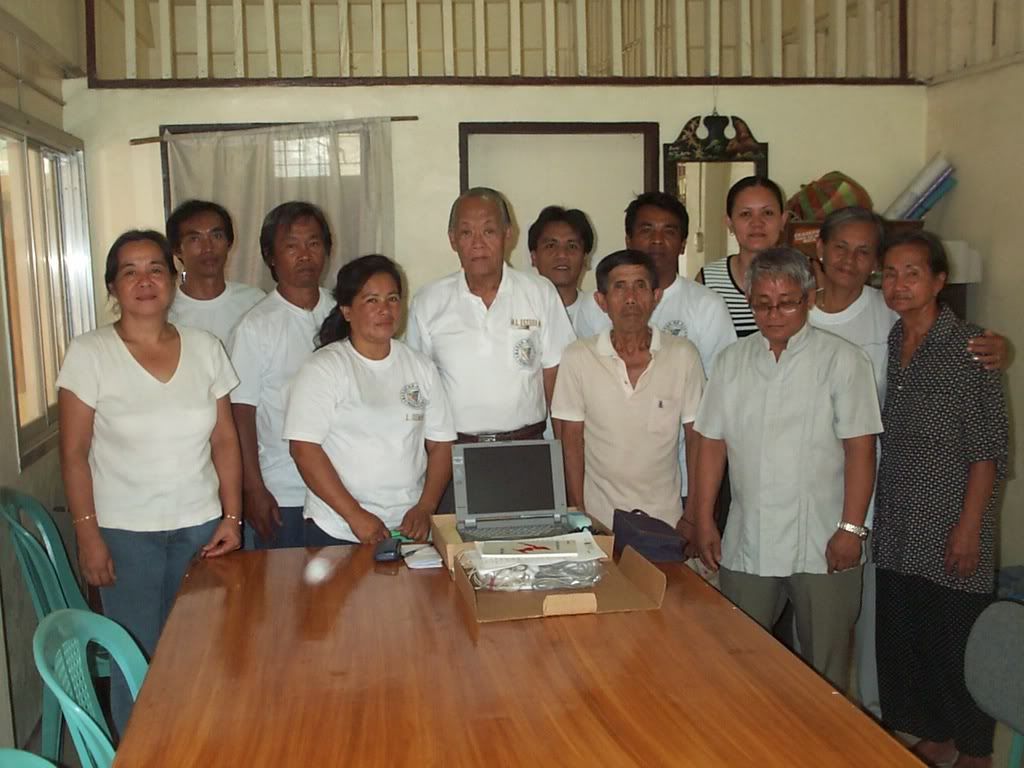
Manuel Valdehuesa Street talk
Source: http://www.sunstar.com.ph/static/cag/2008/05/26/oped/editorial.html
REPUBLIC Act (RA) 7160 states that in addition to being the primary planning and implementing unit of government, the barangay is also "a forum wherein the collective views of the people may be expressed, crystallized and considered."
This makes governing the barangay similar to the direct democracy practiced in the districts of Switzerland (canton) and Israel (kibbutz), and indeed, ancient Athens.
Arroyo Watch: Sun.Star blog on President Arroyo
By assembling periodically, deliberating on issues affecting the community, taking responsibility for their neighborhoods, adopting resolutions, then taking collective action, people govern themselves.
In other words, they manage their community directly - deciding policy, program, and projects - the essence of autonomy, of self-governance. All these apply to every barangay.
The law makes it possible for the community not to rely solely upon higher-ups, not especially those who mistake public service as self-service, or those whose personal agendas offend public interest.
Good governance lies with the citizens themselves - including the task of guiding their leaders by providing them the direction, content, or standards of public service.
And the citizens may also remove their officials between election periods by direct, collective action if they lose confidence in them.
No one seems to appreciate its role or importance in making our republic strong and democratic.
This may be because when the Code was enacted in 1991, neither its authors in Congress nor its implementers in Malacañang and the Cabinet have bothered to launch a campaign to explain its provisions. They didn't know that introducing a new system requires information, education and communication?
Then again, perhaps they knew too well that to have explained the Code's provisions would have empowered and enfranchised the people.
Then it would have been goodbye to the good times, goodbye to dynastic rule, goodbye to election cheating, and, most horrid of all, goodbye to fabulous allowances, commissions, and graft!
Thus, instead of an IEC campaign, they just made half-hearted gestures to autonomy accompanied by pompous demagoguery.
And that is how and why the trapos remain the center of power in the community instead of the people.
Will barangaynons ever take charge? More on this as this column runs on.
Manny is a former UN executive, diplomat, DAP director, and vice chair of the Local Government Academy. He appears here Mondays, Wednesdays, Fridays. Email: valdeman_esq@yahoo.com
Tuesday, July 1, 2008
People's Power in Venezuela: Communal Councils Advance in Libertador

by John Riddell
January 10, 2008
Source: http://www.zmag.org/content/showarticle.cfm?SectionID=45&ItemID=14695
"If we want to talk of socialism," says Argenis Loreto, "we must first resolve the people's most urgent needs: water in their homes, accessible health care, easy access to housing."
In the Venezuelan municipality of Libertador (state of Carabobo), of which Argenis is mayor, "we have 90% poverty. Ending that is our first task. I am convinced that the existing state cannot do this." It's essential that "the majority of the people become part of the decision-making process."
But when Argenis was elected in 2000, the second year of the Bolivarian government headed by president Hugo Chávez, he found that "the people did not possess the tools needed for their participation."
That insight led Chávez and the Bolivarian government to initiate the formation of neighbourhood councils across the country—councils that they view as the embryo of a new people's state.
Suzanne Weiss and I spent two days in Libertador, one of the first municipalities where such councils were formed, talking to Argenis and dozens of others. This report is based on what we saw; it also draws on Marta Harnecker's outstanding study of the Libertador experience.*
"Before we had many problems," recalls Félix Hernández, member of a community government. "The roads were super-awful. The electricity worked one or two days and then shut off. Health service was chaotic. Water service was complete chaos."
Appealing to city hall was a waste of time. "It was horrendous," says another council member, Virginia Diaz. "We'd go with petitions and explain. They'd visit and approve the project." But nothing would happen. "When we went back to the office, they'd never heard of us, didn't know anything…. As useful as tits on a bull."
The result was public apathy, says municipal social activist Fidel Hernández—like Argenis, a published poet. "The people had let itself be convinced that it could not govern. There was a deliberate policy for this … that's why we had 1½ million who were illiterate."
Of peasant origins, Argenis Loreto finished only six years of schooling before starting his working life in factories, industrial management, farming, and again in factories. He joined a revolutionary group at age 17, took part in the Bolivarian movement's unsuccessful coup in 1992 and became mayor after two decades of underground activity.
Convinced that only the poor and disenfranchised could reconstruct his municipality—and his nation—he sought to bridge the gulf between them and the instruments of government. Argenis and his colleagues set out to do this by extending governmental structures to the community level and by delegating power to community governments. Such a shift was authorized by a decentralization clause (Article 184) in the Bolivarian constitution adopted in 1999.
Progress was slow at first. The right-wing coup and bosses' strike of 2002-2003 delayed restructuring. The Libertador plan ran into strong opposition from some Bolivarian national legislators, who accused Argenis of "creating illegal associations."
Finally, in 2006, the community structure was in place: 35 "social territories," which united residents that shared similar problems, a common project, and a sense of belonging to a common environment. They ranged in size from 1,000 to 15,000 residents. Each territory elected a government through assemblies of its residents, usually choosing between competing slates of candidates. All community government work is voluntary—no salaries are paid—but relevant expenses are reimbursed.
In one of the social territories, skeptical residents declined to name a council. In another, a centre of Libertador's small middle class, the opposition slate was elected. "Many right-wing oppositionists join in community council activity," says Argenis. "They feel they cannot stand aside from the social programs and local projects that the councils carry out…. The opposition's role in local government has helped ease political tensions here."
The people's power structure has two tiers. Each social territory or commune includes smaller and more homogenous communities, each of which has its own communal council. The size of component communities is determined by social geography: urban councils typically unite 200-400 families; rural councils, 20-50 families. The smallest social territory by population (Mont Vernont), is composed of dispersed mountain hamlets: it therefore includes the largest number of communities. In Libertador, there are 204 such communal councils.
Each communal council and social territory holds assemblies to choose and prioritize its ten most needed projects for the coming year. The municipal planning council then evaluates the top three proposals from each territory—more than three, if finances permit. A value of 1 to 9 is assigned to each of a number of criteria: number of residents, number who will benefit, cost, how long the request has been pending, the number of previous projects in this community, etc.
This ranking creates a proposed project list that is presented to an assembly in each territory, which can change its priorities and request reconsideration—if for example a favored project turned out to be impossibly expensive.
Once the project list is decided, the required funds are allocated to the community bodies, which handle administration, buy materials, and engage workers or contractors, giving preference to cooperatives. Community networking and know-how helps keep costs down, and any savings stay in the community for other purposes. Argenis estimates that $1 million a year is saved simply by eliminating private profits.
"For example, a flood control project was approved with a budget of 184 million bolivars [about $90,000]," says Fidel Hernández. "But in fact the community councils did it for 47 million and had lots left over for fixing roads.
"In another case, the local council got a price of 80 million to bring electricity to a district. But in fact they managed to do three districts for that price.
"Last year the community councils spent 84% of the municipal budget [for projects]," Fidel notes.
Popular control has steered funding toward small, plain, and inexpensive projects densely spread through local neighborhoods. Urgent human needs have taken priority over infrastructure requirements like road upgrades.
Argenis highlights the 74 primary-care health centres built by neighborhood councils, which at first sometimes even manufactured the bricks. "We had only nine centres before," he says. In addition, Libertador boasts four Integral Diagnostic Centres—small hospitals—"the pride of our community," according to Felix Hernández.. Another community government member, Aixa Silvera, calls the Cuban doctors working in these centres "the most spectacular thing we have in the communities.
Indeed, Libertador led the way in Venezuela by arranging for Cuban doctors to work in the communities, before this became a national program.
Argenis says that community governments are building 48 primary schools this year—mostly one-room structures serving a neighborhood. There are also now three university campuses in Libertador—part of a national program to "municipalize higher education."
"As for sports, there are now only two or three communities that do not have a minimal installation" which means a playing field.
The citizens of Libertador are also trying to establish cultural centres in each social territory, usually an "open-air amphitheatre." Eight cultural centres are now under construction In some cases resident assemblies gave building a cultural centre priority over fixing the road or installing street lighting. "You can't have a revolution without beauty," Fidel Hernández says.
The obvious progress is confirmed by two surveys that were taken at the beginning of the community government program and again in May 2007. The first survey showed that the most urgently felt needs were for health care and educational facilities. In the second, no one cited health care as a concern, and almost no one mentioned education. Moreover, "we now have hardly any kids on the streets," says Argenis, "and the problem of homelessness is almost solved."
According to official estimates, Venezuela has a shortage of 2.7 million homes, while another 1.3 million dwellings are inadequate home-made shacks. In 2006, 200,000 homes were built—a positive achievement, but far less than what is needed.
Argenis believes that community councils, who feel this urgent need acutely, are best suited to build houses. Sometimes they "build 10, 12, even 15 houses with the money provided for seven," he says.
"But we desperately need raw materials. Our economy was destroyed, and now we don't have the capacity to make the cement blocks, the paint, the ceramic toilets. We're working with Iran, China, and Brazil to meet these needs."
And Venezuela is building six factories to produce plastic building materials—"we have oil, after all," says Argenis. This project, called Petrocasa, will supply materials for 15,000 new houses a year. One of these factories, is close by, in the state of Carabobo.
In 2006 Hugo Chávez endorsed the establishment of communal councils as a priority across Venezuela. In January 2007, he declared them institutions of "people's power," an embryo of a new people's state. An enabling law was passed in April, and there are now more than 10,000 councils across the country.
While vindicating the innovative program in Libertador, this expansion also caused the municipality many headaches. The national government intended the councils to be free of the deadening hand of the traditional state bureaucracy. Among other things, word went out that mayors should not get involved with these people's organizations. This directive might be appropriate in the nearby industrial city of Valencia, ruled by the opposition, but in Libertador it was totally at odds with reality.
Unfortunately, the Carabobo state government, led by critics of Argenis's initiatives, seized on this opening to create problems for Libertador's government. Utilizing its own statewide network of paid social activists, it promoted the notion that communal councils don't need to work with Libertador's larger social territories or with the city government.
"That caused a terrible process of fragmentation and division between the two levels of popular power," says Argenis.
Much effort has gone into knitting the two levels of people's government back together, Argenis says. "When they work together they're unbeatable."
People's power was an element of the constitution reform narrowly defeated in the December 2, 2007, referendum. The communal councils are still authorized under Article 184 of the constitution and the April 2006 legislation, and there is no legal barrier to expanding the structures beyond this framework. However, the referendum setback may encourage the councils' critics.
The community government bodies in Libertador aren't perfect. Among the occasional abuses noted by Argenis:
· Only one community is represented in a social territory council.
· One slate takes all the leadership positions.
· Elected officers take decisions on their own without convening the residents' assembly.
· The assembly functions poorly because of lack of interest.
More troubling is the conduct of other branches of government, such as the problems with Carabobo State. Among the many stories of this sort that Argenis tells, the pig manure episode is enough to illustrate what people's power is up against.
The city government makes special efforts to help Libertador's many farmers, a number of whom raise pigs. Some time ago the Ministry of the Environment banned hog-raising in the municipality because of concerns for water quality, but did not enforce the regulation. Libertador tried to help farmers solve the water problem on their own, by providing septic tanks for environmentally safe treatment of pig manure. The manure's polluting gas discharge was captured and burned for cooking. "This is a miracle," says Argenis. "It cuts out the smell and uses the gas!"
But the ministry intervened and nixed the project, which they said broke their rule against raising pigs. The bureaucratic method could not be better demonstrated: only the formal regulation counted; the real-life problem of manure pollution was of no interest.
What explanations do the ministry provide? "None whatsoever," says Argenis. "Just as we always say: this bureaucracy is eating us alive… We can't change things with this type of state."
Even among inherited municipal officials, "the apathy is barbaric. We have to establish a new conception of a staffer," Argenis says. "I'd like to dissolve the municipal administration … and create a confederation of community governments."
Reflections
At first glance, Venezuela's people's power can seem to be just a formal structure—municipal government on a street level. This is misleading. The councils have appeared and made gains only as part of an immense popular movement on a national level: the Bolivarian revolution.
This revolution was born in the mass mobilizations against the U.S.-backed oligarchy's attempts to overthrow the country's elected government—by a military coup in 2002, by an economic shutdown in 2003, and by an anti-Chavez referendum in 2004. All were defeated by the initiatives of masses of working people.
In Libertador, Argenis recalls, the embryonic community governments acted as defense committees, struggling to ensure that food, cooking gas, and gasoline reached the people. "That was just so wonderful," he says. "Quickly we had a network of more than 200 Bolivarian shops," distributing necessities and helping defend the revolution. Such national struggles were the true birth of people's power.
Venezuela's success at forging constructive ties with other non-imperialist states has also played a role, not just through Cuba's contribution to health services, but above all in building alliances to help fend off, for now, a U.S.-led assault.
The sometimes destructive role of national and state authorities is also a reminder that the power of working people will not flourish at the street level unless it is consolidated nationally.
Yet the community councils in Libertador call us to us, Sí se puede! – Yes we can do it! Enlisting the majority, the working people, in government is indeed possible. Venezuela's people's power—while still embryonic—is a living, viable reality.
John Riddell is co-editor of Socialist Voice
* Marta Harnecker, Gobierenos Comunitarios: Transformando el Estado desde abajo. [Community governments: transforming the state from below] Monte Avila Editores, 2007. This book is not readily available outside Venezuela. However, its text is available online. Harnecker is director of the "Popular Participation in Public Management" program of the Central Internacional Miranda, a Bolivarian research institute in Caracas.
Audio program from Venezuela Solidarity Symposium: http://calamadison.org/dasa/


