
 According to the piece below, much of the developing world relies upon the radio for outside information. As the social structures evolve from small village-based consensus governance to an increasingly urbanized and diversified population, modes of communication struggle to transform as quickly. Radio is used as tool to disseminate information in areas where TV and Internet cannot reach. As with any form of media, the radio is an opportunity to hold governments accountable to the people as it provides people with information regarding the issues at hand. The more radio stations and views presented, the more people will be educated about the issues and therefore more likely to participate in the debate. If radio becomes one-sided or dogmatic, it becomes stifling, and it poses risks to democracy and discourages people from standing up against decisions they oppose. -Editor
Ghana: Radio, Participation And Governance - the Nexus
Source: http://allafrica.com/stories/200805161022.html
Public Agenda (Accra)
OPINION
16 May 2008
Posted to the web 16 May 2008
Richard Ellimah
The caller tells Joy FM's Super Morning Show host, Kojo Oppong-Nkrumah that she is caught up in the middle of an early morning rainstorm and there is a danger of her car submerging in the ferocious floods.
In fact, the panic in her voice is so palpable. Another caller, Bernard, sends an SOS to the programme host and says if help does not come in a few minutes he will be swept away by the floods. In response, Kojo calls National Disaster Management Organisation (NADMO) and Ghana National Fire Service (GNFS) officials and directs them to the areas where the distressed calls came from. It is amazing the level of people's expectations of radio.
Radio is the new craze in developing countries. It is uncommon to see young and old, men and women, rich and poor, urban and rural dweller clutching at rectangular electronic devices that blare out both music and talk shows. For some of these people, radio is their companion day and night and is the closest device to contemporary technology that they possess. Welcome to the radio revolution!
Radio is simple, cheap and accessible. This makes it a real friend to many in the developing world where pervasive poverty means people cannot afford the luxury of a television set let alone access the internet. In Ghana, with as little as 2 cedis, a person can get a radio set. Families therefore purchase one set and the entire household benefits. Wherever you are, be it the kitchen, farm, bathroom, toilet, classroom, walking by the roadside or relaxing under a tree, radio can intrude and keep you company. The added benefit of radio is the multiplicity of stations one radio receiver can churn out.
It is not that there has never been a mode of sending messages in the past. Long before the advent of European colonialists, traditional societies had their own means of sending messages. In times past, the town crier was the chief messenger. It was his duty to transmit messages to the people from the chief and his elders. His mode of presenting the message galvanized people to actively participate in local governance. In traditional Akan societies, the tone of the drum beat connotes the message being sent. For instance, when the chief or a prominent person passes away, the sound of the drumbeat is different from that of a festival announcement. This way, the community was adequately informed of events both within the community and outside.
This medium of communication that promoted active participation in community governance has virtually faded out. One reason is that through increased urbanization, more and more people have moved out of the close village environment into more diversified and complex environments where community mobilization by means of a town crier is extremely difficult, if not impossible. Such communities will therefore have no need of a village crier. Furthermore, increased use of modern technology has presented other opportunities for announcing events to community people and certainly, the "tontonsansan" or talking drum is not one of them because it has outlived its usefulness.
With these disadvantages, radio presents the easiest and simplest methods of enhancing community mobilization for development. Its advantages transcend both rural and urban dwellers. In fact, the late media icon Professor P. A. V. Ansah describes radio as the only true "mass medium" because the transistor revolution has reached even "the rural dwellers".
In developing key governance indicators, the World Bank, notes that accountability of government officials, transparency in government procedures, openness in government transactions as well as reliable flow of information are all crucial to the survival of any democratic order.
Governance is therefore not only about structures or institutions. These institutions exist to further the process of governance. Ultimately however, empowering the people to actively participate in this process by feeding them with timely and reliable information is critical to the survival of the structures. It can therefore be deduced that there exist the "hard" and "soft" parts of governance. What most developing countries have done is to place a lot of emphasis on the hard part. These countries have succeeded in establishing flamboyant institutions with sweeping powers and incidentally, raised hopes that the mere existence of these institutions alone ever solved any governance questions. Why didn't Bernard call NADMO or the GNFS straight away? There are several possibilities one can look at. It is very probable that he did not even know the contact numbers of these public officials who are supposed to come to their aid in their moment of need. The other possibility is that even if he did know the contact numbers, the problem might be with how he would be received. To expand the argument further, how many Ghanaians know the telephone numbers of key governance institutions? At the district level, what is the nature of interaction between the assembly and the people within the district?
The advent of radio has contributed significantly to solving the questions of governance. How does radio contribute to governance? If indeed, the general consensus is that governance involves people, then how do people participate in governance? To begin with, there is no denying the fact that radio plays some role in enhancing participatory democracy. It provides a platform for the citizenry to share ideas, question existing policies of government, and generally hold public office holders accountable to the people. In an election year like this, radio stations are bringing politicians and the electorate together in a marriage whose fruits can only further our democracy.
What do Ghana's radio stations sound like? Check out this link:http://myghanaradio.com/
Thursday, June 5, 2008
Ghana: Radio Promotes Participatory Democracy

Wednesday, June 4, 2008
ECUADOR: Indigenous Movements Press Correa on Cultural Rights and Control of Resources
 Ecuador's long running clash between exploiters of natural resources and defenders of indigenous cultural rights is yet again coming to a head as CONAIE (the country's main indigenous organization) released a rejection of President Correa's proposed exploitation of land and resources. The indigenous voice must be recognized in the country's new constitution or Correa will face mass revolt by the people who have always been excluded from political processes. Symbolic gestures will not be tolerated because these people want to make their own decisions about how their land and their country will "develop". The article below outlines the demands of CONAIE and the government's oppositional actions. -Editor
Ecuador: CONAIE Indigenous Movement Condemns President Correa
Source: http://upsidedownworld.org/main/content/view/1288/49/
Written by Daniel Denvir and Thea Riofrancos
Friday, 16 May 2008
The Confederation of Indigenous Nationalities of Ecuador (CONAIE) declared itself in opposition to the government of Ecuadorian President Rafael Correa on May 12. The CONAIE accused the president of continuing right-wing neoliberal economic and racist social policies. The harsh condemnation focused on Correa´s opposition to two key demands: the recognition of Ecuador as a plurinational state in the new constitution and the requirement that communities must offer prior consent before large-scale mining and other major extractive projects take place.
Ecuador is currently governed by a Constituent Assembly, which is writing a new Ecuadorian constitution as well as performing all legislative functions. The Assembly was convened after voters overwhelmingly approved a constitutional referendum in April 2007. Members of Correa´s Alianza Pais party won 74 of the 130 seats. Patchakutik, the CONAIE's electoral arm, has four representatives in the Assembly.
While the CONAIE has supported a number of Correa`s programs, most social movement activists in Ecuador say that this conflict was foreseeable. Correa`s support for large scale mining and his opposition to plurinationality run up against the indigenous movement's top political priorities.
Plurinationality is a broad framework that encompasses a number of key indigenous movement demands, including cultural rights—such as bilingual education and culturally appropriate healthcare—and collective economic rights such as the requirement of affected communities' consent before any exploration or extraction of non-renewable resources, whether by State or multinational corporations.
The CONAIE's strong position against large-scale mining and for prior consent is a boon to Ecuador`s anti-mining movement, led by the National Coordinator in Defense of Life and Sovereignty. Over the past several months, the Coordinator has organized massive road blockades in Southern Ecuador, sparking government condemnation and repression. In response, a large pro-mining march took place in Quito in early May, apparently organized by government and industry forces.
The environment is a central issue for the Ecuadorian indigenous movement, as they see cultural rights as closely tied to territorial rights and the preservation of biodiversity. The CONAIE's environmental demands extend beyond the indigenous movement and involve close collaboration with local and international environmental organizations. The CONAIE, along with a wide range of regional social movements, rejects the South American regional integration plan known as the Initiative for the Integration of Regional Infrastructure in South America (IIRSA). The development program, funded by the Inter-American Development Bank and other regional financial institutions, such as the Brazilian Development Bank and the Andean Development Corporation, consists of mega-development projects such as dams and hydroelectric plants. According to the Bank Information Center, the IIRSA "poses one of the greatest challenges to environmental sustainability and social justice today." In Ecuador, the main IIRSA project is the Manta-Manaos multimodal transportation axis between Ecuador and Brazil, which includes building a port and the construction of several new roads leading to and from the coast. In the words of the Ecuadorian government, this transportation project will achieve the "dream of joining the Atlantic and Pacific oceans through a terrestrial-river route," and will facilitate the creation of a new East-West trade axis.
The CONAIE also strongly criticized the negotiations for a Free Trade Deal (misleadingly called "Association Agreement") between the European Union and the Andean Community, which took place three weeks ago.
The CONAIE's leadership is now visiting and holding consultations with its constituent base communities throughout Ecuador. The leadership will reconvene at the end of the month to make decisions about what actions to take next. It is widely rumored that the CONAIE will launch a national indigenous uprising, events that have in the past shut down the entire country. According to the CONAIE spokesperson Pacha Taran, "We are not calling for an uprising. But we are not ruling that out, either."
While certain members of Correa´s Alianza Pais (AP) party have made statements in support of plurinationality, Correa and a number of AP assembly members either oppose the measure or support it symbolically while opposing its substance of collective territorial and cultural rights. As Taran put it, "Correa likes us, except for when we start to protest. Then he tells us to shut up."
According to the CONAIE declaration, "We reject President Rafael Correa´s racist, authoritarian and antidemocratic statements, which violate the rights of [Indigenous] nationalities and peoples enshrined in international conventions and treaties. This constitutes an attack against the construction of a plurinational and intercultural democracy in Ecuador. Correa has assumed the traditional neoliberal posture of the rightist oligarchy."
The declaration goes on to accuse the government of "handing over national and indigenous territories to transnational oil, mining, pharmaceutical, logging and hydroelectric companies." The CONAIE also demands that the Constitutional Assembly support food sovereignty and declare Ecuador "free of transgenics and agrofuels."
Furthermore, the twelve-point resolution called for the firing of Minister of Mines and Petroleum Galo Chiriboga and Minister of the Environment Marcela Aguiñaga. Chiriboga has been widely criticized for allowing foreign companies, namely the Brazilian state company PetroBras, to violate Ecuadorian law. Aguiñaga is accused of allowing large scale logging in the Amazon and of failing to adequately investigate the murders of an undetermined number of Huaoroni indigenous people earlier this year. It is widely believed that the Huaorani were killed by either loggers or paramilitary groups hired by logging companies. They have also called for action to be taken against Attorney General Washington Pesántez. Pesántez is accused of persecuting social movement activists from unions and indigenous groups and organizations like Indymedia.
Finally, the CONAIE declared its solidarity with the people of Bolivia and President Evo Morales. They condemned the Bolivian right-wing's attempt to declare wealthy regions like Santa Cruz "autonomous" and warned against pro-autonomy statements by Ecuadorian opposition leader Jaime Nebot. Although this resolution represents the indigenous movements' strongest public condemnation of Correa to date, the CONAIE makes it clear that they are not part of the right-wing opposition and oppose Correa on their own terms.
Daniel Denvir and Thea Riofrancos are independent journalists from the United States and collaborators at the Latin American Information Agency (www.alainet.org) in Quito, Ecuador. They are also editors at the forthcoming journal Caterwaul Quarterly (www.caterwaulquarterly.com). Daniel Denvir is a 2008 recipient of NACLA's Samuel Chavkin Investigative Journalism Grant.
Mexico: Taking Stock of the Oaxaca Commune

Granito de Arena and Un Poquito de Tanta Verdad by Corrugate Films are recommended viewing for first-hand accounts of the people's resistance to structures of continued poverty and lack of education. -Editor
"Assemble-ist" forms of direct democracy were developed in order to organize both the rebellion and the governing of the city of Oaxaca for the five months that the popular forces controlled the city. This experience demonstrated the tremendous creative potential that can emerge in the course of popular struggle. It also exposed the limitations of rebellion in one region.
To understand the experience of the Oaxaca Commune, its strengths and limitations, the rebellion must be situated and contextualized in the conjuncture of the national crisis, a crisis that created space for the rebellion and – as it was not yet a national revolutionary crisis – set limits on its development and eventually led to its defeat. The national situation allowed the movement to grow but also set boundaries on its potential. The movement was brutally repressed on November 25, 2006, but it has survived – weakened but alive, vibrant, and with great potential.
The continuing crisis in Mexico
The crisis of the neo-liberal, authoritarian Mexican regime continues to deepen. The regime has very little political legitimacy. Popular discontent exploded in two mass and creative mobilizations in 2006: that of the anti-fraud movement over the presidential elections and the Oaxaca insurgency and commune.
These two movements, while sharing many of the same roots and hopes, were very different. And their failure to coalesce into a broader movement was a key factor in their mutual defeat. Nevertheless, important currents in the Partido de la Revolución Democrática (Party of the Democratic Revolution – PRD) provided linkages between the Oaxacan popular movement and national forces. Now, the deepening crisis – and likely split – of the national PRD could isolate the Oaxaca resistance even more from national struggles.
Neither the national crisis nor these two movements have disappeared. The national crisis deepens by the day with the determination of the national government to carry out a slightly veiled privatization of oil and energy and anti-labour reforms. The tenacity of popular resistance has slowed the neo-liberal assault without being able to stop it.
The "catastrophic equilibrium" of the Mexican regime continues. Militarization and repression have intensified but popular resistance continues to grow, in spite of continuous repression and the weaknesses and political crises of the left.
State-engineered assassinations, disappearances and arrests have continued on a daily basis in Oaxaca. Some people have remained in jail. The low intensity war against popular movements that started even before November 25, 2006 has continued ceaselessly. It has had a great human toll and, combined with the defeat of the popular insurgency, has led to a significant decomposition of the social order. In addition to the constant violence by the state, there has been a generalization of violence in society. This presents very difficult conditions for the resurgence of mass, open, popular resistance.
The Oaxacan popular resistance
Nevertheless, the various components of the Asamblea Popular de los Pueblos de Oaxaca (Popular Assembly of the Peoples of Oaxaca – APPO) continue the battle against repression, authoritarianism and neo-liberalism.
Section 22, the Oaxacan state section of the teachers union, whose repression initiated the rebellion – and who provided a core of cadre for the popular movement – continues to fight for union democracy, improvements to education, better wages and working conditions, and an end to the ongoing repression. And both section 22 and the APPO play important roles in attempts to form national movements of resistance. The APPO has sought, with some success, to deepen its roots in small towns and the countryside. But the same structures of power and the same repressive governor that the people rose up against continue. None of the problems that gave rise to the APPO have been resolved. Section 22 and the APPO lost the battle in 2006, but the war continues. Major mobilizations are planned for Oaxaca for May that will intensify both the resistance and the repression.
The possibilities for the resurgence of the Oaxacan popular movement will be conditioned by developments both at the state and the national level. The Oaxacan resistance needs a strong national left as an ally but the Mexican left is itself in deep crisis.
The defeat of the Oaxaca movement and the escalation and institutionalization of extreme violence in Oaxaca also present extremely difficult conditions for the growth of the Oaxacan movement. There is, however, a continuing vitality to movements of resistance in Oaxaca and no end in sight to the continuing assault of neo-liberalism and repression. There is also now a shared memory of democratic, popular insurgency that can play an important role when popular resistance rises to new levels again.
The Oaxaca Commune has added the experience of popular, self-governing insurrection to the repertoire of images, strategies, and processes of struggle in popular consciousness. As things polarize more and more in Mexico, this example could take on even more relevance as an alternative in the repertoire of those in struggle. But for a new Oaxacan rebellion to have any possibilities of success, the Mexican left nationally must overcome its deep crisis.
This article was originally published by the Socialist Project E-Bulletin. A pamphlet on the Oaxaca Commune is available for download
Richard Roman writes regularly on Mexico.
Edur Velasco Arregui is a Mexican trade union activist.
Sunday, June 1, 2008
Switzerland: Immigration Referendum Update - The People Have Spoken

Critics said the posters for tougher rules had racist undertones.
Voters in Switzerland have rejected a move to make it even harder for foreigners to obtain citizenship.
In a referendum, they voted 64% against a bid to revive the practice of approving citizenship candidates by secret ballot and scrapping appeals.
Secret ballots were outlawed five years ago by the supreme court, which judged them to be discriminatory.
Switzerland has one of Europe's highest numbers of foreign-born residents - more than 20%.
Many Swiss said not allowing voters to have the final say on who became a citizen violated the country's system of direct democracy, the BBC's Imogen Foulkes reports from Berne.
However, opponents of Sunday's poll, which was called by the nationalist Swiss People's Party, suspect the real agenda behind it was not Swiss democracy, but how best to keep certain groups out of Switzerland, our correspondent adds.
Twelve years of residence
Initial reporting of the poll results showed that the measure to raise the threshold for citizenship was soundly defeated, gaining approval in only one of Switzerland's 26 cantons (states).
Swiss laws on naturalisation are already tough.
Candidates for citizenship must live in Switzerland for at least 12 years, they have to pass tests in one of the official languages of the country, and culture, and those born in Switzerland have no automatic right to citizenship.
The final hurdle is approval by the local community at a town meeting.
The supreme court outlawed secret ballots five years ago after it became clear that some towns were regularly rejecting candidates from the Balkans, Turkey and Africa, while approving those from Western Europe.
It also gave those rejected the right to appeal.
The Swiss People's Party, the largest in parliament, wants the secret ballots back and the right to appeal removed.
More on the Swiss Naturalization Referendum Debate

The political uses of Swiss-ishness
Source: http://www.opendemocracy.net/blog/ourkingdom-theme/admin/2008/05/24/the-political-uses-of-swiss-ishness
Tony Curzon Price (London, oD): A friend of mine tells this story of a first encounter with a French scientist, met under the building-sized replica of the DNA molecule in Crick and Watson's laboratory: English Scientist: "Beautiful, isn't it ?... " pointing at the bobbles and wire. French Scientist: "Not like Fermat's theorem". English Scientist: "Of course, I speak from Anglo-Saxon empiricism". French Scientist: "I know. You should never have burned Joan of Arc".
These are the coded short-cuts which, with enough depth to the relationship, speak loudly. Helvetiophiles will know this kind of short-cut well: Helvetiophile: "Democracy can be distributed, look at Switzerland". Party Animal: "Don't you miss the strong leadership, the direction, the re-alligments and historic moments?" Helvetiophile: "I meant for everyday democracy, for an informed citizenry, for people responsible for their collective decisions". Party Animal: "Ah yes. Cuckoo clocks, Nazi gold, gnomes and sanatoria ..."
Time Magazine is running the latest episode in this rapid reduction. (Hat tip to the enthusiasts at Direct Democracy). The populist anti-immigrant Volkspartei (SVP) has organised a referendum aiming at returning the power to bestow citizenship to the lowest level of government, the Communes. This is where the power lay until 2003, when a Supreme Court ruled that the repeated refusal of citizenship by some German-speaking rural Communes was against the federal constitution. Naturalisation became a centralised administrative procedure.
So is the SVP referendum to add to the litany of abuse: "... sanatoria and anti-immigrant referenda"? I am not sure. The Volkspartei holds plenty of nasty opinions, and it wants this referendum to reduce the rate of naturalisations. But I think it is right, and for legitimate reasons that are far from the considerations of the Volkspartei, to keep the decision at the most local level possible.
Naturalisation is not asylum; it is a request to join a group for the long haul, to participate in a future. It is quite right for asylum and sanctuary to be universal rights, protected by international law. But not naturalisation. Naturalisation engages everyone, and responsibility for it should be active and positive on all sides. A bureacratic Britishness test does not politically engage either the host or the potential subject.
Before 2003, it was always known that the French-speaking cantons, and especially Geneva, were an easy touch for naturalisation. There is no reason to think that these open political cultures would become closed if the power to naturalise were returned to them. Many London local authorities would similarly be open if naturalisation decisions were so-devolved here. Switzerland taken as a whole naturalised more people per head of population in the decade before 2003 than any other European country.
Of course, giving localities the right to naturalise imposes an "externality" on the other localities within the state. This is the same for citizenship of the EU---whoever Sweden naturalises also has residence permission in Poland. There is the danger that "rogue liberals" will become extra-soft on naturalisation knowing full-well that some of the cost will be borne by the xenophobic autarchies of the union. Decentralised naturalisation seems to have an automatic bias in favor of openness---anyone naturalisable by the most liberal is naturalisable by the group.
The Volkspartei, it hardly needs to be said, is not championing states rights for this reason. There is a danger that "rogue openness" will stretch the federation to breaking point, but if it does not get that far, then it offers a wonderful compromise: all the benefits of a liberal naturalisation policy while the xenophobes can continue to feel that the foreigners in their midst are not there with their blessing.
Our grandchildren and great-grandchildren will point to us and say: "How could you have done it? how could you have excluded so many, so systematically, from your protected gardens?" We should have an answer that does not involve the excuse that these decisions were taken by an impenetrable central bureaucracy that we trusted to do the right thing. Localising naturalisation would be a good place to start.
MarkZ said:
Mon, 2008-05-26 15:10
You're making an interesting point here. However you seem to ignore why this initiative is so highly disputed here in Switzerland. It's not because we're taking power away from the communes as the SVP wants everyone to believe. It's because the SVP wants to bypass our constitution and basic human rights. The main point about this initiative is that the decisions made by the communes are irrevocable and not subject to a need for explanation. Basically this would mean that the commune could decide "We don't like your skin colour, so go away" and no one would be able to do something about it. However it is a basic right, from our constitution, that you are allowed to know the reason for such a decision.
Thanks anyhow for motivating me to register and post at openDemocracy. MarkZ
opendemocracy said:
Mon, 2008-05-26 16:24
Thanks, MarkZ for the clarification.
Can you explain the pre-2003 situation --- did that have the rights of communes subordinated to Federal over-ruling? Or is the SVP essentially asking for a return to the status quo ante?
I am also interested in the notion of "reason" in democracies. Is it not a reason to say: "you were refused naturalisation because your demand was voted down"? And if you were told: "your demand was voted down because this commune is full of nasty xenophobes", then would you have been given a reason or a motive? The first is a better reason, it would seem to me.
But I suppose this just delays the fundamental point. While sanctuary and refuge ought to be rights, administratable by courts, I am less sure about naturalisation. Pretending that it is not political pushes xenophobes into anti human rights positions.
paul.carline said:
Mon, 2008-05-26 21:17
Very interesting. We (members of IRIE - Initiative and Referendum Institute Europe which specialises in direct democracy) were discussing this very issue last weekend in Marburg.
The discussion became quite heated - especially between two Swiss members: one who lives in Switzerland, the other now living in Finland. The first was defending the pure principle of popular sovereignty on which the Swiss system is supposed to be based i.e. a local direct-democratic decision by simple majority in a referendum has the highest level of legitimacy and should not take second place, even to the national constitution or the Constitutional Court.
The second believes that there must be some limitations on popular sovereignty - that it cannot be allowed to infringe fundamental human rights and that in this case the Constitutional Court was right to ban the practice of deciding on applications for naturalisation by secret ballot.
It's important to remember the precise circumstances which led the court to make its decision. On 12th March 2000, 56 applications for naturalisation were decided on by referendum in the Emmen local authority (commune) are of the canton of Lugano.
48 of the 56 were rejected. The 8 people accepted were all Italian, the others Jugoslavian, Hungarian, Turkish and Polish-Dutch. One of the initiators of a popular initiative to allow these decisions to be made by local referendum stated: "The voters [in Emmen] made the right decision by rejecting all the applications of those people who are not in harmony with our central-European way of thinking".
The court decided that this was a clear case of discrimination based on ethnicity and was therefore unconstitutional.
Tony Curzon Price takes an easy route by setting the (in principle admirable and enviable) direct-democratic rights of the Swiss against the centralised, opaque and undemocratic decision-making by Whitehall we have to suffer here.
But surely the issue deserves a more in-depth consideration. It forces us to face up to one of the limitations of democracy - even in the best-case scenario of Swiss direct democracy. To repeat: can popular sovereignty come before fundamental human rights?
It's an important question, because a decision in favour of local democracy opens the door to other potential 'breaches' of human rights. It also forces us to confront the dilemma of the "tyranny of the majority" and ask: is Swiss-style direct democracy the ultimate, the gold standard - or must we not find an even better solution?
It should also make us think about the need for such rituals and such tokens of 'belonging' - and whether we must not move beyond the nation-state and the identity it claims to confer. Why not plan for European citizenship - or ultimately global citizenship and an end to all forms of discrimination?
Paul Carline (Initiative & Referendum Institute Europe)
Anthony Barnett said:
Tue, 2008-05-27 10:24
Tks Paul - this discussion is now touching one of the most basic and familiar issues but is now all the more important thanks to President Bush's attempt to impose 'democracy' by force.
The key, surely, is that we favour "rights based democracy" (see an earlier discussions about this in OurKingdom; for example, here.
This means that the majority do not have a tyrannical sovereignty and cannot remove the fundamental rights of minorities (eg to liberty or freedom of speech).
The issue becomes more complicated here as the issue is who should be allowed into the political community. Is this a political question that the majority has got the right to decide (whether you like it or not)? Or is it a question of fundamental human rights that has to be decided according to universal rules however inadequately interpreted by human judges?
I think Tony has it right: if the issue is asylum, ie flight from torture and violent repression, it must be decided by human rights law whatever the views of the majority. But if the issue is economic and practical then long live politics.
But what, will come back the objection, if the majority acts in a way that is discriminatory? Well, this needs a longer debate but can here be life without any discrimination?
MarkZ said:
Tue, 2008-05-27 11:34
@opendemocracy:
It depends. Some communal rights are, some not. However, in the case of naturalization, the law (as far as I know) didn't state explicitly whether it was subordinated or not. The federal court simply made clear that the communes had to give a reason for a rejection.["Voted down" is not a reason in my opinion. It should be more along the lines of: "You've never had more than a temporary job, and we feel that you're not trying enough, so we believe that you'd be a burden to our social security."] If the commune did not give a reason, the court would force them to go over it. So all the court can do, is to tell the communes that their decision as it is now doesn't count. The court CANNOT naturalize someone on its own. The commune can reject someone several times. If the court doesn't accept it the first time, they just have to explain why they decided on a "no" and say so the second time.
The court did not ban the practice! It simply made an amendment (I think that's the most appropriate word) to it, namely, the need for an explanation. Additionally it stated that the right to complain applies also to the decision about naturalization. (I hope this is understandable, I'm Swiss and English isn't my mother tongue...)
Germany: Germans Discover Direct Democracy

Germans Discover Direct Democracy
By Markus Deggerich
Source: http://www.spiegel.de/international/germany/0,1518,549794,00.html
While political parties are losing members and voter turnout is sinking, Germans are discovering direct democracy. Their referendums, such as this Sunday's on Tempelhof Airport, are beginning to make life difficult for politicians and the business community alike.
The mayor seemed flexible on the evening of his greatest defeat to date. The outcome of the referendum represented "a clear commitment" by residents in the eastern German city of Leipzig to city-owned businesses, said Leipzig Mayor Burkhard Jung, a member of the Social Democratic Party (SPD). "Ultimately, the citizens delivered a resounding no to all unscrupulous privatizers," said Jung, whose comments came as a surprise to his rivals. It was Jung himself who had wanted to sell a 49.9-percent minority share of the city's public utility company to the French company Gaz de France.
In Leipzig's first-ever referendum, 149,000 people, or about 87 percent of votes cast, voted in late January to block the partial privatization. In Leipzig, a city known for its trade shows, the controversy brought 40,000 more people to the voting booths than for the mayoral election two years earlier. Mike Nagler, 28, was one of those who organized the citizens' initiative called "Stop Them from Selling Off our City," and he still gushes over the day the referendum triumphed. "It was a great success for democracy," he says.
The Leipzig citizens' uprising is part of a trend. While parties are losing members and voter turnout is declining, citizens all across Germany are taking matters into their own hands with petitions and referendums. Next Sunday, the will of the people could cause problems for Berlin Mayor Klaus Wowereit, a Social Democrat, when Berlin residents vote in a referendum on the closing of the city's Tempelhof Airport. Close to 200,000 Berliners have already ordered letter ballots.
Are the complaints of many pollsters about political apathy unfounded? And what is suddenly driving so many people to the polls?
Citizens' Participation and Direct Democracy, a research group at the University of Marburg, has studied the phenomenon and come up with statistics to corroborate the trend toward citizens taking matters into their own hands. In the mid-1990s there were fewer than 100 referendums a year in Germany. Last year there were about 300, with half of them ending in victory for the rebels.
The Appeal of David-versus-Goliath
The Marburg researchers also examined the issues behind the protests, and discovered a noticeable shift. For a long time, people collected signatures mainly to protest mobile phone towers, bypasses and parking meters. Nowadays, however, the goal of most petitions for referendums is to secure general public services. One in three citizens' efforts today involves privatization plans, major transportation projects or the basic supply of water and energy. In the southwestern city of Freiburg, for example, citizens blocked a proposal to sell public housing. In Meissen, in the former East Germany, a decision to privatize the city's municipal hospitals had to be revoked. And in the western state of Hesse, citizens flexed their muscles to stop energy giant E.on from building a new power plant.
This David-versus-Goliath pattern is not only effective, but also seems to hold great appeal for many citizens, fascinated by the notion that getting their own back at the authorities is easier than they had believed. The people are saying a big "No," and yet they are not the ones left dealing with the consequences or having to search for alternatives. Leipzig Mayor Jung has now been forced to severely tighten his administration's belt. Because of the referendum, his proposed budget, which was to be approved in early February, is no longer worth the paper it is printed on. And the next time Leipzig citizens go to the polls, they could very well be voting against the cost-cutting measures that resulted from the first decision.
Captains of industry often -- or at least more often than politicians -- complain about the annoying intervention from below. "We have noted this growing resistance with concern," says Michael Feist, the president of the Federal Association of Energy and Water Industry (BDEW). Citizens' initiatives directed against energy providers seeking to build new power plants or just power lines are currently underway in seven cities. Energy conglomerate RWE had planned to build a coal-burning power plant in Ensdorf in the western state of Saarland, at a cost of more than €2 billion ($3.2 billion), but a referendum forced it to scrap the project. Stories like these explain why the German Institute for Economic Research is calling the referendums part of a "citizens' wave" that could hurt German economically in the long run.
All kinds of tricks are being devised to put citizens back in their place. In Stuttgart, for example, city officials decided to stand up to a popular movement intended to prevent a planned expansion of the main train station, a project that would cost billions. A meeting of the Stuttgart city council has rarely been as chaotic as the one held shortly before Christmas, when officials were forced to call in security. "We are the people," the audience shouted from the overfilled visitors' gallery. Boos and whistles accompanied a heated, two-hour debate among council members. Nevertheless, a clear majority of the council used a legal loophole to reject a referendum on the controversial project. The right to a referendum, opponents argued, had already expired in this case.
The options for referendums are quietly being restricted in some German states. Saarland and Thuringia have set the bar for the conditions of approval so high that very few citizens' initiatives stand a chance of collecting enough signatures. In some states, there are so-called off-limits issues. For instance, if a project relates to urban land use planning or government budgets, citizens are not permitted to have their say. And the Federalism Commission is quietly trying to bury the voices of citizens in another respect: In the future, when states decide to merge, it would no longer be necessary to poll their citizens first...
Click HERE to read full article....
A Little Bit of So Much Truth.
The following clip is an interview with Filmmaker Jill Friedberg regarding her award-winning docu-drama "Un Poquito de Tanta Verdad". The film covers the popular uprisings of Oaxaca and the peoples' successful take-over of the media in the face of an oppressive government clampdown. The film is certainly recommended and the following interview provides a preview and background information that is sure to intrigue. - Editor
Friday, May 30, 2008
Venezuela: Moves are Taken to Maintain Grassroots Democracy Within the P.S.U.V.

Controversy Erupts Over Nominations for PSUV Candidacies in Venezuela
May 26th 2008, by Kiraz Janicke - Venezuelanalysis.com
Source: http://www.venezuelanalysis.com/news/3494
Caracas, May 26, 2008, (venezuelanalysis.com) – A controversy surrounding the exclusion of the popular Mayor of Torres Municipality, Julio Chávez, from the list of pre-candidate nominations for governor of Lara within the United Socialist Party of Venezuela’s (PSUV) internal elections was resolved yesterday with Mayor Chávez’s nomination being reincorporated following the direct intervention of President Hugo Chávez.
As part of a nominations process open to all PSUV members, Julio Chávez (no relation to President Chávez), registered his pre-candidacy for governor of Lara on May 14. Days later, three high officials from the PSUV national executive met with Chávez and asked him to renounce his candidacy in favor of Henri Falcón, (currently Mayor of Barquisimeto), instead, they suggested, Chávez should run again for mayor of Torres Municipality.
Despite Mayor Chávez’s rejection of the proposition, the subsequent list of pre-candidates released to the media by the PSUV national executive on May 23 showed that he had been excluded from the list of pre-candidates for governor of Lara, but included in the list of pre-candidates for Torres Municipality.
On the same day Falcón also announced to the media that Chávez had withdrawn his aspirations for governor.
However, in a signed declaration, evocative of President Chávez’s declaration during the short-lived April 2002 military coup in which he confirmed he had not resigned as president, Mayor Chávez confirmed that he had not withdrawn his nomination.
The exclusion of Chávez from the list of pre-candidates provoked outrage amongst the rank and file PSUV members in Lara who saw it as a bureaucratic attempt by the national executive to override internal democracy within the party and impose a candidate from above.
Hundreds of PSUV members mobilized spontaneously and surrounded the party’s regional headquarters last Thursday and Friday chanting the infamous slogan celebrating the defeat of the coup; “Uh ah, Chávez no se va! Uh ah Chávez no se va!” (Chávez is not going), however, this time not in reference to President Hugo Chávez, but to Mayor Julio Chávez.
The PSUV national executive was forced to back down and on Sunday met with Mayor Chávez in the local government offices in Torres to rectify the situation and reincorporate him back onto the list of pre-candidates for governor of Lara. President Chávez, who has repeatedly called for candidates to be selected democratically by the members of the party, telephoned the mayor directly to assure him that the situation had been corrected.
Underlying the dispute is not only the question of candidates, but of two competing and completely different political projects.
“With Henri Falcón we go towards the right wing… The national leadership doesn’t know what’s going on in Lara. They are guided by opinion polls,” “It is necessary to respect the will of the grassroots,” members of the PSUV regional leadership commented to Aporrea on May 25.
Earlier this month PSUV vice-president Alberto Müller Rojas announced that Falcón had been expelled from the PSUV for allegedly violating party regulations and launching himself as a candidate for governor without having been democratically chosen by the members.
Falcón then said he would continue his campaign for governor of Lara through the For Social Democracy Party (PODEMOS), once part of the “Chavista” alliance, now in the opposition. However, before that happened, Muller Rojas announced that it was an “error” and Falcón had not actually been expelled from the party.
According to an April 30 article on the website of the newspaper Panorama, Falcón has support among both government and opposition sectors, with various opinion polls indicating he has a good chance of winning the governorship in the November regional elections.
However, supporters of Mayor Chávez argue that Falcón is the “visible head” of the endogenous rightwing of the Bolivarian revolution in Lara and contend that he has implemented a neo-liberal program during his time as Mayor of Barquisimeto.
On the other hand, while Mayor Chávez is loathed by opposition sectors, particularly local business elites and the private media, he is extremely popular amongst the grassroots and the poor for being the only mayor in Venezuela to have transferred control of the majority of the municipal budget directly to organized communities and for implementing a process of radical transformation and democratization of the entire governance system of his municipality.
His municipality served as a testing ground for the implementation of the direct democratic communal councils that were launched nation-wide in late 2005.
Controversy also continues to grow surrounding the pre-candidacy of the current governor of Bolivar, Francisco Rangel Gómez, who is running for a second term.
On May 21 Hector Herrera Jimenez, a pre-candidate for governor, and PSUV members and lawyers Atilio Tapia and Francisco Sierra accused Rangel Gómez of corruption and of using public money for his own political campaign with in the PSUV internal elections.
Tapia also argued that an investigation should be opened of Rangel Gómez, relating to an incident on March 14 when the National Guard, acting under orders from the governor, violently broke up a protest of striking workers from the SIDOR steel plant.
This was followed by a call from José Gregorio Beria, a PSUV member and pre-candidate for Mayor of Caroní, for Rangel Gómez to withdraw his nomination, saying the party is headed for an “electoral debacle” in the state of Bolivar if Rangel Gómez is chosen as the candidate.
Today National Assembly Deputy Adel El Sabayar, also a pre-candidate for governor of Bolivar, denounced that Rangel Gómez is utilizing public resources in a “gross and abusive” manner and confirmed that he lodged a formal complaint to the regional and national leadership of the PSUV over the multiple irregularities that are alleged to have occurred.
According to El Sabayar, the conditions exist for the immediate annulment of Rangel Gómez’s candidacy due to his violation of party regulations.
In particular, El Sabayar criticized as a “show” an event organized on May 18 for the presentation of pre-candidates, from which many pre-candidates were excluded and governorship employees were obliged to wear t-shirts saying “Rangel for Governor.”
El Sabayar also denounced that PSUV members who are employees of the governorship in the state of Bolivar are being “intimidated” to vote for Rangel Gómez on June 1.
“In the different institutions of the governorship of the state it has been said to the workers that it is possible to know who they voted for in the internal party elections,” he said.
However, the National Assembly Deputy assured, voting in the PSUV internal elections is by direct secret ballot and members should not be intimidated.
In a separate press conference today PSUV members Elio Sayago, Yaritza Rodríguez, Francisco Sierra, and Gervasio Coronado assured that they have documentary proof that Rangel Gómez has violated party regulations including the use of the figure of President Chavez to influence the opinion of voters, as well as using public employees and public funds to promote his candidacy.
The PSUV militants will hand over the document and are demanding the immediate disqualification of Rangel Gómez in the party’s internal elections.
Sayago, a worker from the ALCASA aluminum plant and pre-candidate for Mayor of Caroní, said the demand for Rangel Gómez’s disqualification has been endorsed by a “good part” of the workers in basic industry and especially by the workers at the SIDOR steel plant.
According to Yaritza Rodríguez, Rangel Gómez does not guarantee the development of the revolutionary process in the state of Bolivar. “He has worked in function of his own interests,” she said.
Thursday, May 29, 2008
Swiss Immigration Referendum: Should Direct Democracy Determine Naturalization Case by Case?

By HELENA BACHMANN/GENEVA
Tuesday, May. 20, 2008 By HELENA BACHMANN/GENEVA
Source: http://www.time.com/time/world/article/0,8599,1807955,00.html
Walking along Rue de Cornavin, near Geneva's main train station, Nesim, a 34-year-old immigrant from Turkey, stops to look at a poster plastered to a wall. It shows five dark-colored hands grabbing a stack of Swiss passports above the phrase STOP MASS NATURALIZATIONS.
The message is not lost on Nesim, whose dream of becoming a Swiss citizen is turning into a nightmare. Although he has fulfilled all the criteria necessary for naturalization — a 12-year residency requirement, fluent language skills, solid employment record as a mason, and good cultural integration — "I feel ostracized," he says. "I wonder whether I'll ever be 'good enough' to become Swiss."
The answer to Nesim's question may come on June 1, when the voters will decide who should have the final say in naturalization procedures: the authorities or the local people.
The controversial initiative was forced by the right-wing Swiss People's Party (SVP), which put up the poster that unsettled Nesim and has collected the obligatory 100,000 signatures required under Swiss law to put a constitutional amendment to a national vote. It seeks to overturn a 2003 Federal Court ruling that deemed ballot box votes on naturalization an infringement on the rights of would-be citizens. The decision was handed down after residents of the town of Emmen in central Switzerland repeatedly voted to reject citizenship applications from non-Western European nationals living in their midst.
A staunch proponent of tighter immigration policies, the SVP says Switzerland naturalizes more foreigners than any other European nation, and official figures seem to support that claim. The party charges on its website that more than half of all citizenship requests — in 2006, approximately 50,000 were granted in this country of 7.5 million — go to immigrants from the Balkans and Turkey. The SVP claims those immigrants commit a disproportionate number of violent crimes and abuse Swiss social and welfare benefits. Some official statistics do attribute the rise in serious infractions to resident foreigners, but the numbers are not clear. For example, official statistics show that in 2007 nearly 70% of all prisoners in Switzerland were foreigners, but some experts say that is because foreigners are considered a flight risk and are more likely to be sent to prison than local criminals.
The SVP argues that in a country based on grassroots democracy where voters can challenge any legislative decision by launching a referendum, the people, not what the party considers to be lenient government authorities, must approve each citizenship request. Each community must pick a competent panel to decide who among the local applicants is eligible for naturalizations, with the final decision left to the voters, the SVP says. While this system may be more difficult to implement in large cities, in small towns and villages, says Francis Matthey, a former socialist parliamentarian and currently President of the Federal Commission on Migration, "it would play right into the SVP's hands, because of the party's strong agrarian base." Under the current system a rejected candidate for citizenship has the right to appeal; the SVP wants any such decision to be irrevocable.
To Nesim, who is planning to apply for naturalization at the beginning of 2009, direct democracy is a double-edged sword. He worries that the new law might open the floodgates to subjective and harsh judgments. "What if someone doesn't like the fact that I am a Muslim?" he asks. "He or she will vote against me based on their personal bias."
Not so, says Christian Girard, a 19-year-old high school senior who is the vice-president of SVP's youth section in Geneva and supports the initiative. "Direct democracy has been a Swiss tradition for 150 years and we know how to vote responsibly," he says. "Naturalization must be a political, not an administrative process. And in a political process, people should be the ones to decide."
This stance does not resonate with Matthey, who says the system proposed by the SVP is flawed and open to discrimination. "It would give the voters in each community the power to decide, arbitrarily, another person's future, without so much as justifying their reasoning," he argues. "In a democracy, the voter should have a say in the issues relating to laws or principles, not to other people's lives."
Matthey says that the SVP neglects the fact that Switzerland needs immigrants to boost its labor force, and, in fact, the country has a long tradition of opening its borders to immigrants and refugees; at present, some 22% of the population is foreign-born, one of the highest rates in Europe.
"Naturalizing these people is not a matter of simply doing them a favor," he says. "A person who becomes a citizen will be more involved and respectful of our laws and values."
Girard insists that he — and his party — is not against granting citizenship to foreigners who are assimilated. "But we should be more selective in this process, rather than just handing out Swiss passports like candy to anyone who asks."
As the debate rages on, Nesim ponders his future. It is of some relief to him, he says, that the government as well as Switzerland's other parties, are urging voters to reject the SVP's initiative, deeming it unconstitutional and difficult to apply in practice. He hopes that, come June 1, the people will heed the advice. "I have waited a long time to be able to apply for citizenship, but the thought of townsfolk weighing in on it scares me. Should this initiative be accepted, I just won't apply for naturalization. Still," he adds, "whatever happens in the end, I will always love this country. It's a paradise."
Soon enough Nesim will find out if his love is reciprocated, or whether he's destined to remain a stranger in paradise forever.
Resource Wars and Social Movements in Bolivia: A Book by Ben Dangl
Control of land and natural resources determines the economic position of peoples and governments and often creates conflict between these two entities. A privileged, and often foreign, elite has always controlled the natural resources of Bolivia and continues to do so today. But there has always been resistance among the masses who have been exploited as workers and peasants that is culminating in great upheaval today. Their struggle for control of resources and their economic sustainability does not end at the ballot box, where an indigenous and self-proclaimed socialist president was elected. Now more than ever, as the struggle between the central government and the indigenous poor against the separatist elite centered in Santa Cruz who seek to restore control over natural gas resources and wealth heats up, these popular movements are even more politically relevant. The book reviewed in the following piece reveals how social movements in Bolivia participate in the struggle for control of resources and a more equitable distribution of the wealth they generate. -Editor
Published by AK Press
Source: http://www.boliviabook.com/
New social movements have emerged in Bolivia over the "price of fire"—access to basic elements of survival like water, gas, land, coca, employment, and other resources. Though these movements helped pave the way to the presidency for indigenous coca-grower Evo Morales in 2005, they have made it clear that their fight for self-determination doesn't end at the ballot box. From the first moments of Spanish colonization to today's headlines, The Price of Fire offers a gripping account of clashes in Bolivia between corporate and people's power, contextualizing them regionally, culturally, and historically.
Advance Praise:
"Ben Dangl takes the reader on an unforgettable and inspiring journey through Bolivia and neighboring countries, providing a window on the revolutionary struggles of the poor and dispossessed, and particularly on the resurgence of indigenous resistance and leadership."—Roxanne Dunbar-Ortiz, author of Blood on the Border: A Memoir of the Contra War
"Most Americans know nothing of Bolivia, an ignorance that only plays into the hands of empire. Ben Dangl's book is both informative and inspiring, a cure for the apathy that grows from that ignorance. A must-read for those already interested in solidarity with Latin America and indigenous people."—Tom Hayden, author of The Zapatista Reader and Street Wars
"Ben Dangl has found himself under the skin of the Bolivian freedom struggle: he accurately represents its constraints, its opportunities, and its hopes. On your feet, Bolivia! We're ready to march with you."—Vijay Prashad, author of The Darker Nations: A People’s History of the Third World
"With lively narrative and unpretentious but intelligent analysis...The Price of Fire is not yet another bleak "tell-all" account of globalization, its pages are filled with stories of resistance, struggle and, above all, hope."—Teo Ballvé, editor of the NACLA Report on the Americas and co-editor of Dispatches from Latin America
"With great empathy and lucid prose, Dangl captures the exemplary courage that has put Latin America in the vanguard of the new internationalism and has made it one of the few bright spots on an otherwise dismal global landscape."—Greg Grandin, author of Empire’s Workshop
"I highly recommend this book for working people, students, and radical democrats to hear the voices of South American people and their chronicle of grassroots democratic empowerment."—Peter Phillips, Director of Project Censored
Tuesday, May 27, 2008
The French May: Fifty Years Later

It is imperative to reflect upon revolutionary moments in the past so as to improve movements and organizing now. Looking back on 1968 is especially popular among socialist groups, but everyone can take away lessons from the mass revolts in France and the causes behind them. Here we see that participatory democracy played a role and should continue to do so in foreseeable rebellions. -Editor
The French May
Source: http://socialistworker.org/2008/05/15/the-french-may
May 15, 2008
This month marks 40 years since the titanic struggles of May 1968 in France. What started with protests by students at a few universities set off a mass rebellion that paralyzed Paris and other cities--and the largest general strike in history to that point.
Joel Geier, the associate editor of the International Socialist Review, spoke on the French May and the other revolutionary events of 1968. His speech was the basis for an article in the ISR, "Year of revolutionary hope"--part of a series on 1968 that has appeared in the magazine. Here, we print an excerpt from that article.
1968 WAS a year of revolutionary hope.
Most of the time, people have little hope. They accept or adapt to existing conditions around them, even miserable ones. They feel powerless; they don't think they can change things.
Most of the time, revolutionaries are a small, marginalized minority, considered unrealistic and utopian. Revolution is seen as being impossible; people, we are told, are too apathetic or ignorant--they'll never fight back. The working class has been bought off, it's fat and contented; so forget it, relax, enjoy your own life, that's the best you can hope for.
And then suddenly, unexpectedly, out of nowhere, there are huge explosions from below, in which millions of people heroically engage in radical struggles that totally transform the world, politics and themselves. They reach for revolutionary solutions to the oppressive conditions they live under, and large numbers of them come to revolutionary consciousness.
In this country, for example, millions of people thought of themselves as revolutionaries in the late 1960s. By 1970, 40 percent of all college students said a revolution was necessary in the United States. A majority of young Blacks identified with the Black Panther Party.
What else to read :
Joel Geier's article "Year of Revolutionary Hope" can be read in the International Socialist Review.
It is part of a series of articles in the ISR chronicling key points in the revolutionary year of 1968. Others include "Tet: Turning Point in the Vietnam War" by Joe Allen and "Martin Luther King's Last Fight" by Brian Jones.
One of the best histories of May '68 is Prelude to Revolution: France in May 1968 by Daniel Singer, which combines an eyewitness account of events with an analysis of the social forces at work. For another view, see Revolutionary Rehearsals, which contains a chapter on May 1968 by Ian Birchall.
The veteran revolutionary Tariq Ali chronicles the struggles of 1968 through prose and pictures in a book co-authored with Susan Watkins titled 1968: Marching in the Streets. Ali also writes about 1968 in his Street Fighting Years: An Autobiography of the Sixties.
We're told those things can't happen in the United States--that millions of people could consider themselves to be revolutionaries--but they did. Large numbers of people wanted not just any change; they wanted a sweeping radical, revolutionary socialist change. They didn't just want to elect somebody different; they wanted to do away with rulers and ruled. They wanted to do away with rich and poor, with bankers and bosses. They wanted to run their own lives, in what was called participatory democracy.
Participatory democracy was the idea that we should have the right to make the most important decisions that affect our lives, and that we should determine the conditions under which we live. And the key word of 1968 was liberation--national liberation, Black liberation, women's liberation, and gay liberation.... CLICK HERE TO READ FULL ARTICLE
Friday, May 23, 2008
2008 e-Democracy Conference in Talin, Estonia
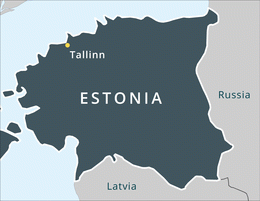
2008 e-Democracy Conference in Talin, Estonia
22.05.2008.
The 2008 eDemocracy conference "Opportunities for Citizen Participation in an Information Society" will be held on June 5th, in the press room of the Ministry of Foreign Affairs of Estonia.
This year we touch upon the opportunities ICT and the Internet provide for citizens to take part in the policy making process and to have a say in political decisions. We introduce the new governmental participation portal OSALE which opens a new way for Estonian people to express their opinion.We are also proud to present a new participation tool, TID+, which, with support of the European Union, is at present being developed and which will be made available to everyone. TID+ is based on the experiences with the Direct Democracy Portal TOM that has been in use in Estonia since 2001.
Last year, on November 29-30 in Skopje, at the “e-Society.Mk 2007” conference organized by the Metamorphosis Foundation, Ms. Nele Leosk, a representative of the Estonian eGovernance Academy presented the portal Tana Otsustan Mina – TOM (Today I Decide) as an example for a good EU practice.
Furthermore, the conference will focus on an analysis of Estonian e-voting experiences and give an overview of future perspectives, plans and developments. We also look forward to hear expert opinions in a panel discussion on whether and to what extent online participation and the New Media influence politics and shape democracy.
The conference is organised by e-Governance Academy together with the State Chancellery and Electoral Committee and is part-financed by the European Commission. Attending is free of charge, but registering is necessary.
More information on the conference and how to register is available on the eGA website.
Thursday, May 22, 2008
Ontario: Mass LBP Creates Unique Citizen Assembly

This story of a lucky entrepreneur who was able to fund his idea to bridge the government and civil society through participatory assemblies is certainly unique. The fact that he was able to get private funding for a grassroots project is exceptional. If only more individuals were willing to fund these kinds of initiatives, citizens would be more inclined and likely to participate. Seeing as participators currently struggle as volunteers, funding would add extra motivation but it also would pose risks to equal and fair access to participatory mechanisms. This case asks us to consider these points. -Editor
Hooked on democratic process
May 19, 2008 04:30 AM
CAROL GOAR
It is not another blueprint for proportional representation. Voters made it clear last October that they weren't in the market for one of those.
It is an appetite for democracy. Ontarians – at least a lucky few – are discovering that they like having a say in how they are governed.
Peter MacLeod, a young entrepreneur who got hooked on collective decision-making during the citizens' assembly, is determined to keep the process alive. He has set up a storefront company to "reinvent public consultation."
It's called MASS LBP. "MASS" is short for mass public. "LBP" stands for led by people.
The company has six employees, all young, all highly educated and all fiercely committed to the proposition that government by the people for the people works.
Their headquarters is a former art gallery on King St. E. They renovated it with supplies from Home Depot and a lot of elbow grease.
The company has just completed its first contract, a citizens' health assembly in Kingston. Its purpose was to set priorities for the region's new health authority (officially known as the South East Local Health Integration Network).
Fifty-four volunteers took part. They came as strangers and left as friends. The vast majority – 97 per cent – found the exercise useful and enjoyable. The regional health authority ended up with a blueprint that reflected the values and wishes of the community.
MacLeod and his colleagues are in Markham this week, discussing the possibility of a citizens' health assembly for the northern section of Toronto, York region and part of Simcoe region (the Central Local Health Integration Network).
But they don't want to confine their activities to the health-care sector. They envisage holding citizens' assemblies on everything from municipal water rates to cross-border pollution.
"I think there's a demand to go beyond polling and focus groups and town hall meetings," MacLeod says. "We want our projects to be seen as the Canadian model of civic engagement."
Citizens' assemblies work best on issues that are politically radioactive, not well understood or stuck forever on a back burner, MacLeod says. "We take participants through a learning phase, a deliberation phase and a consensus phase. We see this as the way to create legitimacy for government action."
Thanks to an angel investor – George Gosbee of Calgary – MacLeod has funding to keep the company going for 18 months. He thinks that will be long enough to prove the model works and find enough clients to make it self-sustaining.
"We have to make a profit because that's the measure of our relevance."
MacLeod was thrilled but astonished when Gosbee, chairman and chief executive of Tristone Capital, agreed to bankroll his "crazy idea." He'd met Gosbee at a speaking engagement at the Alberta College of Art and Design and the two had clicked. But he never expected the investment banker to buy half his company so he could market-test his brainchild.
MacLeod won't say how much Gosbee put in – "it wasn't a princely sum" – but makes it clear he's running the company on a shoestring. He and his colleagues, all of whom have postgraduate degrees, earn $45,000 a year.
For their first few months, they worked out of the living room of MacLeod's apartment with their laptops and cellphones.
They're proud they now have an office and pleased that their Kingston forum is getting good reviews. But they dream of becoming an all-purpose bridge builder between governments and the public, winning international contracts and having their projects copied by other firms.
Participatory democracy is one of the oldest ideas in political theory, MacLeod acknowledges. But it has fallen into disuse in North America. Governments have become distant and impenetrable. Citizens are passive and self-absorbed.
What gives him faith is the answer he gets when he asks people why they don't speak up or get involved. "No one ever asked me."
Wednesday, May 21, 2008
Participatory Budgeting in Tanzania
This article discusses the participatory budgeting initiative underway in Tanzania. Similar initiatives are under development in several western and southern African nations. -Editor
PARTICIPATORY BUDGETING IN TANZANIA
Source: http://www.asaaf.org.zw/newsletter3/page18.htm
Introduction
The Participatory Budgeting process in Tanzania is a continuous engagement all the year round involving training and sensitization of the communities and local government staff and civic leaders on planning through a bottom – up approach and methodologies such as O & OD and Plan Rep which have been adopted by the Local Governments. Through the process, Plans are initiated and approved through meetings at the Lower Local Government levels, and consolidated into District, Regional and National Plans. Budgeting is also done at the Local Government levels whereby Indicative Planning Figures (IPFs) are provided by the Central Government and this enables the Local Governments to know how much they expect to get from the Central Government and determine what they will contribute from their own sources.
Tanzania has democratically elected leaders with democratic institutions like the Parliament, Local Government Authorities and has the Freedom of Association by NGOs, Faith Organizations, Civil Society Organizations, CBOs and the Press.
The driving force behind the Participatory Budgeting initiative: The Government of Tanzania committed itself to enhance community participation in development planning and budgeting. This commitment emanates from the Constitution which enshrines the establishment of Local Government system as a means to give power to the people, the Local Government Reform Policy which aims at decentralizing powers and resources to the Local Authorities and the amended Local Government Laws which provide the framework for Decentralization by Devolution.
Objectives:
- To be able to carter for the needs of the communities inclusively – that is considering the needs of all categories in the society such as the gender, youth, elderly, and other vulnerable groups.
- To address aspects of ownership to the proposed plans and accountability to the successes and failures of this plans by the communities/the people and their localities.
The planning and budgeting process involve and reflect all stakeholders’ interests and priorities and endeavours to develop socio-economically viable plans. Stakeholders are accountable to the public and to each other for their shared decisions and the tasks they have committed themselves to accomplish.
The Participatory Budgeting Process is targeted at the Policy Makers, the Executives, and all other stakeholders in development including development partners and the citizens who are the beneficiaries and the demographic focus being the disadvantaged such as the disabled, women and children.
Participatory Budgeting Tools and Methodologies:
- The Planning Guidelines for Village and Mtaa levels which are participatory ;
- The Medium Term Expenditure Review which involves Local Governments and Central Government levels;
- Opportunities and Obstacles to Development operation manuals in place.
- Public meetings addressed by politicians and staff on the importance of participatory planning and budgeting initiatives;
- NGOs and Civil Society Organizations educate the people on the concept and its importance for their development; The press also advocates for participatory planning and budgeting;
- The National Association of Local Authorities advocate for higher degree of participatory planning and budgeting by the citizens;
Plans are initiated and approved at the lower levels (Village/Mtaa) after which they are forwarded to the Ward level for coordination and then sent to the District/Town/Municipal/City level where they are consolidated and forwarded to the Regional and ultimately to the National level where they form the National Plans.
Inclusiveness:
Despite the various efforts by different actors to sensitize the people on the importance of participating in the planning and budgeting interventions, the degree of participation is still limited by some factors. Some other people still see it as work of the politicians and the executives and that they get paid for that. Sometimes, even the elite do not participate with an excuse of lack of time. It has been very difficult for the poor to participate. Those who attend have been empowered as they precisely know what their priorities are and what their strengths in implementing their plans are.
Monday, May 19, 2008
NIGERIA: Governor calls for Participatory Democracy
 In a country plagued by dictatorship, it would be easy for the people to lose hope and allow resentment to overcome their lives. But Nigerians continue the struggle toward development through participatory democracy. Having a high profile ally such as Dr Muazu Babangida Aliyu is helpful, but it will obviously be a question of the peoples' commitment to creating an alternative to dictatorship through participation. Please click here to see our previous post regarding a call for participatory democracy in Nigeria through Achebe's literature. Similarly to the following article, Achebe looks toward a positive interaction between intellectuals and rural populations to create a full-circle form of communication that would allow a participatory democracy to flourish. -Editor
Gov Lists Gains of Domesticating Democracy
Source: http://www.thisdayonline.com/nview.php?id=111239
From Adibe Emenyonu in Benin, 05.12.2008
Niger State Governor, Dr Muazu Babangida Aliyu has condemned the wholesome adoption of democracy from the developed world , saying the best way for Nigerians to reap the dividends of our nascent democracy is by domesticating it,taking into cognizance the peculiarities of the country 's socio-cultural beliefs . Speaking as a guest lecturer at the foundation day ceremony of Igbinedion University , Okada in Edo state over the weekend, the Niger state Governor advocated a unit based development where the people in the grassroots would be involved in deciding what development projects they want rather than allow politicians to decide for them. Delivering a lecture titled, 'Participatory democracy, an ingredient for sustainable development,' the Niger state Chief Servant said: "Let me emphasize how strongly I share the view that unless we in the developing democracies, are able to systematically evolve a political system that takes account of our socio-cultural peculiarities and characteristics, we run the risk of thinking that the wholesale robust economic and democratic ideas and precepts of the developed world would have the magic wand to solve our development problems. " We thus may be under a dangerous illusion that we are making progress while in the actual sense we may indeed be engaging the reverse gear and be going in the reverse direction, because of wrong application to different settings and environment,” he said. "In other words, we must domesticate democratic principles to take cognizance of excellent values and institutions," he said. According to Aliyu, development must be homegrown, home-made and targeted at improving the lives of the people. He blamed the lack of good governance and the inability of Nigerians to reap the dividends of democracy since 1999 to the non participation of intellectuals in the political system, saying politics was left to charlatans and the unemployed. While commending the progress so far made by the administration of President Umaru Musa Yar'Adua which he said could be attributed to the fact that he is an academic, Aliyu who said he was drafted into politics when he was made to resign his job as a permanent secretary, called on Nigerians to hold their elected representatives accountable for whatever development they desire. "Go back to your villages, your wards, your constituencies, and demand from officials or your representatives to account for their activities and you shall by so doing be starting the process of a necessary revolution,"he said,advising that the country's development plans be institutionalized.


