 We must learn from the various errors of representative democracy in order to build an ideal form of participatory democracy. The developing world continues to struggle against colonial and imperialist forces in response to ethnic, class, and national identities that have outlived invaders. Participatory democracy offers to reconcile distinct identities by allowing diverse people to bring their grievances directly to the table.
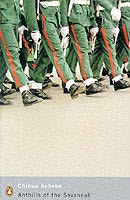
In Chinua Achebe’s novel, Anthills of the Savannah, it becomes obvious that divided people cannot be united by a charismatic figure, but instead by working together. Set in a fictional country called Kangan, the people are faced with post-colonial governance challenges. Achebe does not directly represent Nigeria, his home country, but instead draws upon various historical events to weave the plot and paint a pan-African picture that provides insight into democratic challenges of today.
Rival Identities in Africa Challenge Democracy
The nation can only be seen as a whole in the imagination. Tribes (this term and its variants refer here to social organizations that are pre-capitalist and without a centralized state or a division of economic classes) must suffer from amnesia in order to bring together the conquerors with the conquered. This is true of class struggles as well. In the novel, this is exemplified by the fact that life in the capital city of Bassa is very different from reality in the desert province of Abazon, where problems are more easily ignored by the centralized government.
The village is far more easily conceived as a whole. The circle of communication between leaders and the led is closed, as it should be in participatory democracy. This can be seen in the fact that Abazonian elders are able to speak for all of their people with accuracy and consent. Nil ten Kortenaar points out that for nationalists, “the creation of the state depends on the prior existence of an ethnic community that is distinguished from foreigners by virtue of language and culture.” National boundaries drawn by foreigners make “nationalism” in Africa a creation of foreigners. Likewise, "national identity is the product of literacy and of standardized modern education." The dictator in the novel, Sam, represents this assumed national identity that is not in fact part of Kangan reality for diverse social groups who prefer to identify on class or ethnic lines. Ernest Gellner wrote that nationalism “claims to defend folk culture while in fact it is forging a high culture; it claims to protect an old folk society while in fact helping to build up anonymous mass society”. The government asks for the consent of the populace when the dictator requires a vote regarding his “presidency for life”, claiming that he can defend folk culture and Africa, when in fact he is forging the elite culture that separates itself from tribal reality. This is a major downfall of representative democracy.
Revolutionary democrats, as defined by Eric Hobsbawm, argue that the nation must express the common will of its citizens. This is only possible when a uniting perspective has been identified and the government maintains legitimacy. This is not the case in Kangan where the government expressed the will of itself, without facing the problems expressed by citizens. Ikem, seeks a way in which he can "partake in the source of stability and social meaning" that he has lost due to his foreign education and elite position as editor of the national newspaper. This is where direct participation in democratic processes would be beneficial to both government legitimacy and the power of the people.
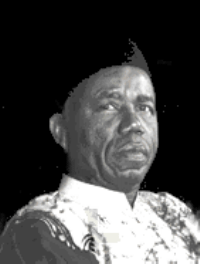 During his speech at the University, Ikem asserts that story tellers, or those who pass on the memories of the people, are a threat to people in control because they advocate freedom of the human spirit and maintain separation between conquered and conquerors. Kortenaar insists that “the memory that would create a communal identity must be selective. Not memory but invented memory is necessary for the nation.” This is the important role of story-tellers in nation building that can uphold the tradition of communication and participation, necessary tools for democratic participation. Ikem notes that the nation must be built from below and cannot be imposed by external, or foreign, powers. The novel is targeted toward leaders who must come to realize this. Hope is represented by the fact that his blood (mixed with that of a market woman) will continue and the naming of his child is witnessed by multiple generations, classes, and ethnicities. Both Chris and Ikem's legacies and aspirations will live on in the future generations.
As a controller, Sam is concerned with the powers of the institutions of the state and not with the nation itself, making the idea of state one of foreign imposition. He maintains a European idea of nationalism that stems from the educated elite living in the capital. His view argues for a centralized power that extends toward the periphery. As Sam senses impending doom, it becomes obvious that he should have listened and responded to the people he was governing over. Sam is doomed to fall. He can neither achieve the consent of the people (represented by Abazonian discontent) nor unify them under a national identity. When he failed to be seduced by Beatrice and instead went with the American journalist, he demonstrated that he was not loyal to the people or to the “motherland”. Sam's concern for institutions instead of people, his foreign idea of national identity, centralized power and failure to respond to the needs of the people demonstrate the downfalls of representative government.
Achebe is advocating for two distinct values to reinforce each other. He wants descent (the value of ancestors and the conception of identity as natural and ineluctable) to support consent (daily plebiscite). These two values help to address tribal culture with its story tellers and focus in the village as a force within government legitimation. It seems that Sam’s empire building might result in the creation of a nation. However, it is made obvious that the nation does not lie within the capital, and by isolating power there, Sam’s government failed. The participation of diverse people is the only way to achieve the reinforcement of descent and consent. -Editor
Sources: Kortenaar, Neil ten (1993)."Only Connect": Anthills of the Savannah and Achebe's Trouble with Nigeria. Research in African Literatures. 24, No. 3, 59-72.

 The following article is important to our analysis of participatory democracy because it discusses the very problems caused by politicians who claim to be promoting "democracy". As you read, be aware of the differences between the electoral democracy discussed here and the direct or participatory democracy we demand. -Editor