Visit the Telematics Freedom Foundation website here: http://www.telematicsfreedom.org/en - Editor
Italy: TFF promotes Direct Democracy
Sepp Hasslberger
11th November 2008
Source: http://blog.p2pfoundation.net/italytff-promotes-direct-democracy/2008/11/11
The italian-based Telematics Freedom Foundation promotes a more direct and participatory idea of the democratic process.
Some of the immediate targets are
- user-controlled telematics services
- self-management of democratic organizations and
- national and constitutional legislative changes
to support the widespread introduction of software-based democratic interaction.
Direct Democracy or ‘Continuous Democracy’ is promoted through the development of tools (software, methodologies and infrastructure) that make it possible for citizens to continuously discuss and to directly express preferences on important political questions.
A first concrete step to promote this change “on the ground” is the Lista Partecipata per la Democrazia Diretta, an electoral list based in Rome.
Their software for consensus-building, which allows simple democratic discussions and provides easy decision-making procedures is called Rule2gether and it is available under a GPL public license.
A proposed hardware solution to the problem of allowing those who do not have routine internet access to participate is a TV set-top box running free open-source software that would make communications possible. It is called the Freedom Box or Z-Box.
Sunday, November 30, 2008
ITALY: TFF promotes Direct Democracy

Friday, May 23, 2008
2008 e-Democracy Conference in Talin, Estonia
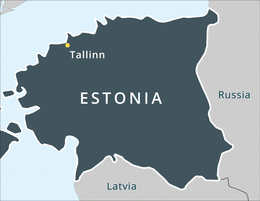 Upcoming conference in Tallin on the heels of the expanding use of e-democracy in Estonia. To visit the countries e-consultation site OSALE click here. - Editor
2008 e-Democracy Conference in Talin, Estonia
22.05.2008.
The 2008 eDemocracy conference "Opportunities for Citizen Participation in an Information Society" will be held on June 5th, in the press room of the Ministry of Foreign Affairs of Estonia.
This year we touch upon the opportunities ICT and the Internet provide for citizens to take part in the policy making process and to have a say in political decisions. We introduce the new governmental participation portal OSALE which opens a new way for Estonian people to express their opinion.We are also proud to present a new participation tool, TID+, which, with support of the European Union, is at present being developed and which will be made available to everyone. TID+ is based on the experiences with the Direct Democracy Portal TOM that has been in use in Estonia since 2001.
Last year, on November 29-30 in Skopje, at the “e-Society.Mk 2007” conference organized by the Metamorphosis Foundation, Ms. Nele Leosk, a representative of the Estonian eGovernance Academy presented the portal Tana Otsustan Mina – TOM (Today I Decide) as an example for a good EU practice.
Furthermore, the conference will focus on an analysis of Estonian e-voting experiences and give an overview of future perspectives, plans and developments. We also look forward to hear expert opinions in a panel discussion on whether and to what extent online participation and the New Media influence politics and shape democracy.
The conference is organised by e-Governance Academy together with the State Chancellery and Electoral Committee and is part-financed by the European Commission. Attending is free of charge, but registering is necessary.
More information on the conference and how to register is available on the eGA website.
Tuesday, April 8, 2008
Romania: e-Democracy Site Keeps Tabs on Government

The following interview illustrates one example of how e-democracy is making inroads in countries where not too long ago institutions of democracy were virtually non-existent. Perhaps this illustrates how, after a revolutionary change such as that which occurred in Romania, the ground is more fertile for the introduction of democratic practices that are more revolutionary in their nature. Meanwhile, in countries where democracy has supposedly been a longstanding tradition, but often falls far short of the mark of being a true democracy, people are less receptive to the necessary changes that would make their governments less corrupt and more accountable to the will of the people. - Editor
Interview with Romanian eDemocracy site builder Adrian Moraru
Posted by Tom Steinberg, 4th October 2007
Source: http://www.mysociety.org/2007/10/04/interview-with-romanian-edemocracy-site-builder-adrian-moraru/
This is the second in a short series of interviews with people building and running some of the most exciting internet and democracy projects in Europe.
Adrian Moraru from the IPP in Romania set the BerlinInAugust unconference abuzz with occasional gasps at the uncompromising relentlessness of their approach, which included suing to obtain the mobile phone numbers of all the politicians with handsets provided on the public purse. Below you can hopefully see why they got people excited…
What is the organisation you work for?
Our organization, the Institute for Public Policy, is an independent think tank based in Bucharest. We have a permanent staff of 12 people plus a pool of external experts and part time collaborators that we work with on project based relationship. This external group may number as many as 50 in a year and range from former public officials, to politicians, independent experts, journalists, students, young researchers and academics. We work in numerous areas but we specialise in local government, parliament and the ministries.
What is the main purpose of the site(s) that you run?
The main purpose is to give people with a specialised, professional interest in politics an easy way to access facts and statistics about the way MPs are working & voting, as well providing information for the general public.
Can you tell us about some of the unusual ways you ensure that your vote attendance information is accurate?
It’s easy. In our parliament the attendance is recorded based on a attendance register at the entrance of the plenary hall. However, it is common for some MPs to sign on behalf of their colleagues and/or friends. So in order to expose the size of this phenomenon we decided to keep track of MP’s real attendance in a more accurate way.
Some politicians have legitimate exemptions, which we record, be we also wanted an accurate record of how many of them are present when votes happen. So lets say you have 20 votes in a day. If the name of the MP Mr. X shows up only in 14 of them then he is present only 70%. Furthermore, if, say, only 204 voted out of a possible 322, we deduce from our database the 118 who didn’t show up, and add that to their record.
We have used video cameras from time to time in order to combat the practice of multiple voting. This is happens because of our voting system in Parliament is based on electronic voting stations placed on your bench were MPs identify themselves with a smart card (aka voting card) before pushing a button corresponding with their voting choice.
Politicians have 10 seconds to do so once the vote is initiated. Some MPs use these 10 seconds to vote once with their own cards and then once with the cards of colleagues who are, for example, out at lunch. This is a widespread practice.
We have the plenary sessions broadcasted live and also available recorded onthe Parliament website. We suggested that the during voting that a camera record the activity int he whole chamber. We therefore exposed a few cases of this multiple voting, although not much has happened as a result yet.
You also collect information about politician’s travel. How did you get that? What does it tell your users?
We get it through our freedom of information laws. But is not that easy to get hold of. Sometimes we even have to go on court to get it, and sometimes even when we do it comes on paper, not in electronic formats, which is obviously harder to re-use.
What it shows is where an MP went, when, why, how much it cost, how long they stayed and so on. From this we can help people establish whether they think it was strictly necessary for an MP to visit French Guineau to see the launching of an Ariane V rocket, and we can provide the most popular country destination by political parties.
Do you ever face claims that the effects you have on politicians aren’t entirely positive? If so, how do you respond?
Well this is not a consolidated democracy, you know. MPs are not as nice as yours. So, yes large parts of the databases hurts a lot of them a great deal. Let’s just say we are not scared. But on the other hand we strive to get the best data and to present it in a non aggressive, non biased way using the best algorithms.
You are good at using the law to obtain information. Can you tell us a bit about your approach, and what information you’ve obtained through the courts?
This is a very distinct topic. We always ask for information via our Freedom of Information act, using a special format of letter which cannot be completely ignored. We have lawyers following the flow of requests together with an office manager and we sue every time we do not get an answer, have our request denied or find that information we’ve been provided with is incomplete.
We ask for a lot. A lot! Usually we fight for data that exposes bad practices and most of the things involving expenses or money. It is here where there is a lot to hurt bad politicians by exposing how unwisely some of them are spending the money.
What other projects around the world excite you the most, and why?
Tough one. None. I like opensecrets.org and votesmart.org but that’s it. I do not believe in moving participatory democracy online in our life time. Instead I think we should be looking for ways to open up government and make it more transparent using the internet. In my opinion we are not even at 10% of the way to what we can ultimately do, either in Romania or elsewhere. We can think also about real interactivity in the future.
What’s next for you and IPP on the Internet?
Who knows?
Tuesday, March 11, 2008
New Zealand: Police Let Public Write Laws
 Last fall, New Zealand opened up the task of writing a new police act legislation to the public through the use of a Wiki site. The following BBC article describes the process. You can also visit the Wiki site by clicking HERE. The site gives a summary of the results of the process, which is now complete, and encourages future input. This initiative is but one of many that illustrates how the internet is a viable means and a valuable tool for implementing participatory and direct democratic processes worldwide. - Editor
NZ Police Let Public Write Laws
The "wiki" will allow the public to suggest the wording of a new police act, as part of a government review of the current law, written in 1958.
Police say they hope to gain a range of views from the public on the new law before presenting it to parliament.
The wiki, one of the first of its kind in the world, is open to any internet user, police say.
'Wiki sandbox'
The wiki is the latest round of public consultation in the 18-month review of the 50-year-old law.
Launching a wiki version of a statute is a novel move, but one we hope will yield a range of views from people interested in having a direct say on the shape of a new Policing Act
The officer in charge of the review, Supt Hamish McCardle, described the site as "similar to a whiteboard" and said it was open to anyone who wanted to have their say on the new law.
It even includes a "wiki sandbox" that lets nervous newcomers practise their posting.
"Launching a wiki version of a statute is a novel move, but one we hope will yield a range of views from people interested in having a direct say on the shape of a new Policing Act," Supt McCardle said.
Aaron Smith - from the US-based Pew Internet Project, which studies the evolution of internet uses - told the BBC News website that the wiki was a new frontier in online government.
"You see a lot of government sites worldwide allowing for various feedback mechanisms... but in terms of bringing this to the public in the form of writing laws, that's obviously a different thing entirely and something that we certainly haven't seen yet," Mr Smith said.
He said any possible corrupting of the process should be reduced by the "self-policing" nature of wikis.
"It would certainly be difficult for people to put in bogus information... without people recognising that fact and the community of users correcting that before the finished product is completed," he said.
A "wiki" - from the Hawaiian word for "quick" - is a type of website that can be easily edited by anyone. The most well-known wiki is the online encyclopaedia Wikipedia.
Visit the Wiki site: http://wiki.policeact.govt.nz/
Saturday, March 8, 2008
UK: Update on Petition Process
 The following article submitted by Consultation Watch in the UK gives an update on 10 Downing's e-petitions initiative and related moves underway to institute a similar system at the local level. For more information on this subject see our previous related post. CLICK HERE. - Editor
Direct Democracy or Petition Sham?
As part of the Governance of Britain green paper, the Department for Communities and Local Government is now consulting on Local petitions and Calls for Action.
Since November 2006 members of the public have been able to start or sign online petitions at the 10 Downing Street website, which can run for up to 12 months and receive a Government response if signed by 200 or more people.
The Governance of Britain green paper committed the Government to considering means of petitioning Parliament and devising a mechanism which could lead to a debate in the House of Commons – but strangely this is not included within this consultation, with no explanation of why not or whether it will be in the future. To find out you may want to email Hazel Blears (Secretary of State for Communities and Local Government)
Instead, another issue, not even mentioned in the green paper is being consulted upon: petitions to local government.
The consultation document proposes that local authorities would have a duty to respond to petitions in much the same way as the 10 Downing Street system, if they relate to an issue in local government jurisdiction; are organised by a local person; and have a sufficient level of support.
However, as the consultation document admits, "many local authorities already deal with petitions systematically, scrupulously and fairly" – so it is not clear what difference this proposal would make – except for the minority of councils who perhaps do not respond formally to petitions (no examples are cited in the consultation document).
However, the document does mention examples of countries where petitions are a "trigger leading to electoral action, typically in the form of a referendum". One such example of this is Switzerland whereby any change to Swiss law can be subjected to a referendum if 50,000 people sign a petition opposing it within 100 days. Additionally, a referendum on a constitutional change can be initiated by 100,000 people signing a petition within 18 months.Campaigning organisations such as charities, trade unions and other NGOs may therefore wish to reply to this consultation suggesting the Swiss model.The deadline for responses is 20th March 2008.
- Raise public awareness of Government consultations;
- Encourage people to respond to consultations; and
- Share the expertise and insight of charities, trade unions and non-profit organisations.
- Providing links to active consultations on Government department websites;
- Featuring prominent consultations and highlighting their most important aspects; and
- Publishing consultation responses from charities, trade unions and non-profit organisations.
To learn more about Consultation Watch visit their website: http://www.consultationwatch.org.uk/default.asp
Also see this related link for more information on Downing Street's e-Petitions one year on from it's inception: http://newpolcom.rhul.ac.uk/past-events-appearances/2007/11/16/2008-01-30-the-prime-ministers-e-petitions-one-year-on.html
Tuesday, February 26, 2008
Action Network: BBC Adventures in e-Democracy

The following article examines the role of the BBC in promoting citizen participation through their BBC Action Network. An e-democracy promoting website which facilitates grassroots organizing. Evidently some activists have reservations about using a site constructed by a state sponsored institution. The article examines the complexities of a major news organization with links to the state backing such an effort. - Editor
Laurence Pawley - Horizontal politics in a vertical world: The BBC and Action Network
Source: http://www.re-public.gr/en/?p=146
Examining the BBC’s experiments on facilitating participatory e-democracy, Laurence Pawley finds that such re-imaginings of political action must be accompanied by a re-imagination of the institutions that provide them.
The growth of the ‘new’ politics enabled by technological developments like blogs and wikis has, generally speaking, emerged from outside of established nodes of political power. The informal, collaborative methods of action proposed by these spaces have predominantly been taken up by looser social movements and individuals, with the anti-capitalist movement and maverick ‘political bloggers’ serving as obvious examples.
But what happens when similar opportunities are facilitated by a national institution, with substantial links to the state? Can active citizenship be promoted through an organisation associated with a centralised, linear mission to ‘inform, educate and entertain’? This is the question raised by the BBC’s Action Network mini-site (originally launched in 2003 as iCan). 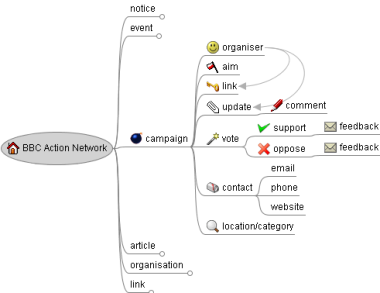 The site takes the form of a facilitative space, aimed in at individuals who wish to develop single-issue campaigns in their local area. Users can leave ‘notices’ (effectively equivalent to a standard online messageboard) or create more permanent ‘campaign’ pages in a collaborative blog format. The site has won several awards for its contribution to e-democracy, and its founder Martin Vogel claimed in late 2005 that Action Network was receiving 175,000 unique users per month.
In itself, this appears relatively unproblematic. Action Network is a well-organised and relatively simple site, with clear ground-rules that forbid (party) political activity and encourage a collaborative, dialogical dynamic. As such, it shares good practices with other successful examples of online campaign activity, and exudes the ethos of equitable participation central to the ideals behind wiki politics. However, if we begin to institutionally contextualise Action Network within the contemporary BBC, a series of tensions emerge with potential implications for the site, its users, and the BBC itself.
For the latter, Action Network appears to have emerged as part of a concerted effort to integrate notions of participation and public agency into the BBC’s practice. This much was made clear in the Corporation’s 2004 mission statement Building Public Value, which identified Action Network as a key initiative within its new goal of ‘supporting active and informed citizenship’. But how does such a notion function within the BBC? The organisation has long been associated with a centralised and sometimes paternalistic approach to the delivery of public service to a passive public, and has been subject to consistent critique on these grounds. Indeed, one might argue that the BBC is in fact reliant on this position, insofar as only the presumption of a uniform, passive citizenry justifies the continuing prominence of a single public service broadcaster.
Within Building Public Value, this issue is never fully resolved. On the one hand, the BBC (evidently responding to external pressures including media fragmentation, and the development of new discourses of citizenship) is keen to develop a more active, decentred conceptualisation of the public sphere- concluding with the aim to build ‘new civic avenues and town squares… places where we can celebrate, debate and reflect’. Simultaneously however, it lauds the historical success both of the national BBC structure and its successful relationship with Parliament and state institutions, and places considerable emphasis on its ability to set both political and cultural agendas.
In this context, the BBC’s support for initiatives like Action Network implies a contestation of its own position. Put simply, the ideas that underlay Action Network and similar projects (a ‘bottom-up’ approach to citizenship, localism, and the achievement of political goals through non-traditional strategies) exist at least in contradiction – if not in fact in direct opposition - to the precepts that have previously bulwarked the Corporation.
In practice, I would suggest that this contradiction has been largely ignored, with the result that both Action Network and the wider BBC appear somewhat compromised. Although the site maintains a certain level of independence from the BBC, the Corporation maintains the right to place its own postings, provide ‘expert’ advice on campaign methods, and editorialises content (for example, the featured campaigns on the front page). The BBC also clearly views the site’s activity as a potential source of content- in 2006 for example, BBC1’s Breakfast ran a series of reports based on Action Network projects. Even as it encourages open participation, it maintains a strong branded presence.
One argument of course is that such links are beneficial- providing advice and the potential for wider exposure for groups and individuals utilising the site. This however comes at a price, insofar as the BBC ‘preferences’ certain types of action in its advice pages, and certain elements of content in its editorial work. This at least carries the potential to skew the success or failure of certain campaigns, and the types of causes to which the site is deemed amenable. One can argue that any attempt to provide similar forums through a state (or in this case, quasi-state) organisation would carry the same risks, if only because the discursive association between provider and service would seem to privilege particular strands of thought.
In addition, there is a risk that sites like Action Network, because of their particular location, will become as much a complaints forum as a place to ‘celebrate, debate and reflect’. A cursory search for ‘BBC’ on the site leads to campaigns called for the Corporation to be banned, or demanding changes in programming. While such entries don’t necessarily undermine the site’s broader potential, their frequency is illustrative of the difficulties it faces in ‘shaking off’ the legacy of its provider (a fact undoubtedly known to Tony Blair’s government after the recent e-petition on road pricing). If such sites become increasingly ‘hijacked’ as a means to attack their founders, it is possible that other users will seek alternative platforms without such strong associations.
So, there appear to be some definite obstacles in the development of online political networks through an established national body. And should it attempt to resolve them, the BBC – by virtue of the more centralised aspect of its institutional logic – may find itself in an awkward situation. It could for example step back from Action Network, removing the obvious links with BBC content and leaving the site truly ‘open’ to participation. Yet while this might alleviate the concerns of some users, it is unlikely to benefit the BBC itself. If such a move succeeded, it would give ammunition to those who wish to see a more general scaling back of the BBC’s role in UK life. And if it failed (for example because users appreciated the guidance offered by the BBC content), then the Corporation has both failed in its attempt to support active citizenship, and wasted licence-payers money in doing so. Meanwhile, to continue with the current format exposes the BBC to the charge of interference with an ostensibly public-led platform.
This article, it should be stressed, is not intended as a condemnation of Action Network, or of the BBC’s intentions in its establishment. The site has much to commend it, and a glance around it will quickly prove that much useful work is being done, both via the campaigns themselves and the broader encouragement of civic responsibility. Nonetheless, it is perhaps the case that to be optimally effective, such re-imaginings of political action must be accompanied by a re-imagination of the institutions that provide them. Such a solution, while optimistic, offers the best chance of transcending tensions between participation and passivity, centralisation and subsidiarity, and past and future.
Further links:
Action network wins e-democracy award
The BBC plans for digital democracy
BBC Action Network
Wednesday, February 20, 2008
10 Downing Street's e-Petitions
 10 Downing St. has set up a website where british citizenry can post their petitions to the prime minister. The petitions can gather signatories on the site, and completed petitions generate a response from the Prime Minister. It is unclear whether this site has in fact been a means for the public to influence policy, or merely a gimmick to allow people to believe that they have a voice in government. It's mere existence however is yet another example of how the internet can be a revolutionary tool in bringing direct democracy to bear on a large scale. The trick is to make the popular will binding, and create a system in which representatives are merely executors of that popular will. Barack Obama in the U.S.A. has proposed measures in his platform that would allow for much more significant citizen participation and transparency than this somewhat symbolic british measure. To learn more about his proposals see our previous post on the subject. (click here) It is encouraging to see such proposals reaching the mainstream but we must continue to build upon them and push for deeper direct democracy. - Editor
Click here to visit the P.M's e-petitions site
Source: http://www.pm.gov.uk/output/Page11051.asp
13 November 2007
There is a long-established tradition of members of the public presenting petitions at the door of Number 10 Downing Street. The e-Petitions service has been designed to offer a modern parallel, which is more convenient for the petitioner. Unlike paper-based petitions, this service also provides an opportunity for Number 10 to respond to every petitioner via email.
Since its launch in November 2006, the ePetitions site has proved to be a highly popular innovation, helping people communicate with Government and with the Prime Minister's Office. ePetitions has become a part of the landscape of debate in the UK.
The service allows any UK citizen to create a petition and collect signatures via the website. Petitioners are asked to meet basic criteria, but we aim to accept most petitions. The principal reasons for rejecting petitions so far have been obscenity, potential to cause offence, libel or duplication.
Facts and figures
Since its launch, the site has been very busy. The facts and figures to the end of October show:
Over 29,000 petitions have been submitted, of which over 8,500 are currently live and available for signing, over 6,000 have finished and 14,601 have been rejected outright.
There have been over 5.8 million signatures, originating from over 3.9 million different email addresses.
The most common reason for rejection is duplication - many users have commented that there are petitions on similar subjects clogging up the site. We are trying to eliminate too much duplication or overlap, although we need to balance that with the need to allow for the nuances of similar petitions.
The other common reasons for rejection are: legal issues, offensive language, party political content and issues outside the government's remit.
If a petition is rejected, petitioners are given a chance to reword their petition. Some users choose to resubmit their petitions, some prefer not to.